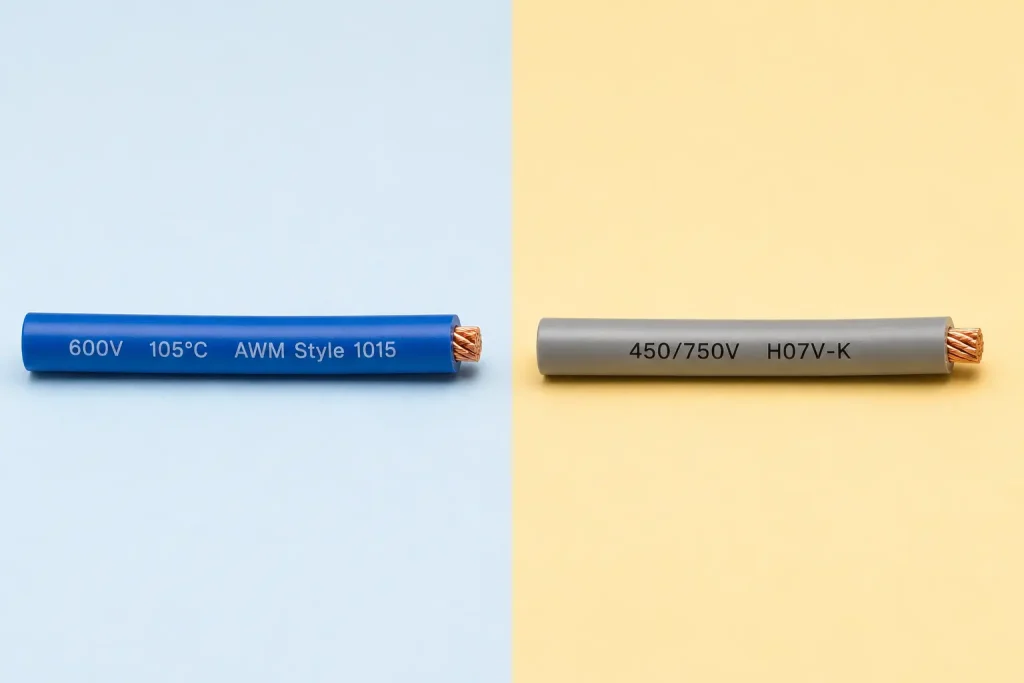
UL 1015 vs H07V-K — Wire Equivalent Comparison for Global OEM Projects
UL 1015 and H07V-K are the two most commonly specified single-conductor PVC internal wiring standards in global OEM manufacturing — UL 1015 for equipment destined for North American markets, H07V-K for equipment destined for European IEC markets. When an OEM manufacturer produces the same equipment platform for both market destinations, or when a company transitions production from Europe to a country targeting North American exports, the question arises: are these two wire standards equivalent, and can one substitute for the other?
The short answer is no — UL 1015 and H07V-K are not interchangeable for compliance purposes, even though both are single-conductor PVC wire with broadly similar physical construction. This page explains exactly why, and what the differences mean for procurement and compliance.
UL 1015 vs H07V-K — Full Parameter Comparison
| Parameter | UL 1015 | H07V-K |
|---|---|---|
| Standard | UL Subject 758 AWM | IEC 60227-3 / HD 21.3 |
| Voltage Rating | 600 Vac / 750 Vdc | 450/750 V |
| Temperature Rating | 80°C / 90°C / 105°C | 70°C (90°C heat-resistant variant) |
| Insulation Material | Extruded PVC (UL compound) | Extruded PVC (IEC compound TI1) |
| Insulation Wall (1.5mm² / 16 AWG equiv) | 30 mils min avg (0.76mm) | 0.7mm min |
| Conductor Sizing System | AWG (American Wire Gauge) | mm² (metric cross-section) |
| Conductor Type | Solid or stranded (Class 1 or 2) | Flexible stranded (Class 5) |
| Flame Rating | Horizontal flame (UL 758) | IEC 60332-1 vertical flame |
| Certification Mark | UL Recognized Component Mark | CE mark (via ENEC or national body) |
| Wire Marking | “AWM Style 1015 80°C 600V” printed on surface | “H07V-K” or “450/750V” printed on surface |
| Target Market | North America (USA, Canada) | Europe, IEC markets globally |
| Compliance Interchangeable? | No — cannot substitute one for the other in compliance documentation | |
Key Differences Explained
1. Voltage Rating — Similar Numbers, Different Systems
UL 1015 is rated 600 Vac — a single AC voltage figure. H07V-K is rated 450/750V — a dual-voltage designation where 450V is the conductor-to-conductor voltage and 750V is the conductor-to-earth voltage in a multi-conductor installation. In practical single-conductor appliance internal wiring, both are adequate for standard mains-voltage (120V, 220V, 240V) internal circuits. The voltage rating difference becomes relevant in higher-voltage three-phase equipment where the conductor-to-conductor voltage in a 480V three-phase system reaches 480V — within UL 1015’s 600V rating but at the ceiling of H07V-K’s 450V conductor-to-conductor rating.
2. Temperature Rating — UL 1015 Has a Clear Advantage
Standard H07V-K is rated 70°C — 10–35°C lower than UL 1015’s 80°C to 105°C range. This means UL 1015 at 105°C grade provides substantially more thermal headroom than standard H07V-K in high-ambient temperature enclosures. For equipment where enclosure internal temperatures under full load reach 70–90°C, UL 1015 at 105°C is the appropriate specification while standard H07V-K would be operating at or above its thermal rating. H07V-K 90°C heat-resistant variants exist but are less commonly stocked.
3. Conductor Flexibility — H07V-K Is More Flexible
H07V-K specifies Class 5 flexible stranded conductor — the highest flexibility class in IEC 60228, with the finest strand count for maximum flexibility. UL 1015 permits solid or stranded conductor at Class 1 or Class 2 — less fine-stranded than H07V-K Class 5. For applications where repeated flexing during installation or service is required, H07V-K’s Class 5 conductor construction provides superior flexibility. For static internal appliance wiring — the primary application of both wire types — this difference is not operationally significant.
4. Flame Test — Different Methods, Both Adequate for Internal Wiring
UL 1015 passes UL Subject 758 horizontal flame test. H07V-K passes IEC 60332-1 vertical flame test. These are different test methods and cannot be directly compared — a wire passing one does not automatically pass the other, and vice versa. For internal appliance wiring compliance, the relevant flame test is whichever standard applies to the finished product’s certification market: UL flame test for North American market products, IEC flame test for European market products.
5. Conductor Sizing — AWG vs mm² Requires Conversion
UL 1015 uses AWG sizing — a logarithmic scale where larger numbers indicate smaller conductors. H07V-K uses mm² metric cross-section. When converting between specifications for equivalent current-carrying capacity, the closest AWG equivalents to common H07V-K sizes are: 1.5mm² ≈ 16 AWG, 2.5mm² ≈ 13 AWG, 4mm² ≈ 11 AWG, 6mm² ≈ 9 AWG. These are approximate — actual cross-section values differ slightly between AWG and metric sizing, and terminal connector sizing must be verified for each AWG/mm² substitution.
Can UL 1015 Replace H07V-K? — The Compliance Answer
For North American market products: Yes, use UL 1015 — H07V-K is not acceptable. U.S. and Canadian product certification (UL listing, CSA certification) requires UL Recognized Component wire under UL Subject 758. H07V-K with CE mark does not satisfy this requirement — it is not a UL Recognized Component and cannot be specified for internal wiring in UL-listed or CSA-certified equipment destined for the North American market.
For European market products: Yes, use H07V-K — UL 1015 is not the standard specification. CE-marked equipment for European markets specifies wire to IEC standards. UL 1015 with UL Recognized Component mark is not the specified standard for European equipment internal wiring, though the physical wire would function adequately in most applications.
For dual-market products (both North America and Europe): Specify UL 1015 for North American production runs and H07V-K for European production runs. Alternatively, some manufacturers use UL 1015 for both markets — since UL 1015 satisfies North American requirements and its physical construction is adequate for European applications, even though it does not carry IEC certification. This approach requires confirmation with the European certification body that UL AWM wire is acceptable in the specific equipment category.
Practical Guidance for Turkish, Polish, and German OEM Buyers
For Turkish appliance manufacturers exporting to both EU and North American markets — stock H07V-K for EU-market production and UL 1015 for North American-market production. The physical wire routing and harness geometry can be identical; only the wire specification changes between production runs. UL 1015 in 16 AWG is the direct North American-market equivalent of H07V-K in 1.5mm² for the majority of appliance internal wiring applications.
For Polish EMS manufacturers producing for U.S. OEM customers — your U.S. customer’s bill of materials specifies UL 1015, not H07V-K. Do not substitute H07V-K even if the physical wire appears identical — the compliance documentation chain requires UL Recognized Component wire specifically, and H07V-K does not satisfy this requirement regardless of its physical adequacy.
For German equipment manufacturers with North American distribution — work with your North American certification body to confirm whether UL AWM wire is required or whether IEC-certified wire with appropriate derating is acceptable for your specific equipment category. Some equipment categories accept IEC wire with North American market derating; others specifically require UL AWM recognition.
Request a Quote — UL 1015 for North American Market Projects
Submit your AWG, temperature grade, color, spool format, and annual volume estimate below. Our team responds within 12 business hours. AWG-to-mm² conversion table included with every quotation for engineers transitioning from H07V-K mm² specifications. Free 10-meter samples available for qualification testing.