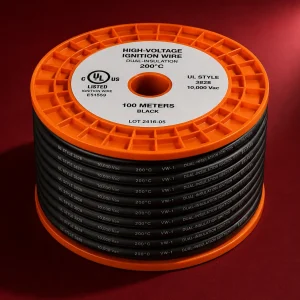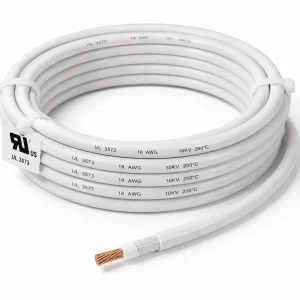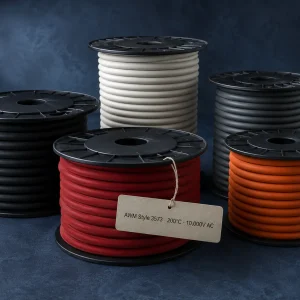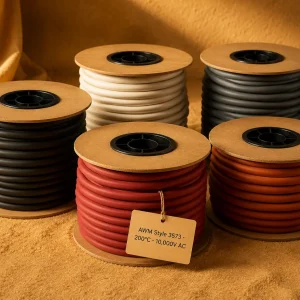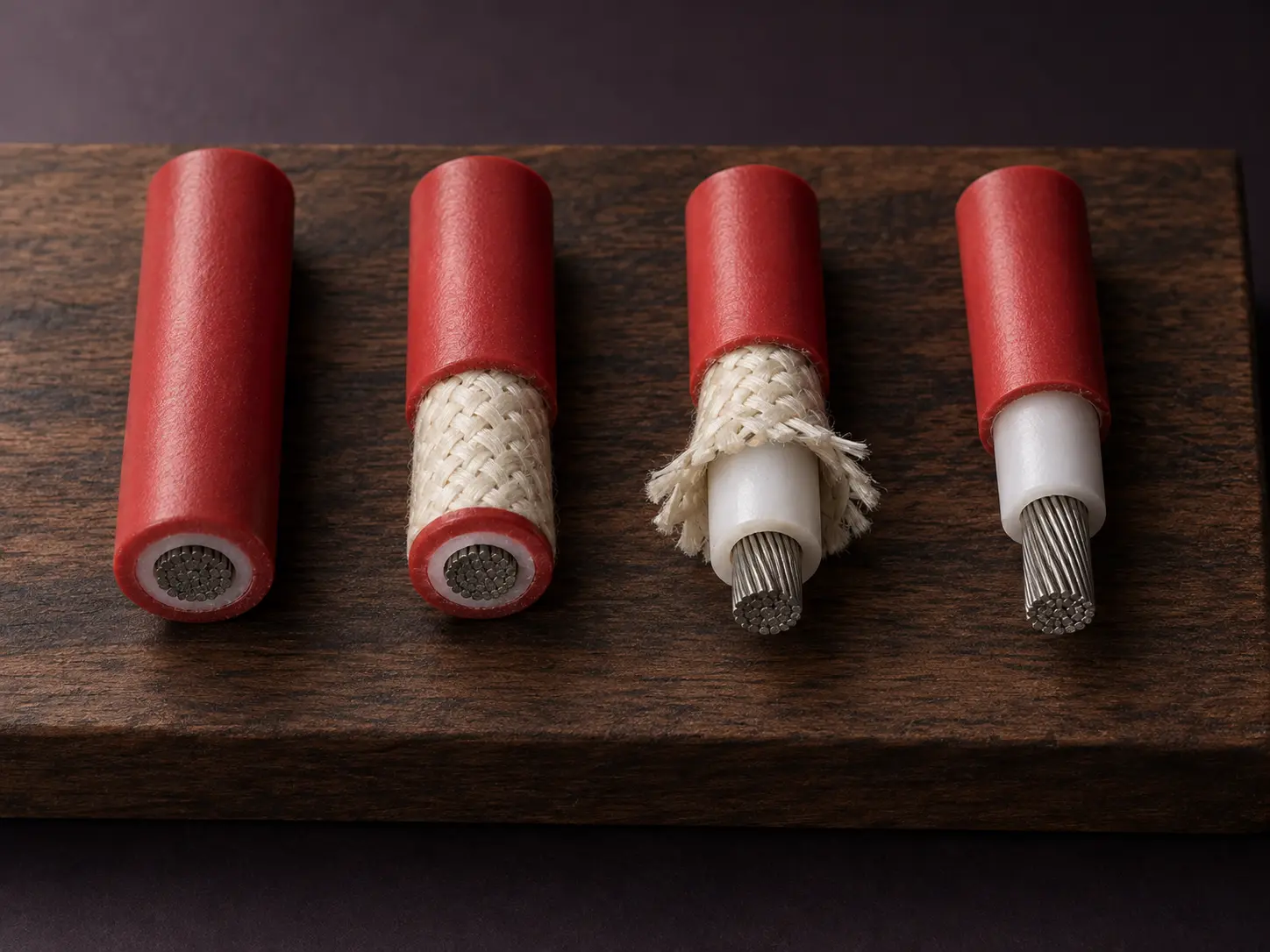
UL 3573 200°C 10000V Silicone Fiberglass Braid Wire for Protected Gas Burner Ignition
This page covers UL AWM Style 3573 as a construction type: an insulated wire rated 200°C and 10000 Vac, built with an SR silicone inner insulation, a fiberglass braid or serve, and an outer insulation over that braid. It is written for appliance and burner OEM engineering and procurement teams working from a drawing, BOM or ignition wiring specification.
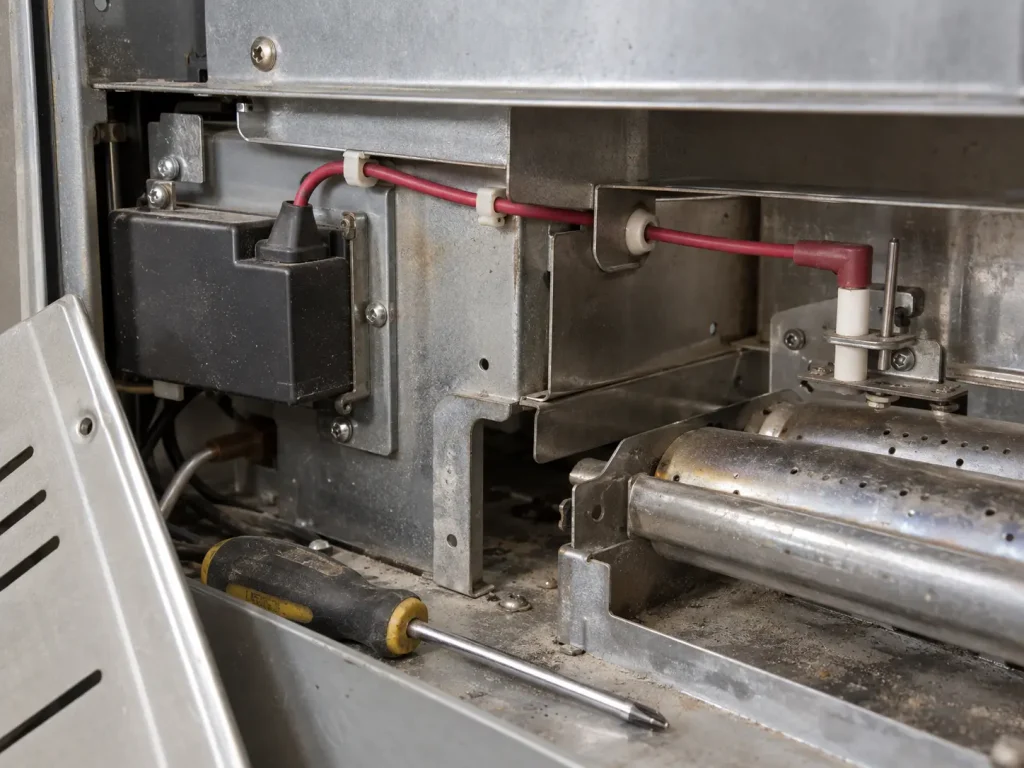
The conductor range is 22 AWG–12 AWG, solid or stranded round, the flame designation is Horizontal Flame, and Marking is General. The official Use is tied to ignition service and carries a protection condition: “Electronic Ignition or similar application in Gas Ranges or Gas or Fuel Oil Burner Systems where protected from damage during handling, installation and servicing of the appliance.”
What follows is organised around the three things a buyer most often needs settled: how the layered build is actually specified, what the 10000 Vac rating does and does not say, and where the Use boundary sits.
Confirmed UL Style 3573 Construction and Ratings
| Parameter | Requirement |
|---|---|
| UL AWM Style | 3573 |
| Product Description | Insulated Wire |
| Temperature Rating | 200°C |
| Voltage Rating | 10000 Vac |
| Flame | Horizontal Flame |
| Style Conductor Range | 22 AWG–12 AWG |
| Conductor Form | Solid or stranded round |
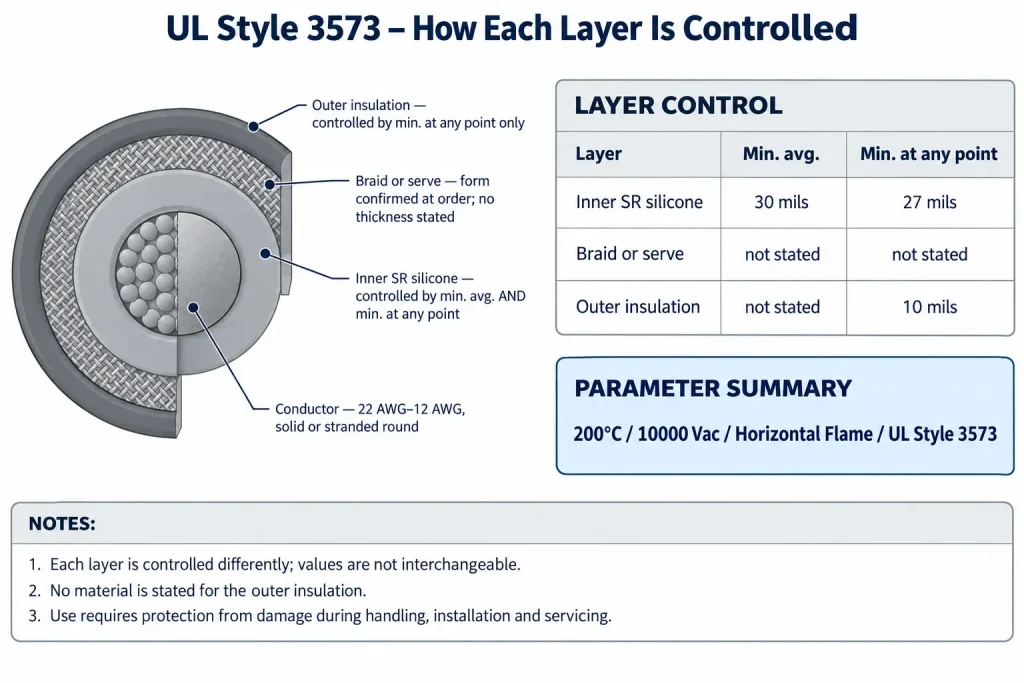
| Inner Insulation | SR silicone, 30 mil minimum average / 27 mil minimum at any point |
| Braid or Serve | Fiberglass braid or serve |
| Outer Insulation over Braid | 10 mil minimum at any point |
| Marking | General |
| Official Use | Electronic Ignition or similar application in Gas Ranges or Gas or Fuel Oil Burner Systems where protected from damage during handling, installation and servicing of the appliance. |
| Documentation | UL marking and compliance documents according to the confirmed ordered construction |
| RoHS / REACH | Applicable RoHS / REACH documentation can be confirmed according to the ordered construction |
Nine points to clarify about the table above:
- The voltage rating is 10000 Vac. It is an AC rating for the wire, and the record gives no DC rating.
- The inner SR silicone insulation carries two independent requirements: a 30 mil minimum average and a 27 mil minimum at any point.
- The outer insulation over the braid carries only a minimum at any point, stated as 10 mils. The record publishes no minimum average for that layer.
- The middle layer may be a fiberglass braid or a serve. Which applies belongs to the qualified construction.
- The record states no material for the outer insulation, so none is named here.
- The conductor is round, solid or stranded, across 22 AWG–12 AWG. Sizes outside that range are outside the Style.
- Conductor material, plating, strand count, strand diameter and lay length are not defined by the Style.
- Finished OD, OD tolerance, conductor resistance, bend radius and ampacity are not defined by the Style.
- The Style range is not a stock list, and availability of a given construction is confirmed per enquiry.
How the Layered Build Is Specified
Style 3573 is defined in three stages over the conductor, and each stage is controlled differently. That asymmetry is the practical point of this Style.
Inner insulation. SR silicone, controlled by both an average and a point minimum: 30 mils and 27 mils. A construction must satisfy both.
Braid or serve. A fiberglass braid or a serve. The record states no thickness for this layer and no choice rule, so a buyer whose drawing requires one form specifically should say so; otherwise the form follows the qualified construction.
Outer insulation. Controlled only at its thinnest point, at 10 mils. Writing a minimum average for this layer would add a requirement the record does not contain, and treating the 10 mil figure as a nominal or typical outer wall would misread it in the other direction.
No performance function is assigned to any of the three layers in the record, so this page claims none: not mechanical protection, abrasion resistance, dielectric contribution or corona behaviour. Nor does the layered build substitute for the protection condition in the official Use.
The layers also do not produce a published finished diameter. Actual OD depends on the conductor construction, the applicable layer thicknesses, whether a braid or a serve is used, the extrusion and manufacturing tolerance. Where boot fit, bushing entry or routing clearance is controlled, state a maximum finished OD and OD tolerance in the RFQ.
Reading the 10000 Vac Rating
The rating describes the wire. It is not an ignition system rating, a transformer secondary specification or a spark energy figure, so this page does not state that Style 3573 covers any particular ignition output. Those are determined by the appliance design against its own specification.
The rating is also not restated as a DC value, and no peak, pulse or impulse figure is derived from it. The 200°C temperature rating is stated without a duty qualifier, so this page does not describe it as continuous and derives no service life or thermal margin from it. The flame designation is Horizontal Flame; VW-1, FT1, vertical flame and fire-resistant descriptions are not part of this record.
Conductor Range and Construction
The Style covers 22 AWG through 12 AWG, solid or stranded round. The following are RFQ fields rather than Style values:
- solid or stranded form
- conductor material
- plating or surface finish
- strand count, strand diameter and lay construction, where controlled
- maximum conductor resistance, where controlled
No stranding class or flexibility grade is applied here, since the record contains none. Conductor size assigns no circuit function or current capacity either: the record gives no ampacity, and none is inferred from conductor size or the ratings. Current-carrying capacity is evaluated through the buyer’s equipment design and the applicable approval process.
The Protection Condition in the Official Use
The Use names the application and then attaches a condition: the wire is protected from damage during handling, installation and servicing of the appliance. That condition is satisfied by the appliance design and assembly practice, through routing, clipping, bushings, boots and access arrangements, rather than by the wire’s own braid or outer layer.
The application boundary is equally specific: electronic ignition or similar application in gas ranges or gas or fuel oil burner systems. This page does not extend it to general high voltage wiring, automotive ignition leads, X-ray, laser, electrostatic, plasma or high voltage power supply wiring, industrial furnace wiring, building wiring or field cable. Buyers sometimes enquire from adjacent contexts and any enquiry can be reviewed against the drawing, but those contexts do not become approved uses. Compliance of a finished appliance or burner system is established at the equipment level and is not conferred by the Style designation of one internal wire.
How to Specify UL 3573
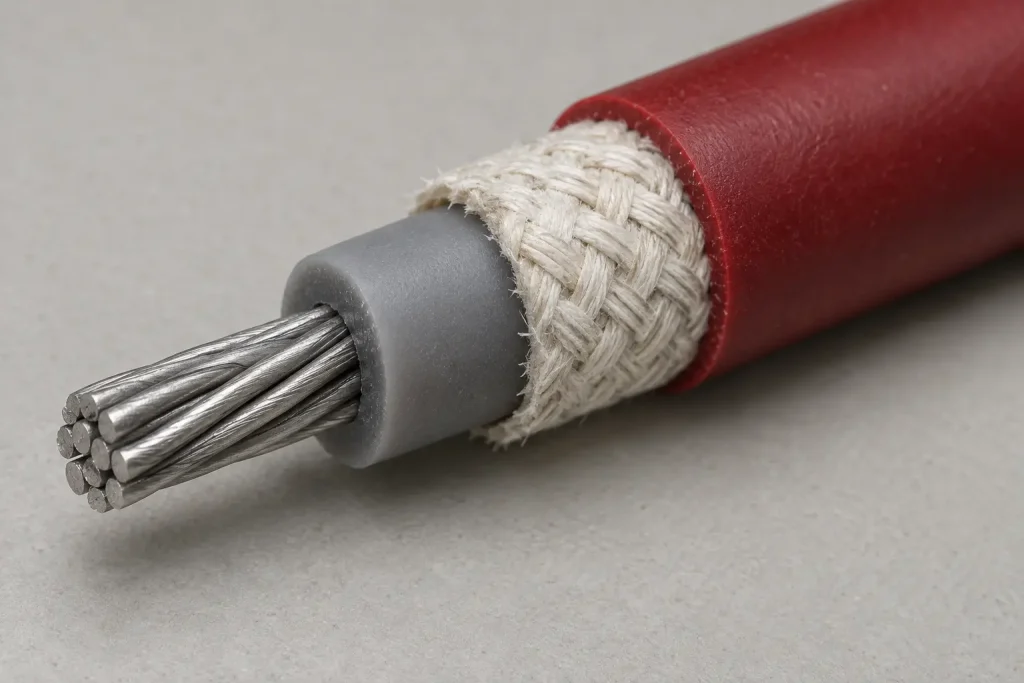
A Style designation is a construction requirement, not a complete purchase specification. A complete enquiry adds:
- the UL AWM Style 3573 requirement
- the AWG within 22 AWG–12 AWG
- solid or stranded round conductor
- conductor material and plating, where controlled by the drawing
- strand construction and maximum conductor resistance, where controlled
- whether a fiberglass braid or a serve is required
- insulation colour and any identification requirement
- the marking requirement
- maximum OD and OD tolerance, where controlled
- the ignition wiring location, and how the wire is protected during handling, installation and servicing
- the drawing, BOM or equipment specification
- documentation requirements, quantity and packaging preference
- the destination and the requested Incoterm
No price, currency, pricing formula or price validity period is published on this page. A quotation is prepared against a defined construction and commercial scope and issued as a separate quotation document.
What Style 3573 Does and Does Not Define
Style 3573 defines:
- 200°C temperature rating and 10000 Vac voltage rating
- Horizontal Flame
- conductor range 22 AWG–12 AWG, solid or stranded round
- inner SR silicone insulation, 30 mil minimum average / 27 mil minimum at any point
- a fiberglass braid or serve
- outer insulation over the braid, 10 mil minimum at any point
- Marking: General
- the ignition Use and its protection condition
Style 3573 does not universally define:
- conductor material, plating, strand count, strand diameter or lay length
- a minimum average thickness for the outer insulation
- the outer insulation material, or a thickness for the braid or serve
- a performance function for any layer
- finished OD, OD tolerance, bend radius, flex cycles or flex class
- conductor resistance, ampacity or current rating
- a DC, peak or impulse voltage rating
- ignition system, transformer output or spark energy characteristics
- automotive ignition, high voltage power supply, X-ray, laser or industrial furnace suitability
- colour, reel length, MOQ, stock, lead time, production capacity or shipping term
Common Procurement Errors
- Quoting a minimum average thickness for the outer insulation.
- Treating the 10 mil outer figure as a nominal or typical wall.
- Assuming a fiberglass braid when a serve may apply, or vice versa.
- Naming a material for the outer insulation that the record does not state.
- Attributing mechanical protection or abrasion resistance to any layer.
- Writing “200°C continuous”, or adding a duty qualifier to the rating.
- Restating 10000 Vac as a DC, peak or impulse value.
- Treating the wire rating as an ignition system, transformer or spark energy specification.
- Extending the conductor range beyond 22 AWG–12 AWG.
- Assuming the conductor is tinned copper, or that all Style 3573 is stranded.
- Deriving a finished OD from the layer minimums, or an ampacity from conductor size.
- Presenting the wire for automotive ignition, high voltage power supply or industrial furnace wiring as an approved use.
- Relying on the construction instead of protecting the wire during handling, installation and servicing.
- Treating component Style recognition as appliance or burner system compliance.
RFQ Information to Confirm
Style and ratings
- UL AWM Style 3573 requirement
- 200°C temperature rating requirement
- 10000 Vac voltage rating requirement
- AWG within 22 AWG–12 AWG
Conductor and construction
- Solid or stranded round conductor
- Conductor material and plating requirement, if controlled by the drawing
- Strand construction, if controlled
- Maximum conductor resistance, if controlled
- Fiberglass braid or serve requirement
- Maximum OD and OD tolerance, if controlled
Identification and application references
- Insulation colour and identification requirement
- Marking requirement
- Ignition wiring location and the protection method during handling, installation and servicing
- The circuit requirement for engineering review, rather than a self-derived ampacity
- Drawing, BOM or equipment specification
Commercial
- Quantity and packaging preference
- Destination and requested Incoterm
- Requested UL marking and compliance documents, including any RoHS / REACH documentation requirement
UL Marking and Documentation
CableApex is an international sales and export company and does not hold a UL File for Style 3573. Supplied wire is UL-recognized component wire where supplied under a qualified manufacturing scope, with UL marking according to the confirmed ordered construction. The Style record lists Marking as General.
Applicable RoHS / REACH documentation can be confirmed according to the ordered construction. CSA, FT1, VW-1, CE and dual UL/CSA designations are not claimed here.
Commercial, origin, compliance and transport documents are identified during quotation and confirmed according to the order. They are not supplied as a fixed package with every shipment.