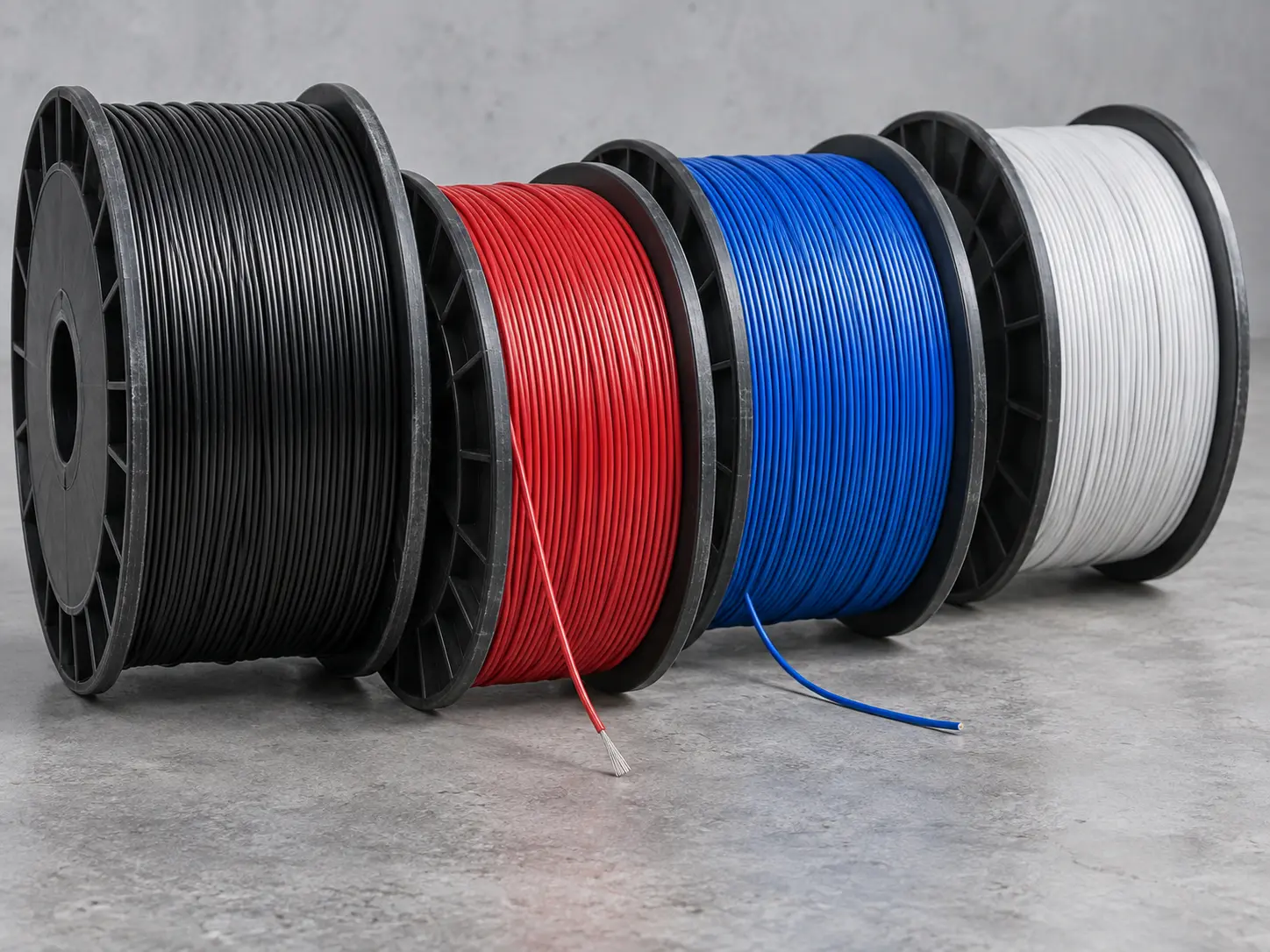
UL 1569 as Bulk Wire for Fixed Appliance Internal Harnesses
UL AWM Style 1569 is a single conductor with extruded PVC insulation, rated 300 Vac with Horizontal Flame, in 80°C, 90°C or 105°C temperature ratings. The Style conductor range is 30 AWG through 2 AWG, solid or stranded.
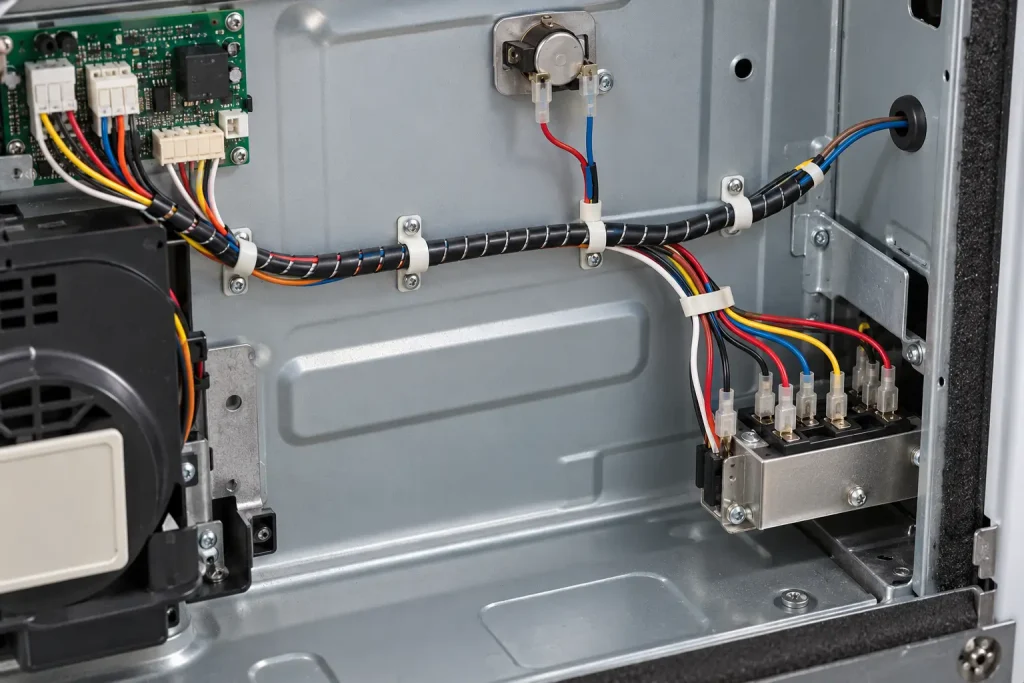
This page covers the supply of that wire in bulk, in the 30–10 AWG thin-wall group, for use as fixed internal wiring within appliance harnesses and grouped internal lead assemblies. Harness is a procurement and assembly context here — it describes what the buyer builds from the wire, not what the Style defines.
The official Use is internal wiring of appliances or electronic equipment where not subjected to movement or mechanical damage. This page works within the appliance branch and keeps that condition attached throughout.
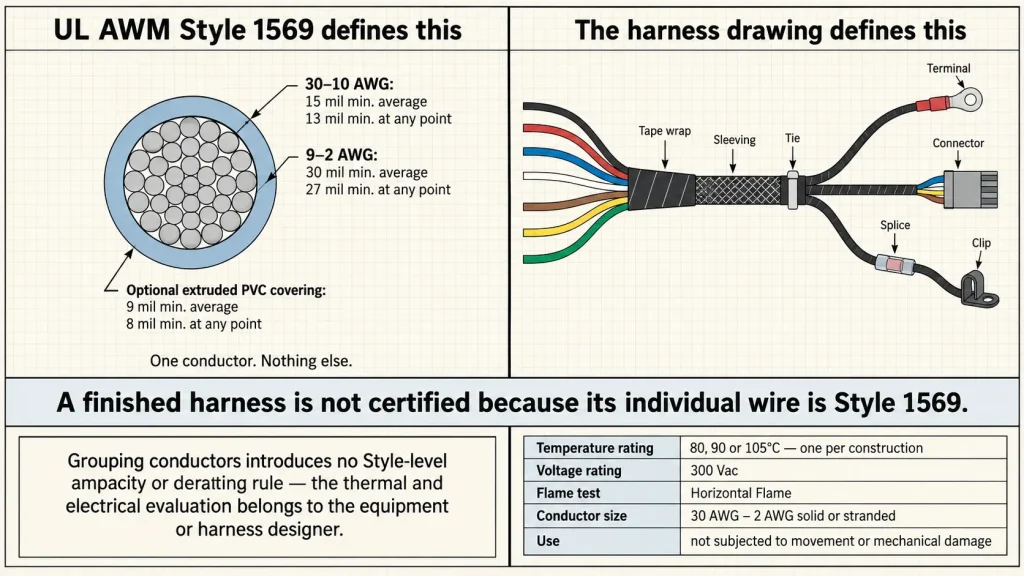
Verified UL Style 1569 Construction
| Parameter | Style-level information |
|---|---|
| UL AWM Style | 1569 |
| Construction | Single conductor with extruded insulation |
| Temperature | 80°C, 90°C or 105°C |
| Voltage | 300 Vac |
| Flame | Horizontal Flame |
| Conductor range | 30 AWG–2 AWG |
| Conductor form | Solid or Stranded |
| Insulation | Extruded PVC |
| 30–10 AWG | 15 mil average / 13 mil minimum at any point |
| 9–2 AWG | 30 mil average / 27 mil minimum at any point |
| Optional covering | Extruded PVC, 9 mil average / 8 mil minimum at any point |
| Marking | General |
| Official Use | Internal wiring of appliances or electronic equipment where not subjected to movement or mechanical damage |
| Optional tag — not a normal rating | 600 Volts Peak for Electronic Use Only |
This page focuses on the 30–10 AWG / 15 mil base-insulation group for fixed appliance internal harness applications.
The Style Defines the Wire, Not the Harness
This is the distinction that matters most on a page about harness wire.
Style 1569 defines a single-conductor construction. It does not define the number of wires in a harness, the colours within it, branch geometry, bundle diameter, tape, sleeving, conduit, ties, clips, terminals, connectors, seals, splices, crimps, cut lengths or strip lengths. Every one of those belongs to the harness drawing and the harness builder.
A finished harness is not certified because the individual wire in it is Style 1569. The wire carries its own construction and marking; the assembly is evaluated on its own terms against the appliance requirements.
Where a buyer requires a processed harness or prepared leads rather than bulk wire, those requirements are separately specified and confirmed. Harness assembly services are not presented here as automatically included.
Grouping Conductors Does Not Change the Style
Bundling several Style 1569 conductors together creates a harness. It does not create a new set of electrical properties, and the Style provides nothing that applies specifically to grouped conductors.
Nothing here claims improved bundled performance, better heat dissipation, higher bundled ampacity, controlled bundle temperature, automatic suitability for dense bundles, freedom from derating, reduced thermal rise or better grouped-current behaviour. The Style record establishes no ampacity at all, and therefore no bundle-derating rule either.
Where multiple current-carrying conductors are grouped together, the thermal and electrical evaluation belongs to the equipment or harness designer working from the actual circuit loads and the enclosure conditions. That evaluation is unaffected by which Style the individual wires carry, and it is not answered by a Style number.
Thin-Wall Applies to 30–10 AWG Only
Style 1569 has two base-insulation groups. From 30 AWG through 10 AWG the requirement is 15 mils minimum average with 13 mils minimum at any point. From 9 AWG through 2 AWG it doubles to 30 mils minimum average with 27 mils minimum at any point.
So thin-wall is used on this page as a description of the 30–10 AWG subset. It is not accurate to say all Style 1569 is 15 mil, that the Style means 15 mil insulation regardless of AWG, or that 30 AWG through 2 AWG share the same thin-wall construction. The Style does extend through 2 AWG on the thicker requirement.
In harness work this is easy to miss, because a wire schedule listing several sizes may cross the 10/9 boundary without drawing attention to it. Confirming which group each listed size falls into avoids quoting one construction against a schedule that needs two.
A Fixed Harness Is Not a Moving Harness
A harness being inside an appliance does not by itself make Style 1569 appropriate. The Use condition is what decides: the wire must not be subjected to movement or mechanical damage.
That wording excludes movement, not only repeated flexing. Appropriate contexts are fixed internal harnesses, protected internal lead assemblies and stationary component-to-component routing. Door-hinge harnesses, repeated-motion cable loops, sliding mechanisms, moving carriage wiring and continuous flexing are not normal Style 1569 applications and are not described as such here.
No flex-cycle performance, bend-life rating or dynamic-flex classification is published, because the Style record establishes none. Where part of a harness crosses into a moving position, that section needs separate evaluation even if the rest of the harness is fixed.
Temperature Rating Is Selected, Not Bundled
Style 1569 allows 80°C, 90°C or 105°C. These are alternatives; a wire does not carry all three simultaneously.
The required temperature rating is specified at RFQ and confirmed for the ordered construction. Nothing here states that all Style 1569 is 105°C or advertises that rating as standard. In a harness with circuits in different thermal positions, the required rating may differ between wire schedule lines.
300 Vac, and the 600 Volts Peak Tag
The normal Style voltage rating is 300 Vac, used precisely here. Style 1569 is not described as 600V, 600 Vac, 300/600V or 600V appliance harness wire.
The Style may separately carry a tag indicating “600 Volts Peak for Electronic Use Only.” That is not the normal continuous voltage rating:
Normal Style rating: 300 Vac.
Optional tag: 600 Volts Peak for Electronic Use Only.
The tag is not restated as 600 Vac, 600V continuous, “UL1569 600V wire” or 300/600V wire, and it is confirmed per ordered construction where a design references it.
The Optional PVC Covering
Style 1569 permits an optional extruded PVC covering at 9 mils minimum average with 8 mils minimum at any point. It is a separate construction field with its own requirement, and it is optional.
Not every Style 1569 wire includes it. It is not called double insulation, an outer jacket, abrasion protection, mechanical protection or bundle protection here — none of those characteristics is established by the Style information. Where the covering is required, it is confirmed as part of the ordered construction.
Conductor Requirements
Style 1569 establishes the 30 AWG–2 AWG range and the solid or stranded form. It establishes nothing else about the conductor.
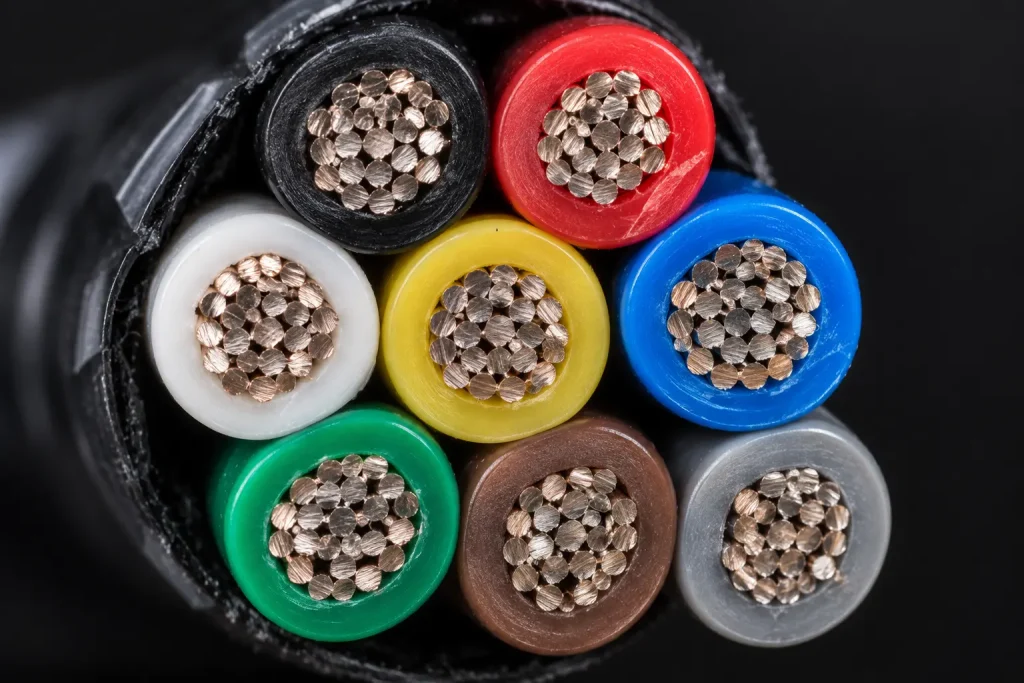
Copper, tinned copper, bare copper, silver-plated copper and nickel-plated copper are none of them established at Style level, and no strand count, strand diameter, lay length, conductor resistance or ampacity is stated here. Specific conductor material, finish and stranding are confirmed for the ordered construction or supported by verified SKU documentation. In harness work stranding is frequently controlled by crimp compatibility, so it is worth stating where the drawing fixes it.
Insulation Colour in a Harness Specification
Colour coding is central to most harness drawings, and it is entirely outside the Style.
Style 1569 does not establish available colours, colour codes, colour stability or batch-to-batch colour tolerance. No universal colour availability is promised here, and no colour consistency is guaranteed without separate support. Specify the required insulation colour for each circuit or harness position in the enquiry, referencing the wire schedule where one exists.
Finished OD and Bundle Dimensions
No universal finished outside diameter is published. The Style specifies minimum insulation wall requirements, not a finished OD.
Actual OD depends on the AWG, the solid or stranded conductor construction, the detailed conductor design, the actual insulation dimensions, and whether the optional PVC covering is included. The 15/13 mil requirement for 30–10 AWG supports a thin-wall positioning; it does not establish an ultra-thin construction, a minimum possible diameter, a smallest OD, guaranteed space saving or maximum packing density.
Where the harness drawing has dimensional limits, specify the required AWG, the maximum finished OD, the OD tolerance, the bundle diameter limit, and the connector cavity or terminal interface constraints.
Application Boundary
The Use covers internal wiring of appliances or electronic equipment, subject to the movement and mechanical-damage condition. This page works within the appliance branch.
It does not extend to building wiring, field wiring, branch circuits, tray wiring, conduit, raceway, external appliance power cords, portable cords, robotic wiring, drag chains, continuous-flex harnesses, moving appliance mechanisms or unprotected abrasion locations.
What Style 1569 Does Not Define
- Conductor material and conductor plating
- Strand count and finished OD
- Bundle diameter
- Ampacity, grouped-wire derating and harness current capacity
- Colour
- Terminal, connector, crimp, cut length and strip length
- Harness geometry
- MOQ, stock and lead time
Each requires buyer specifications, verified SKU documentation or commercial confirmation.
Common Procurement Errors
- 15 mil insulation assumed for every size in a wire schedule. It applies to 30–10 AWG only.
- All Style 1569 assumed to be 105°C. The Style permits 80, 90 or 105°C.
- 600 Volts Peak treated as a 600 Vac rating. The rating is 300 Vac.
- Stranded tinned copper assumed mandatory. Conductor material is not set at Style level.
- “UL1569 harness wire” ordered with no conductor size.
- Style 1569 assumed to define a finished harness. It defines the single conductor.
- Bundled conductors assumed to have a Style-defined ampacity. None exists.
- No thermal evaluation done where multiple current-carrying leads are grouped.
- Used in a moving harness. The Use excludes movement.
- Optional PVC covering assumed always present.
- One universal finished OD assumed.
RFQ Checklist
- UL AWM Style 1569
- Required AWG
- Whether the requirement falls within the 30–10 AWG thin-wall subset
- Solid or stranded conductor
- Required conductor material
- Conductor finish or plating
- Strand construction, if controlled
- Required temperature rating: 80°C, 90°C or 105°C
- Insulation colour for each harness circuit
- Optional PVC covering required: yes / no
- Maximum finished OD, if controlled
- Maximum bundle diameter, if controlled
- Number of circuits or lead positions
- Appliance type
- Fixed internal installation location
- Confirmation that wiring is not subjected to repeated movement
- Mechanical-protection conditions
- 300 Vac requirement
- Whether the optional 600 Volts Peak electronic-use tag is relevant
- Customer harness drawing and wire schedule
- Cut lengths, if processed leads are required
- Strip lengths
- Terminal specifications
- Connector specifications
- Marking, quantity, packaging and destination
- Required compliance documentation
These are buyer inputs. No value on this list is assumed or supplied by default.
Substitution
Different AWM Styles have independent ratings, construction requirements, temperature ratings, voltage ratings and Uses. No Style is presented here as automatically suitable for lighter wiring or as fitting better merely because it carries a higher voltage rating.
Any substitution is evaluated against the actual appliance specification and the ordered construction, including the movement and mechanical-damage condition attached to this Style’s Use.
UL Marking and Documentation
Material is supplied as UL-recognized component wire where supplied under qualified manufacturing scope, and UL marking is applied according to the confirmed ordered construction. The Style-level marking designation is General.
CSA AWM, FT1, VW-1 and dual UL / CSA certification are not claimed here; any additional certification depends on the ordered construction. Applicable RoHS / REACH documentation can be confirmed according to the ordered construction.
Flame Classification
The verified Style-level designation is Horizontal Flame. VW-1 and FT1 are separate classifications and are not claimed here; Horizontal Flame is not converted into either. Any separately confirmed flame requirement remains order-specific.