UL 3304’s Role in an Electronic Ignition Circuit
To design a reliable electronic ignition system, the wire is not just “a connection between two points” — it is an active circuit element with capacitance, dielectric loss, and voltage withstand limits that affect spark performance. German engineers searching UL 3304 10000V Silikon ignition Draht Deutschland are typically system designers who understand this and want to specify the right wire for their ignition circuit topology.
A modern electronic ignition system has four main components, with UL 3304 connecting two of them:
- Power supply — 24V DC or 120V/240V AC input from the appliance main supply
- Ignition module — high-voltage generation circuit (typically a flyback transformer, voltage multiplier, or capacitor-discharge ignition system) that converts low voltage to 10-15 kV pulses
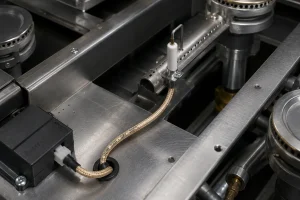
- UL 3304 high-voltage wire — delivers the 10-15 kV pulse from the ignition module output to the spark electrode
- Spark electrode — terminates the wire at the burner, with a 2-4 mm air gap to ground where the spark forms
The UL 3304 wire experiences the full ignition voltage during every spark event — typically 1-2 sparks per second during ignition sequences, repeated thousands of times over the appliance lifetime. The wire must withstand this without dielectric degradation, while also being mechanically routed through the appliance chassis without abrasion damage and remaining functional at sustained 200°C ambient temperature near the burner.
Four Failure Modes That UL 3304 Construction Prevents
An ignition wire can fail in several characteristic ways. UL 3304’s specific construction addresses each:
Failure Mode 1 — Dielectric Breakdown of Insulation
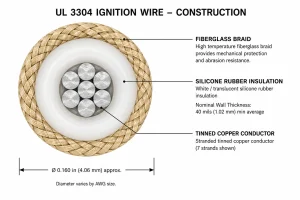
If the wire’s insulation cannot withstand the spark voltage, an internal breakdown occurs — the spark conducts through the insulation to chassis or to an adjacent component instead of jumping the intended electrode gap. UL 3304’s 40 mils (1.02 mm) minimum silicone rubber wall provides dielectric strength of approximately 30-40 kV across the wall — well above the 10 kV continuous rating. The 4x safety margin handles voltage transients during the ignition pulse rise time without breakdown.
Failure Mode 2 — Surface Tracking
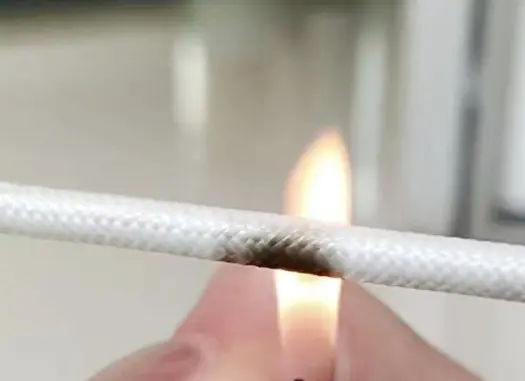
Even when the bulk insulation is intact, surface contamination (dust, grease, condensation) on the wire’s outer surface can create a conductive path along the wire surface. The high voltage finds a path along the surface rather than through the bulk insulation, eventually carbonizing the surface and creating a permanent fault track. The fiberglass braid covering on UL 3304 reduces tracking because fiberglass is non-tracking — surface contamination on fiberglass does not form persistent carbon tracks the way it does on plain plastic surfaces.
Failure Mode 3 — Mechanical Abrasion at Chassis Edges
Ignition wires are routed through metal chassis with sharp edges, mounting brackets, and pass-through holes. Plain silicone rubber alone is mechanically soft and can be cut or abraded by these edges, exposing the conductor or thinning the insulation to below dielectric specification. The fiberglass braid covering provides mechanical protection that pure silicone insulation cannot — even sharp metal edges typically cannot cut through the braided fiberglass structure during normal installation and service.
Failure Mode 4 — Thermal Aging at Sustained Elevated Temperature
Burner operation generates radiated heat that maintains adjacent wiring at 150-200°C continuous. Standard PVC insulation degrades rapidly above 105°C. Silicone rubber maintains its dielectric and mechanical properties at 200°C continuous indefinitely, with only minor mechanical hardening over very long service. UL 3304’s 200°C rating with silicone rubber insulation provides the thermal margin that combustion-environment service demands.
UL 3304 vs Automotive Ignition Wire — Why They’re Not Interchangeable
German engineers familiar with automotive ignition systems sometimes ask whether automotive ignition wire (commonly available, lower cost) can substitute for UL 3304. The answer is no, for two reasons:
- Certification scope. Automotive ignition wire is typically certified under SAE J1127 or J1128 (US automotive) or ISO 6722 (international automotive) — these are vehicle-electrical standards, not appliance-electrical standards. UL Subject 758 (the standard governing UL 3304) is specifically for appliance internal wiring under UL component recognition. An appliance certified by UL with automotive ignition wire substituted for UL 3304 is not a valid UL component listing — the appliance loses its UL recognition.
- Construction differences. Automotive ignition wires are often constructed with EPDM rubber or specialized polymers optimized for under-hood automotive environments (high temperature, oil/coolant exposure, mechanical vibration). UL 3304’s silicone rubber + fiberglass braid construction is optimized for appliance combustion environments (sustained moderate-high temperature, cleaner installation, higher dielectric requirements at lower cycle counts). The two are designed for different applications even though both carry “10 kV” markings.
UL 3304 Specifications
| Parameter | Value (per UL Subject 758) |
|---|---|
| UL Style | AWM 3304 |
| UL File Number | E333030 (Follow-Up Service) |
| AWG Range | 22 AWG – 12 AWG, solid or stranded round |
| Conductor Material | Bare or tinned copper, solid or stranded round |
| Voltage Rating | 10,000V AC |
| Temperature Rating | 200°C |
| Insulation | Extruded Silicone Rubber (SR) |
| Insulation Wall | 40 mils (1.02 mm) min avg / 36 mils (0.91 mm) min at any point |
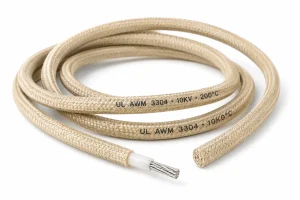
| Covering | Fiberglass Braid (over silicone rubber insulation) |
| Dielectric Strength | ~30-40 kV across insulation wall (silicone rubber typical) |
| Surface Tracking Resistance | Improved by fiberglass braid (non-tracking covering) |
| Flame Rating | Horizontal Flame per UL Subject 758 |
| Designated Use | Internal Wiring of Electronic Ignition or similar application in Gas Ranges or Gas or Fuel Oil Burner Systems |
| Use Limitation | Where protected from damage during handling, installation, and servicing |
| Compliance | UL Subject 758 (AWM), RoHS, REACH |
| Marking | CableApex · UL AWM 3304 · AWG · 10kV · 200°C · E333030 |
Engineering Notes from CableApex
Three points German ignition system design engineers raise about UL 3304 in production design:
- “How does wire capacitance affect spark energy?” Every ignition wire has distributed capacitance to ground (typically 50-200 pF/m for silicone-insulated wires inside metal chassis). When the ignition pulse arrives, this capacitance must charge before the voltage at the spark electrode reaches breakdown. For very short wire runs (under 200 mm), the capacitive load is negligible. For runs over 1 m, the capacitive load can absorb significant pulse energy and reduce spark intensity. For long-run designs, verify the ignition module’s pulse energy specification accommodates the cable capacitance.
- “Should I specify solid or stranded conductor for ignition wire?” For UL 3304 in fixed installations (wire is routed once during assembly and not flexed during service), solid conductor is acceptable and slightly less expensive. For installations where the wire must flex during service (sliding components, hinged access panels, removable burners), stranded conductor is necessary to avoid conductor fatigue cracking. Stranded UL 3304 18 AWG with tinned copper is the most commonly specified construction for general-purpose appliance ignition wiring.
- “What’s the typical service life expectation for UL 3304 in burner applications?” Properly specified UL 3304 in standard burner service (1-2 sparks per ignition sequence, 1-10 ignitions per day, 200°C ambient) typically delivers 10-15 year service life equal to or exceeding the appliance lifetime. The fiberglass braid covering and silicone rubber insulation both have very slow aging mechanisms in this environment. Premature failure usually indicates either installation damage during assembly, application outside the rated parameters (over-temperature, voltage exceeding 10 kV, or chemical exposure beyond silicone tolerance), or use of a non-UL substitute wire.
MOQ, Packaging & Shipping
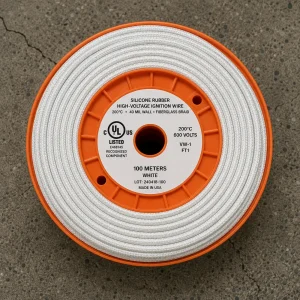
MOQ varies by AWG, color combination, and production schedule — contact us for current MOQ on UL 3304. Standard packaging: spools or reels per customer specification. Export documentation: Commercial Invoice, Packing List, Certificate of Origin (CCPIT), Bill of Lading, UL Recognition reference letter (File No. E333030), RoHS Declaration, REACH SVHC Declaration, MSDS. HS Code: 8544.49. CIF Hamburg or Rotterdam, transit time 25–30 days from Shanghai or Ningbo origin port.
Related UL Styles for Ignition and High-Voltage Applications
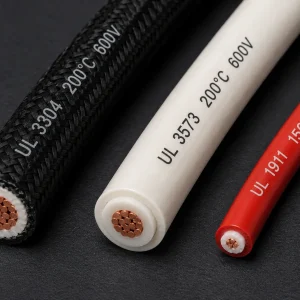
UL 3304 buyers commonly cross-reference: UL 3573 (200°C / 10,000V AC silicone rubber + fiberglass braid, 22-12 AWG — alternative high-voltage ignition wire with different layered insulation construction), UL 3071 (200°C / 600V silicone rubber, 18-13 AWG — same temperature class but lower voltage for non-ignition silicone applications), UL 3135 (200°C / 600V silicone rubber, 26-12 AWG — silicone rubber at 600V for non-ignition appliances), and UL 1659 (250°C / 600V PTFE, 26-4/0 AWG — higher temperature alternative for non-ignition high-temperature applications).