UL 1015 Where the Specification Calls for a Tinned-Copper Conductor
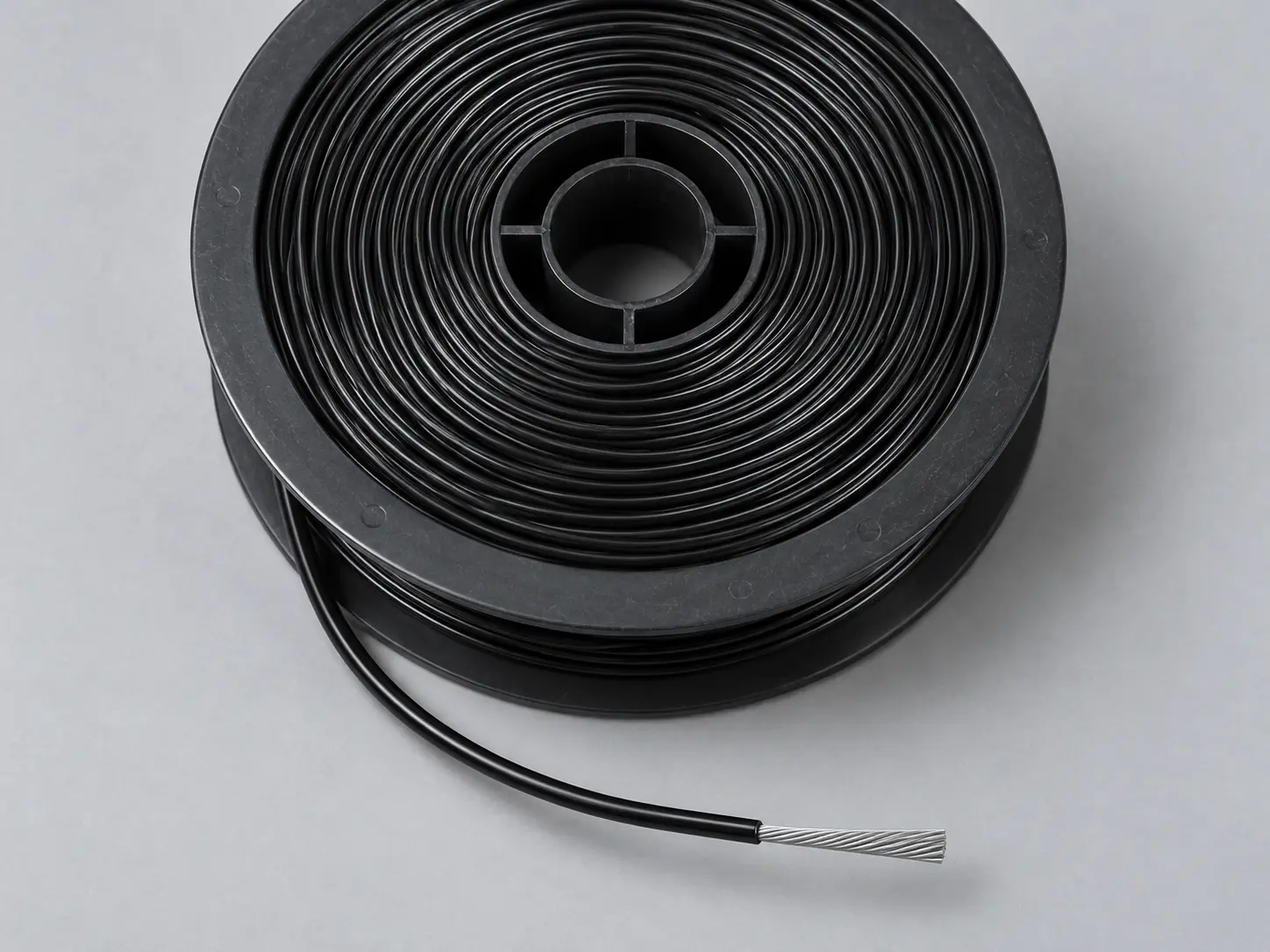
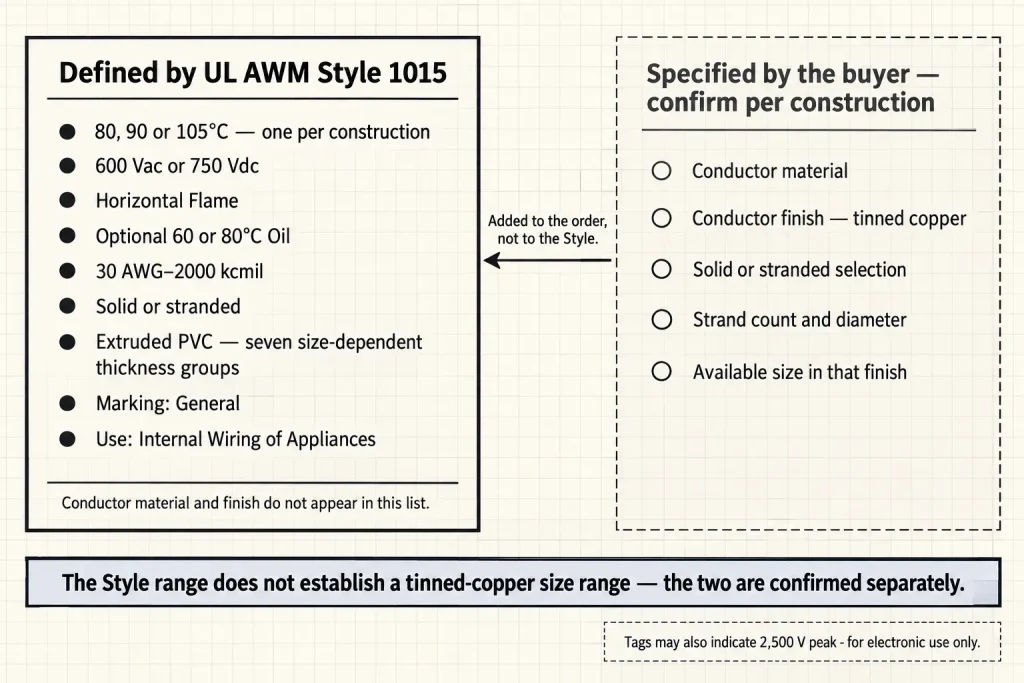
UL AWM Style 1015 is a single conductor with extruded PVC insulation, with 80°C, 90°C or 105°C rating options, voltage ratings of 600 Vac or 750 Vdc, and a Horizontal Flame designation. The Style-level conductor range is 30 AWG through 2000 kcmil, solid or stranded. The official Use is internal wiring of appliances.
This page addresses Style 1015 projects in which tinned copper is a buyer-specified conductor finish rather than a universal Style requirement. Where the appliance specification requires a tinned-copper conductor, the conductor finish should be stated in the RFQ and confirmed against the applicable qualified Style 1015 construction.
The distinction runs through the whole page, because the Style and the conductor finish are two separate specifications that happen to appear in the same purchase order line.
Style-Level Data
| Parameter | Style-level information |
|---|---|
| UL AWM Style | 1015 |
| Construction | Single conductor with extruded insulation |
| Temperature rating | 80°C, 90°C or 105°C |
| Voltage rating | 600 Vac or 750 Vdc |
| Flame | Horizontal Flame |
| Optional oil rating | 60°C or 80°C Oil |
| Style conductor range | 30 AWG–2000 kcmil |
| Style conductor form | Solid or Stranded |
| Insulation | Extruded PVC |
| 30–9 AWG | 30 mil average / 27 mil minimum |
| 8–7 AWG | 45 mil average / 40 mil minimum |
| 6–2 AWG | 60 mil average / 54 mil minimum |
| 1–4/0 AWG | 80 mil average / 72 mil minimum |
| 250–500 kcmil | 95 mil average / 86 mil minimum |
| 550–1000 kcmil | 110 mil average / 99 mil minimum |
| 1100–2000 kcmil | 125 mil average / 112 mil minimum |
| Marking | General |
| Official Use | Internal Wiring of Appliances |
| Optional tag — not a voltage rating | 2,500 V peak – for electronic use only |
Page-Specific RFQ Requirement
| Requested conductor finish | Tinned copper, subject to confirmation against the applicable qualified construction |
This row sits outside the Style-level table deliberately. Tinned copper is not part of the Style conductor field, and combining the two would misstate what the Style requires.
The Style Does Not Fix the Conductor Material
The Style-level conductor statement covers the size range and the form — solid or stranded — and nothing else. It does not establish copper, tinned copper, bare copper, silver-plated copper or nickel-plated copper, and no conductor material is inferred here from the AWG range.
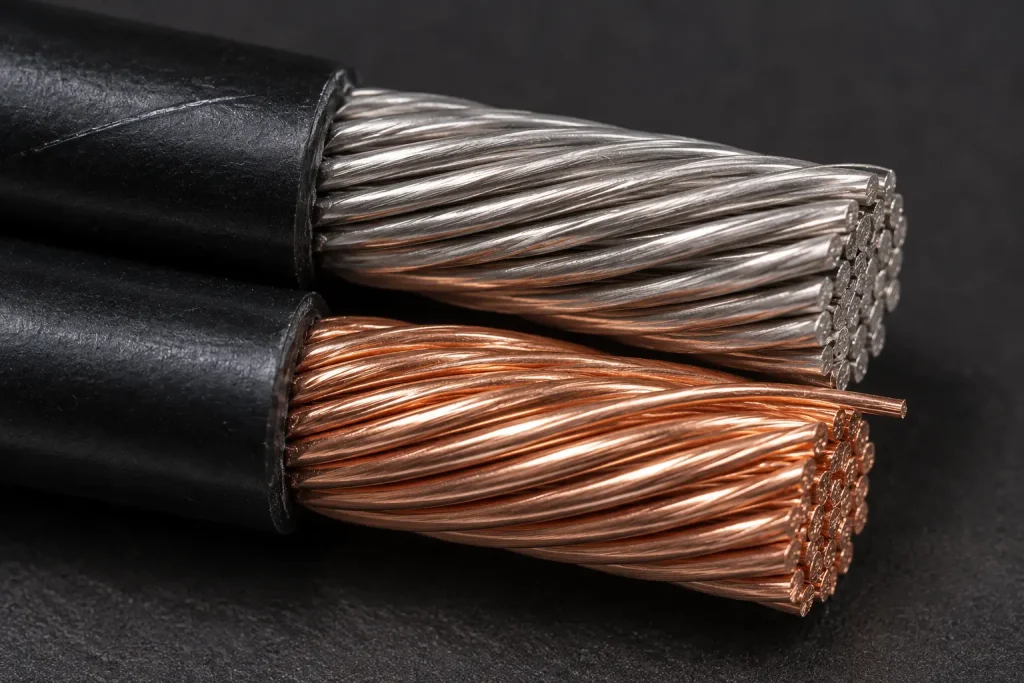
For this page, tinned copper is a customer-specified construction requirement. The applicable qualified construction is what confirms the conductor material, the conductor finish, the solid or stranded form, and the stranding details where they are controlled.
Nothing here should be read as meaning that Style 1015 uses tinned copper, that tinned copper is the standard Style 1015 conductor, or that the Style requires it.
Style Range and Tinned-Copper Availability Are Different Questions
UL AWM Style 1015 permits a Style-level conductor range of 30 AWG through 2000 kcmil. That does not prove that every size within that range is offered with tinned copper.
Style 1015 permitted range: 30 AWG–2000 kcmil.
Requested tinned-copper size: confirm according to the applicable qualified construction.
No tinned-copper size range is published on this page, and the two figures are not merged into one. A request naming both the Style range and tinned copper in the same breath has assumed something the Style record does not support.
Stranded Is Not Automatic Either
Style 1015 permits solid or stranded conductors. A tinned-copper requirement says nothing about which form applies.
Where the buyer requires stranded tinned copper, both the stranded form and the tinned finish are RFQ fields requiring construction confirmation. No strand count, strand diameter, lay length or flex class is stated here, because the Style establishes none.
Why a Buyer Specifies Tinned Copper
The reasons that matter commercially are documentary rather than technical. A buyer may specify tinned copper because:
- Their drawing calls for it
- Their approved component specification calls for it
- Their existing wire specification identifies it
- Their termination process requires a particular conductor finish
- Their internal material standard defines the conductor finish
No technical benefit is inferred or promised here. Better corrosion resistance, better solderability, better crimping, longer storage life, better conductivity, better termination retention, easier stripping and better manufacturing consistency are not claimed, because the available Style data establishes none of them as guaranteed product performance.
Where a specific benefit is relevant to a design, it belongs to product-specific evidence for the ordered construction rather than to a Style page.
Termination
Style 1015 establishes no terminal compatibility, crimp performance, solderability, strip force or termination retention, and no claim that tinned copper is easier to terminate appears here. Those are legitimate engineering topics; they are simply not settled by the Style record.
Where termination is controlled by the drawing, supply the terminal type, the connector, the strip length, the conductor finish and the stranding requirement. Those inputs let the construction be checked against the interface rather than assumed compatible with it.
Storage and Surface Condition
No claim is made here that tinned copper automatically provides better storage behaviour, corrosion protection, oxidation resistance or longer shelf life. General material-performance statements are not introduced without documentation for the ordered product.
Temperature Rating
Style 1015 includes 80°C, 90°C and 105°C rating options, and the applicable ordered construction must be confirmed for the required rating. This page is not described as universally 105°C, and no tinned-copper construction is presented as automatically carrying all three options.
The conductor finish does not determine the temperature rating, and 105°C continuous is not used here without specific product documentation.
600 Vac, 750 Vdc and the Optional Tag
The verified Style voltage ratings are 600 Vac or 750 Vdc, used accurately here and not written as 750 Vac, 600/750 Vac, 600V AC/DC or 750V AC/DC. A tinned-copper conductor does not change the voltage rating.
The Style separately permits a tag stating 2,500 V peak – for electronic use only. That is an optional tag rather than a working voltage, and it is not written as 2500V tinned copper wire, a 2.5 kV wire, 2500 Vac, 2500 Vdc or 2.5 kV continuous. It is not a commercial feature of this page.
Insulation Is Unaffected by the Conductor Finish
The verified Style insulation is extruded PVC across seven size-dependent thickness groups, each with a minimum average thickness and a separate minimum thickness at any point. These are not nominal thicknesses, and Style 1015 is not reduced to one universal insulation wall.
A tinned-copper conductor does not change the insulation type, the insulation thickness, the temperature rating or the voltage rating. Nor is every thickness group presented here as available with tinned copper — that remains a construction question.
Finished OD and Conductor Resistance
Style 1015 establishes no universal finished outside diameter, and a tinned-copper conductor does not give enough information to calculate one. Actual OD depends on the actual conductor construction, the solid or stranded form, the strand geometry, the actual conductor diameter, the PVC extrusion and manufacturing tolerance. Where dimensions matter, ask for the maximum finished OD and the OD tolerance.
No universal conductor-resistance table appears here either. Tinned copper alone does not establish one resistance value — that depends on the conductor size, the material, the strand construction, the actual conductor geometry and the applicable product specification. No value is calculated or invented.
Current Rating
No universal current rating is published. Style 1015 establishes no universal ampacity, and a tinned-copper finish does not create a separate ampacity table. No AWG is associated here with a maximum current, a continuous amp figure or a power rating.
Application Boundary
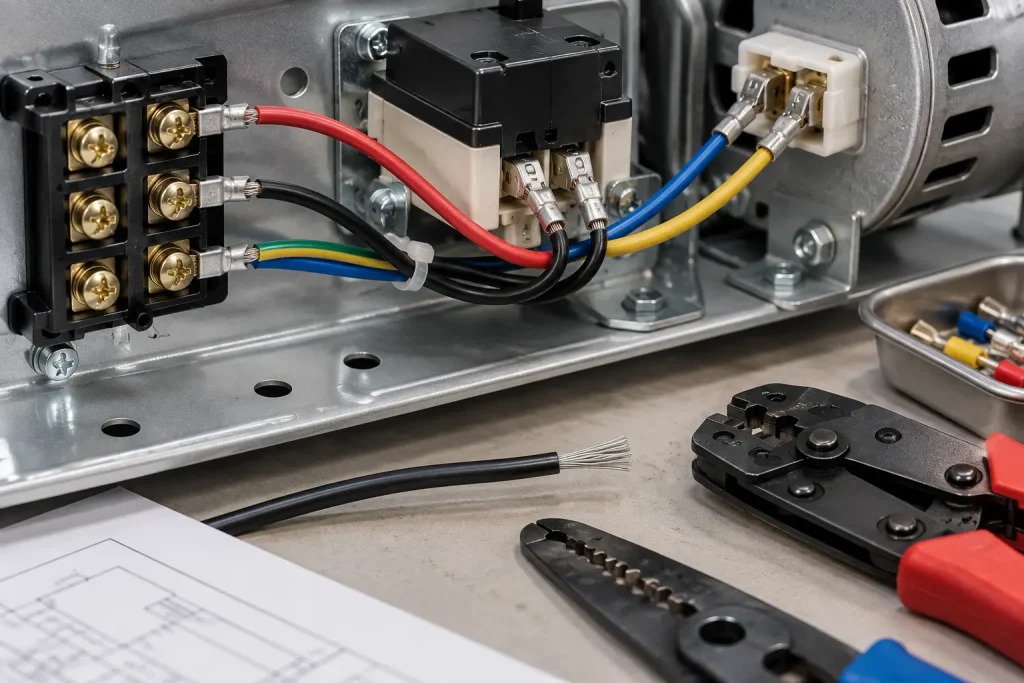
The official Use is internal wiring of appliances, and every commercial context on this page stays inside it: OEM appliance assemblies, appliance internal wiring assemblies, internal appliance leads, and appliance harness or lead manufacturing where a tinned-copper finish is specified.
OEM describes the customer, the sourcing model and the manufacturing context. It does not expand the UL Use, and phrases such as general OEM electrical equipment wire, wire for any OEM equipment or universal OEM internal wire are not used here.
The page does not extend to industrial equipment, control cabinets, building wiring, field wiring, branch circuits, tray, conduit, raceway, portable cord, external power cord or general electrical equipment wiring.
Repeat Orders With a Specified Conductor Finish
A conductor-finish requirement is exactly the kind of detail that gets lost between the first order and the fifth, which makes specification control worth attention.
No batch consistency, stable supply, permanent stock, colour matching, fixed lead time or production capacity is promised here. What keeps a repeat program aligned is controlling the specification itself: the Style number, the conductor size, the conductor material, the conductor finish, the solid or stranded form, the stranding where controlled, the temperature rating, the voltage requirement, the insulation construction, the dimensions, the colour, the marking, the packaging, and the approved drawing or specification.
A reorder referencing that set reproduces the conductor finish. A reorder referencing only the Style number does not.
Confirming a Tinned-Copper Requirement
Tinned copper should be stated as an explicit RFQ requirement. CableApex will confirm the applicable conductor construction against the ordered Style 1015 configuration before quotation.
No statement is made here that all sizes are available in tinned copper, that a standard tinned-copper construction exists, or that tinned copper is available from stock, and no tinned-copper size range is published.
What Style 1015 Does Not Define
- Conductor material, conductor plating, strand count, strand diameter and lay length
- Tinned-copper availability by size
- Finished OD and OD tolerance
- Conductor resistance, ampacity and current rating
- Terminal compatibility, crimp performance and solderability
- Storage life and corrosion performance
- Colour and cut length
- MOQ, stock, lead time and production capacity
Each requires the customer specification, verified SKU documentation, the applicable qualified construction, or commercial confirmation.
Conductor-Finish RFQ Checklist
- UL AWM Style 1015 requirement
- Required AWG or kcmil size
- Required conductor material
- Tinned-copper requirement
- Solid or stranded form
- Strand count, if controlled
- Strand diameter, if controlled
- Conductor diameter, if controlled
- Required temperature rating: 80°C, 90°C or 105°C
- 600 Vac or 750 Vdc requirement
- Optional Oil rating, if required
- Insulation colour
- Finished OD, if controlled, and OD tolerance
- Termination interface
- Customer drawing
- Existing approved wire specification
- Quantity, packaging and destination
- Required compliance documentation
None of these values is invented here, and no requested construction is presented as automatically available.
Common Procurement Errors
- All Style 1015 assumed to be tinned copper. The Style fixes no conductor material.
- Every Style size assumed available with tinned copper. Availability is a construction question.
- The 30 AWG–2000 kcmil range combined with tinned copper without construction evidence.
- Every tinned-copper order assumed stranded. Solid is equally permitted at Style level.
- All Style 1015 assumed to be 105°C. 80°C and 90°C are equally options.
- The 750 Vdc rating omitted.
- 2,500 V peak treated as normal working voltage.
- One insulation thickness applied across the Style range. Seven groups apply.
- Tinned copper assumed to guarantee easier crimping or soldering.
- One universal ampacity published.
- Style 1015 applied to generic OEM electrical equipment outside the appliance Use.
Selection
Tinned copper, bare copper, silicone, XLPE and fluoropolymer constructions are not presented here as automatic alternatives to one another on the basis of material preference.
Wire selection considers the required UL Style, the official Use, the temperature, the voltage, the conductor requirement, the insulation construction, the customer drawing and the qualified construction. A conductor-finish preference is one input to that list rather than a substitute for it.
UL Marking and Documentation
Material is supplied as UL-recognized component wire where supplied under qualified manufacturing scope, and UL marking is applied according to the confirmed ordered construction. The Style-level marking designation is General.
CSA AWM, FT1, VW-1 and dual UL / CSA certification are not claimed here; any additional certification depends on the ordered construction. Applicable RoHS / REACH documentation can be confirmed according to the ordered construction.