UL 1659 PTFE/TFE Wire for OEM Equipment Specification
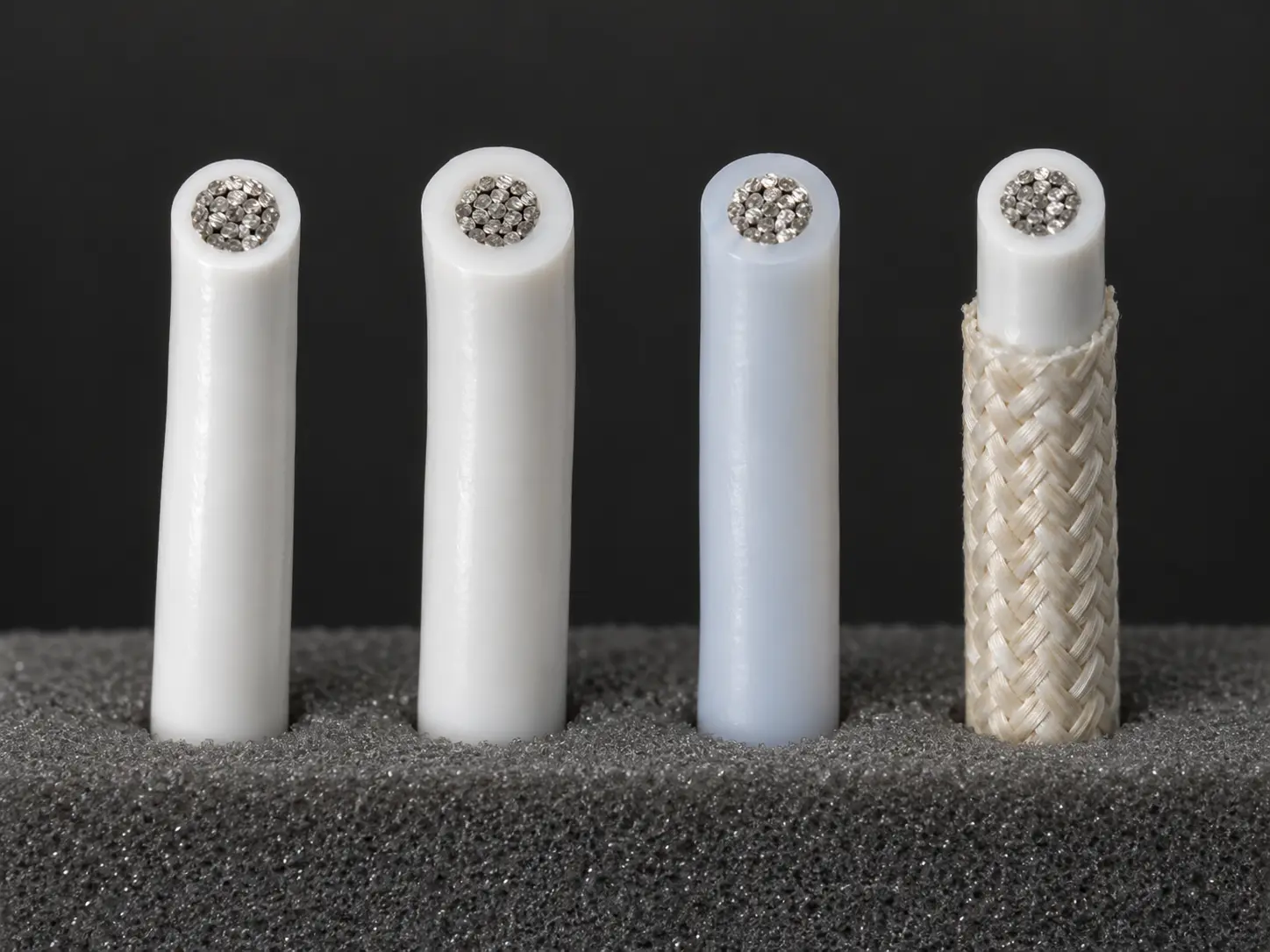
UL AWM Style 1659 is a single conductor with extruded insulation, rated 250°C and 600 Vac with Horizontal Flame, across a 26 AWG through 4/0 AWG conductor range in solid or stranded round form. The insulation is PTFE / TFE.
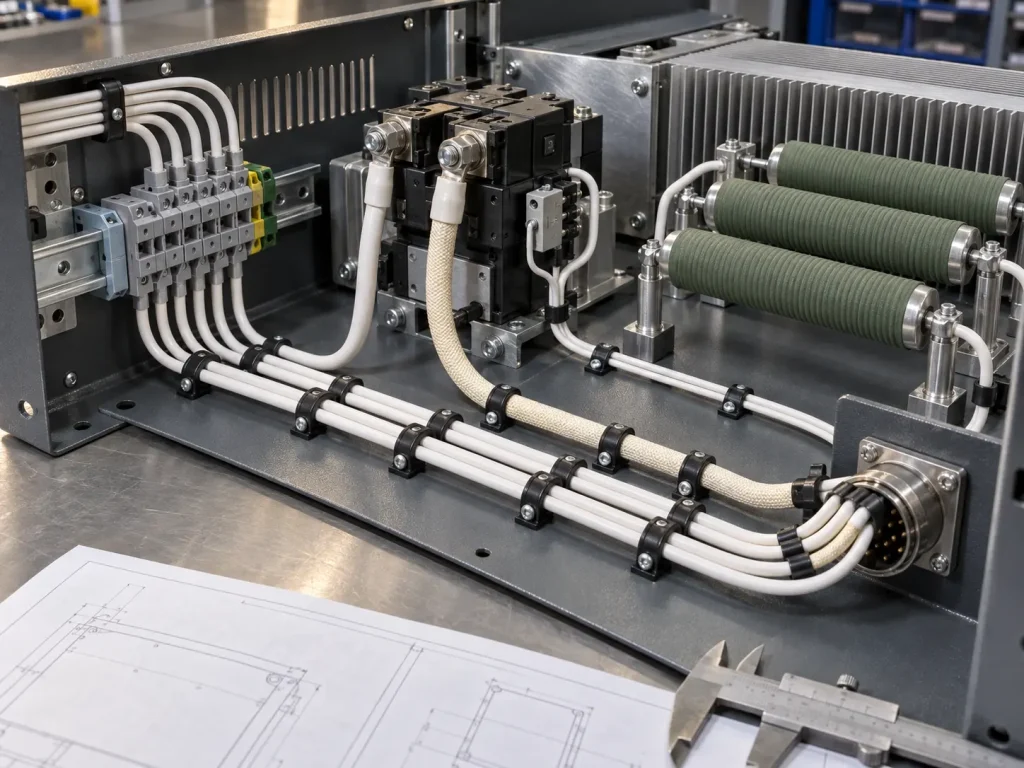
The official Use is internal wiring. OEM high-temperature electrical equipment is the commercial context of this page — internal component wiring within OEM electrical equipment, drawing-controlled internal leads, and internal power, control or component interconnections where Style 1659 is specified.
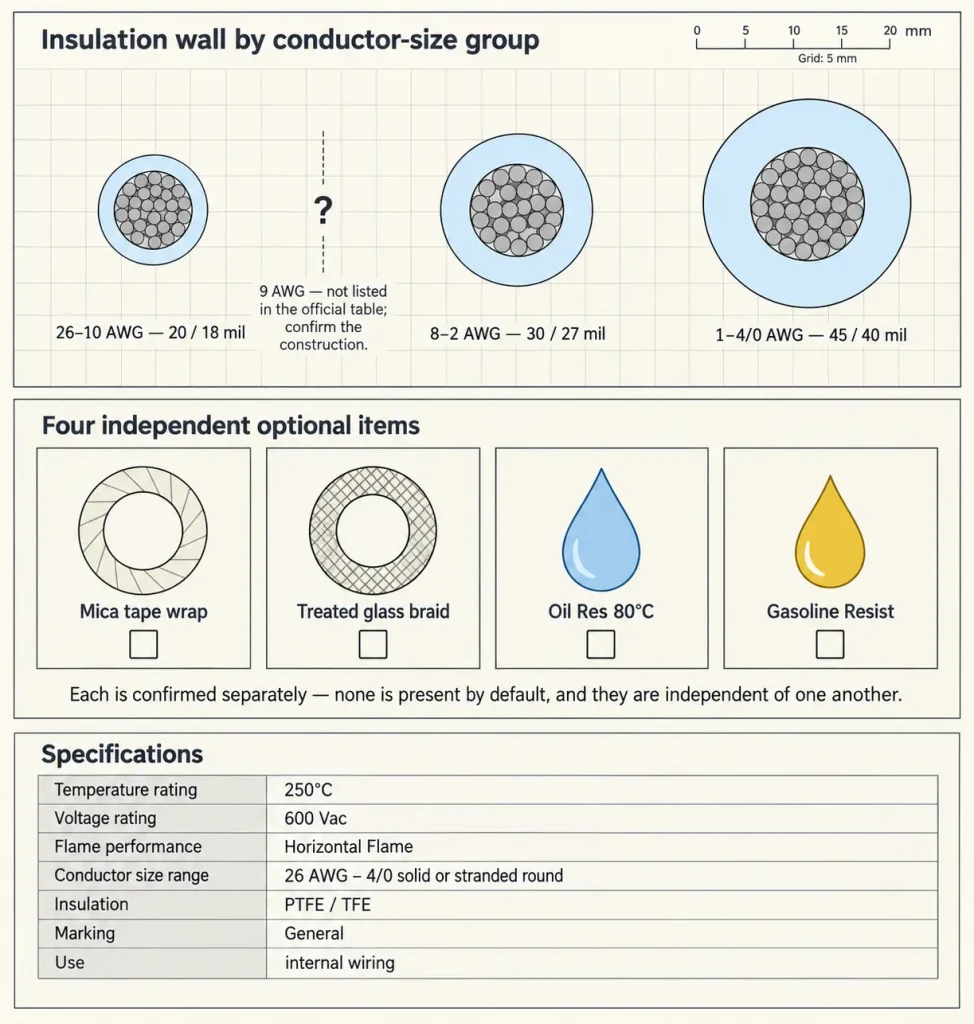
What makes this Style demanding to specify is not the ratings but the number of things left open. Insulation thickness varies by conductor-size group, and the Style carries four separate optional items: a mica tape wrap, a treated glass braid, an Oil Res 80°C rating and a Gasoline Resist rating. Each is confirmed individually, and none is present by default.
Verified UL Style 1659 Specification
| Parameter | Style-level information |
|---|---|
| UL AWM Style | 1659 |
| Construction | Single conductor with extruded insulation |
| Temperature | 250°C |
| Voltage | 600 Vac |
| Flame | Horizontal Flame |
| Optional rating | Oil Res 80°C |
| Optional rating | Gasoline Resist |
| Conductor range | 26 AWG–4/0 AWG |
| Conductor form | Solid or Stranded Round |
| Insulation | PTFE / TFE |
| 26–10 AWG insulation | 20 mil average / 18 mil minimum |
| 8–2 AWG insulation | 30 mil average / 27 mil minimum |
| 1–4/0 AWG insulation | 45 mil average / 40 mil minimum |
| Optional covering | Mica tape wrap |
| Optional braid | Treated glass braid |
| Marking | General |
| Official Use | Internal wiring |
Note on the thickness table: the official groups move directly from 26–10 AWG to 8–2 AWG. A specific 9 AWG construction should therefore be confirmed rather than inferred from either adjacent group.
The 9 AWG Gap
This is worth flagging separately because it is easy to read past.
The three insulation groups are 26–10 AWG, 8–2 AWG and 1–4/0 AWG. Nine AWG appears in none of them, and the table is not silently corrected here by widening the second group to 9–2 AWG or by assigning 9 AWG to either neighbour.
Where a drawing calls for 9 AWG, the applicable insulation construction is an RFQ confirmation item rather than a value to be looked up. Quoting it from an adjacent group would be an assumption, not a specification.
Three Insulation Groups, Not One Wall
The insulation requirement more than doubles across the Style: 20 mils minimum average at the fine end, 30 mils in the middle group, 45 mils at the top. Each group also carries a second figure — the minimum at any point — which is a separate requirement rather than a tolerance on the first.
So “UL1659 has 20 mil insulation” is accurate only for 26–10 AWG. Using 20/18 values for large conductors, or 30/27 values for the 1–4/0 group, misstates the construction in both directions. Identifying the group before quotation is part of specifying the wire.
PTFE / TFE
The Style lists the insulation as PTFE, TFE. The technical sections and specification table on this page use PTFE / TFE accordingly, even where the commercial description says PTFE wire.
PFA, FEP, ETFE and PVDF are not Style 1659 insulation materials and are not introduced here. Nor are PTFE and TFE presented as two independently verified constructions with different properties — the Style names them together, and distinguishing them would require supporting construction documentation.
Four Optional Items, Each Confirmed Separately
The Style permits an optional mica tape wrap, an optional treated glass braid, an optional Oil Res 80°C rating and an optional Gasoline Resist rating. Optional is the operative word in all four cases, and the four are independent of one another.
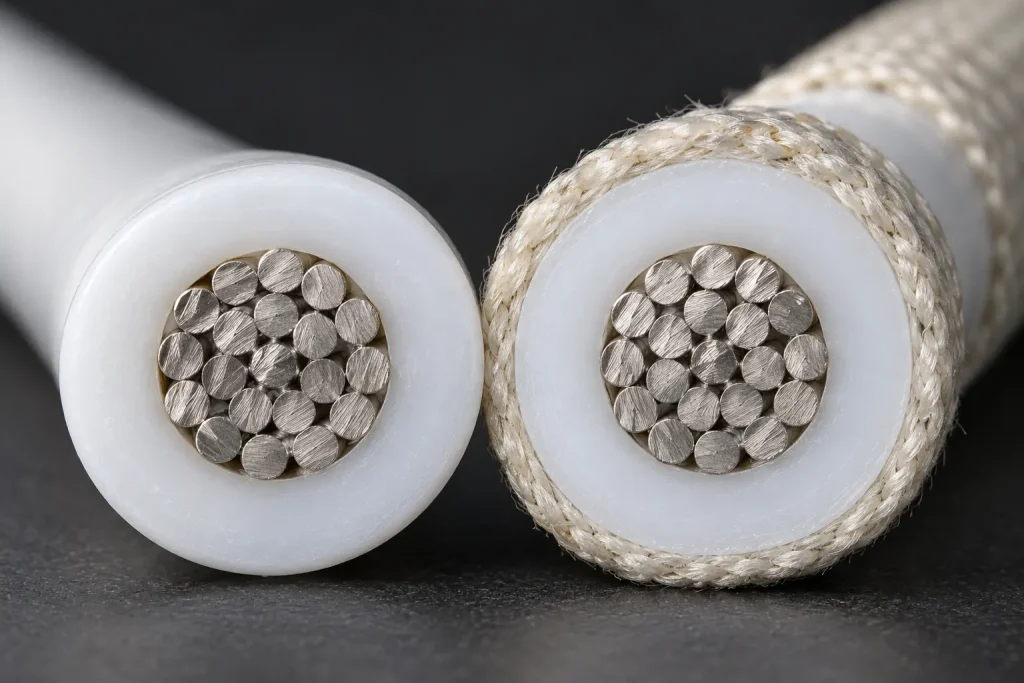
Mica tape wrap. It is not standard or mandatory, and nothing here claims it provides fire survival, 450°C operation, flame resistance beyond the verified Horizontal Flame designation, mechanical reinforcement, arc resistance or dielectric improvement. Those outcomes are not established by the Style data. Where mica tape is required, it is an order-specific construction feature.
Treated glass braid. Not every Style 1659 construction has one. No abrasion resistance, mechanical protection, higher temperature rating, flame improvement, flexibility or cut-through resistance is claimed for it — it is an optional Style construction feature, stated as such.
Oil Res 80°C. An optional Oil Res 80°C rating is included within the Style 1659 construction scope and should be confirmed when required. Style 1659 is not universally oil resistant, all constructions are not Oil Res rated, and no suitability for continuous oil immersion follows from the Style.
Gasoline Resist. Likewise an optional rating requiring confirmation for the ordered construction. Not all Style 1659 is gasoline resistant, and no suitability for fuel immersion is implied.
The practical consequence for an OEM drawing is that four separate yes/no answers belong in the specification, and a Style number carries none of them.
250°C and 600 Vac
250°C is a verified Style 1659 rating and can be stated directly. It is not restated here as 250°C continuous operation, continuous 250°C service, a guaranteed service life at 250°C, or a thermal cycling performance figure, and no durability claim is derived from it.
The voltage rating is 600 Vac. It is not written as 600 Vdc, 600V AC/DC, 600/1000V, 1000V or 600V peak. Where the shorthand 600V appears in commercial context it refers to this verified AC rating.
Horizontal Flame
The verified Style-level flame designation is Horizontal Flame. VW-1, FT1, vertical flame and flame-retardant performance under another named standard are not claimed here. Any additional flame requirement is separately confirmed, and the optional mica tape does not change the Style designation.
Conductor Range and Form
The verified range is 26 AWG through 4/0 AWG, solid or stranded round. That range represents permitted construction scope rather than inventory — it does not indicate that every AWG and every conductor form is automatically stocked or available in every combination of options.
Style 1659 does not establish copper, tinned copper, bare copper, silver-plated copper or nickel-plated copper, and it establishes no strand count, strand diameter or lay length. For OEM quotations, conductor material, finish and detailed stranding are confirmed according to the actual ordered construction or verified SKU documentation.
Specification Control for an OEM Drawing
Because this Style leaves more open than most, the clearest way to approach it is to work through what the drawing has to fix:
- UL Style and required AWG
- Solid or stranded round conductor
- Conductor material, conductor finish and stranding
- 250°C and 600 Vac requirements
- PTFE / TFE insulation
- Applicable insulation wall group
- Optional mica tape: yes / no
- Optional treated glass braid: yes / no
- Optional Oil Res 80°C: yes / no
- Optional Gasoline Resist: yes / no
- Finished OD and OD tolerance
- Colour and marking
- Installation location within the equipment and termination interface
- Quantity, packaging, destination and documentation
The Style fixes the ratings, the conductor range, the insulation material and the wall groups. Everything else on that list comes from the drawing or the ordered construction, and none of it is invented here.
Finished OD
Style 1659 does not specify one universal finished outside diameter, and finished OD is not calculated here from AWG plus minimum insulation wall.
Actual OD depends on the conductor construction, the actual conductor diameter, the extrusion, whether the optional mica tape is present, whether the optional treated glass braid is present, and manufacturing tolerance. With two independent optional layers available, the spread between constructions carrying the same Style number and AWG can be considerable.
For drawing-controlled OEM equipment, supply the maximum OD, the OD tolerance, and the available routing or terminal-entry dimensions where relevant. No standard OD value is published.
Current Rating
No universal ampacity or current rating is published for Style 1659, because the Style page establishes none. AWG alone is not sufficient to publish one universal current value, and no current table appears here.
Performance Characteristics Not Established by the Style
No figure is offered for dielectric strength beyond the 600 Vac rating, corona resistance, partial discharge, arc resistance, chemical-resistance values, abrasion resistance, flex life, bend radius, thermal cycling life, service life, UV resistance or water resistance.
PTFE and TFE have a general material reputation, and that reputation is not a substitute for Style-specific verified data. Only characteristics explicitly supported by the Style information appear on this page — which, notably, includes the optional oil and gasoline resistance ratings as options to confirm, and excludes everything else on the list above.
Application Boundary
The official Use is internal wiring. Style 1659 is not building wiring, field wiring, branch-circuit wiring, tray wiring, conduit wiring, raceway wiring, portable cord, external power cable or general installation cable.
OEM electrical equipment is the buyer context of this page and is not presented as the official Use wording. No OEM equipment type is separately UL-approved for Style 1659 through this Style, and no such approval is implied by naming an application.
What Style 1659 Does Not Define
- Conductor material and conductor plating
- Strand count and strand diameter
- Finished OD and OD tolerance
- Conductor resistance and ampacity
- Bend radius and flex cycles
- Colour
- Terminal, connector and cut length
- MOQ, stock and lead time
Each comes from the customer specification, verified SKU documentation, the applicable qualified manufacturing construction, or commercial confirmation.
Common Procurement Errors
- 20 mil insulation assumed for all sizes. It applies to 26–10 AWG only.
- 20/18 mil values used for large conductors. The 1–4/0 group requires 45/40.
- 30/27 mil values used for 1–4/0 AWG. That group belongs to 8–2 AWG.
- A 9 AWG thickness group invented. The official table has no 9 AWG entry.
- Mica tape assumed to be included. It is optional.
- Treated glass braid assumed to be included. Also optional, and independent of the mica tape.
- Every construction assumed oil resistant. Oil Res 80°C is an optional rating.
- Every construction assumed gasoline resistant. Gasoline Resist is likewise optional.
- Stranded tinned copper assumed. Conductor material is not set at Style level.
- One universal finished OD assumed. Two optional layers alone make that impossible.
- A universal ampacity published from AWG alone.
- Style 1659 treated as field or building wiring. The Use is internal wiring.
- Another fluoropolymer Style assumed interchangeable.
Style Selection
Each UL AWM Style has its own rating, construction, Use, insulation requirements and optional features. None is presented here as an automatic substitute for Style 1659 on the basis of insulation family, and a different Style is evaluated only against the buyer’s actual specification.
UL Marking and Documentation
Material is supplied as UL-recognized component wire where supplied under qualified manufacturing scope, and UL marking is applied according to the confirmed ordered construction. The Style-level marking designation is General.
CSA AWM, FT1, VW-1 and dual UL / CSA certification are not claimed here; any additional certification depends on the ordered construction. Applicable RoHS / REACH documentation can be confirmed according to the ordered construction.