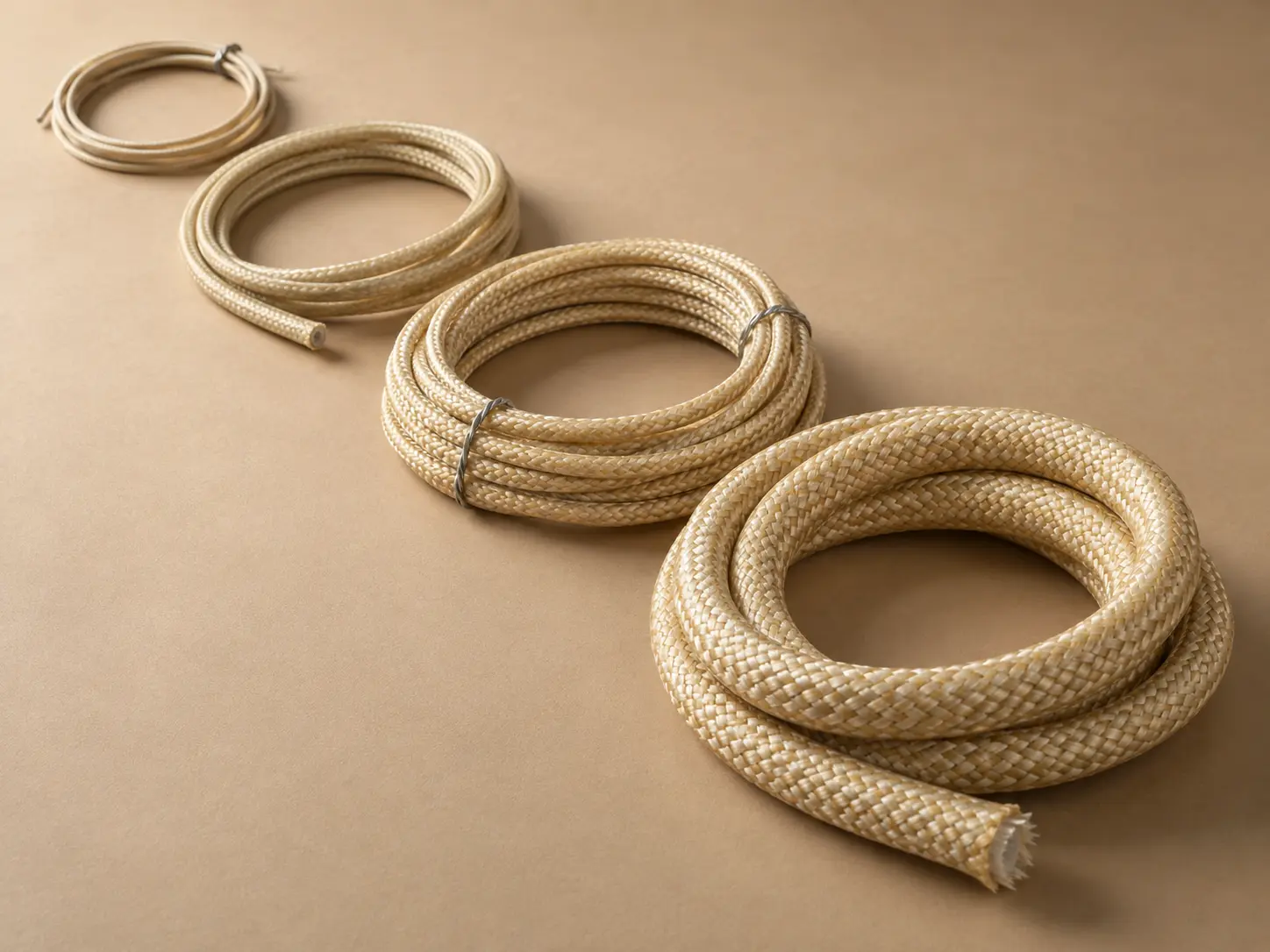
UL 5128 Oven Internal Wiring Overview
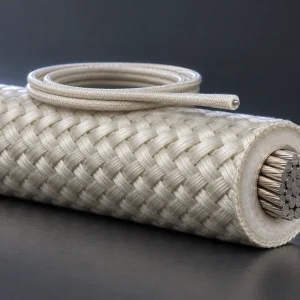
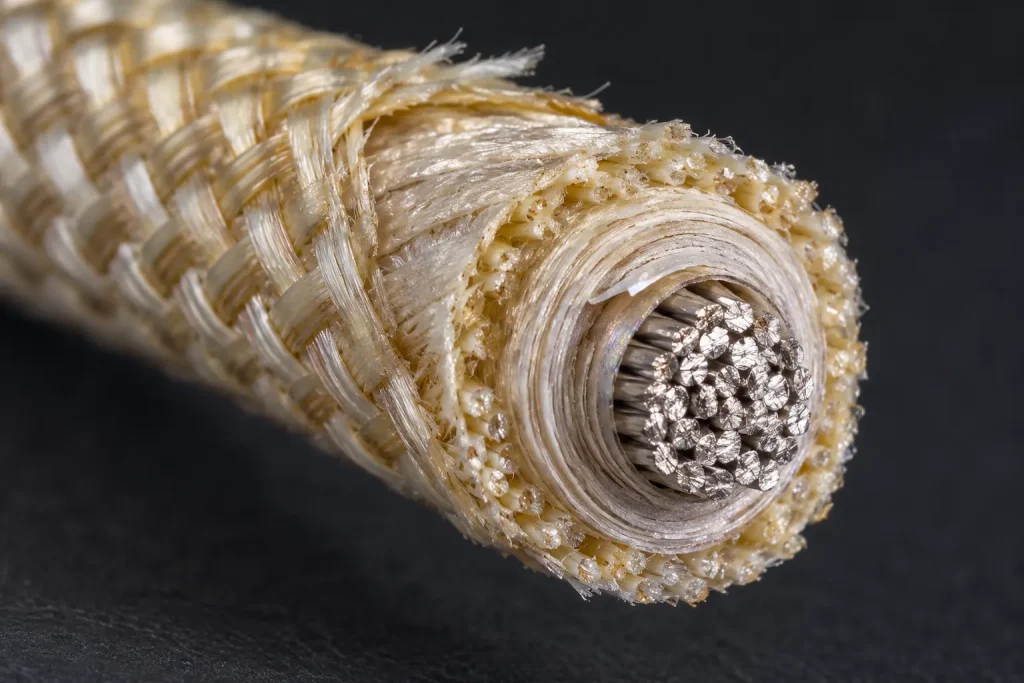
UL AWM Style 5128 is a single or multiple conductor construction with other-than-extruded insulation, covering 24–4 AWG conductors, solid or stranded, rated 450°C and 300 Vac with Horizontal Flame. The insulation system is non-extruded mica tape or a qualified mica composite, with a glass braid treated with silicone varnish or TFE finish over it.
This page covers that mica tape and treated glass braid construction across the full Style conductor range, for fixed protected internal wiring in ovens and other high-temperature equipment. The Style’s official Use carries two conditions that shape almost every sourcing decision on this product: the wiring must not be subjected to repeated flexing, and it must be protected from mechanical abuse. Both are addressed in their own sections below.
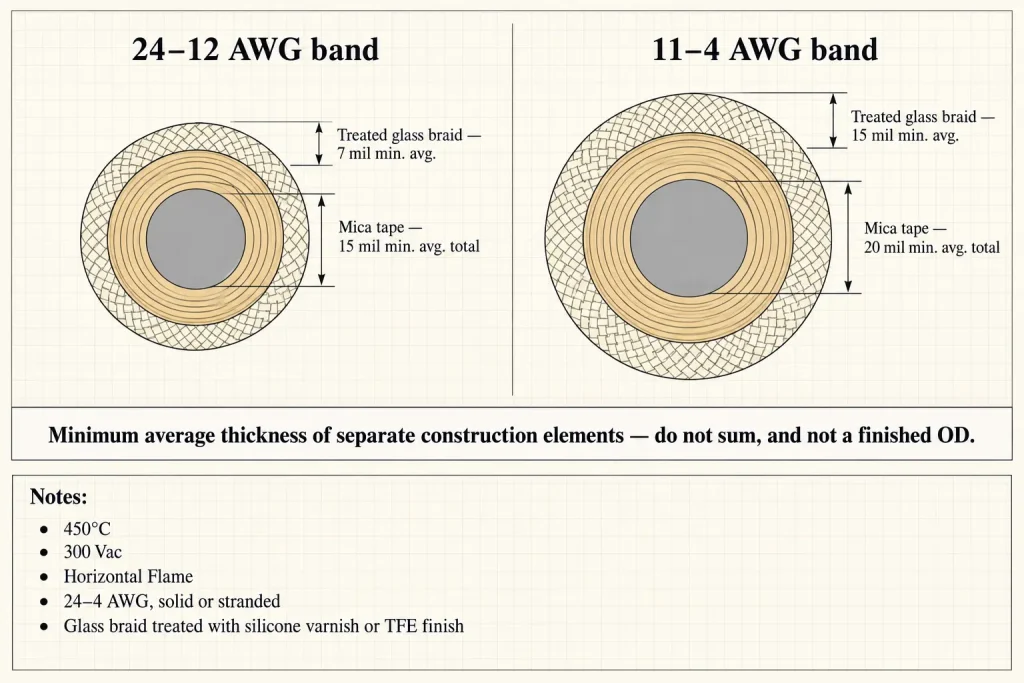
One structural point matters more than the AWG number itself. UL 5128 defines two conductor-size bands with different minimum average thickness requirements for the mica tape and the treated glass braid. Identifying which band applies is a necessary step in specifying this wire correctly.
UL 5128 Technical Specifications
| Parameter | Style-level information |
|---|---|
| UL AWM Style | 5128 (UL 758) |
| Description | Single or Multiple conductor with other-than-extruded insulation |
| Temperature rating | 450°C |
| Voltage rating | 300 Vac |
| Flame | Horizontal Flame |
| Conductor range | 24–4 AWG |
| Conductor form | Solid or stranded |
| Insulation | Non-extruded mica tape or qualified mica composite |
| 24–12 AWG mica tape | 15 mil minimum average total thickness |
| 24–12 AWG treated glass braid | 7 mil minimum average thickness |
| 11–4 AWG mica tape | 20 mil minimum average total thickness |
| 11–4 AWG treated glass braid | 15 mil minimum average thickness |
| Optional shield | Stainless steel alloy 304 braid over the treated glass braid |
| Optional assembly | Two or more conductors may be cabled together, maximum assembly OD 1.500 inches |
| Official Use | Internal Wiring of high-temperature equipment where not subjected to repeated flexing and protected from mechanical abuse. (The acceptability, including current-carrying capacity, has been determined by Underwriters Laboratories Inc.) |
The 24–12 AWG Construction Band
For conductors from 24 AWG through 12 AWG, UL 5128 specifies a 15 mil minimum average total thickness for the mica tape layers and a 7 mil minimum average thickness for the treated glass braid.
These are minimum average thickness requirements for the individual construction elements. They are not a finished insulation wall, a radial wall thickness, or a guaranteed dimension for any particular ordered construction. Nothing about this band is claimed here regarding wall thinness, compact OD, flexibility or ease of termination — those would require separate construction data that the Style-level information does not provide.
The 11–4 AWG Construction Band
For conductors from 11 AWG through 4 AWG, the requirements change: 20 mil minimum average total mica-tape thickness and 15 mil minimum average treated glass-braid thickness.
The larger figures follow the conductor-size band as defined by the Style. They do not by themselves indicate improved current capacity or mechanical strength, and no such claim is made here. Conductor size is still selected according to the actual equipment requirement, and the band follows from that selection rather than driving it.
Do Not Add the Two Thickness Figures Together
The mica tape and the treated glass braid are separate parts of the construction with separate minimum average thickness requirements. Adding 15 and 7, or 20 and 15, does not produce a finished insulation thickness and does not produce a finished outside diameter.
Both figures are also stated as minimum averages, not nominal or maximum values. Any dimensional requirement in an oven drawing needs to be checked against the approved construction rather than derived arithmetically from the Style table.
Mica Tape and Mica Composite Are Both Permitted
Style 5128 permits non-extruded mica tape or a mica composite, according to the qualified construction. This page discusses the mica tape and treated glass braid construction because that matches its identity, but a mica-composite construction is equally within the Style.
Where the BOM controls the insulation system, state which is required. Mica grade, mica chemistry, binder chemistry and tape overlap percentage are not established by the Style-level information and are not specified here.
Treated Glass Braid Is Not “Fiberglass Insulation”
The UL construction is a glass braid treated with silicone varnish or TFE finish, applied over the mica layer. The two are separate parts of the construction and should not be collapsed into a single description such as “fiberglass insulation.”
The glass braid alone is not presented here as providing the 450°C electrical insulation rating — the rating belongs to the qualified construction as a whole. Varnish thickness and TFE coating thickness are not defined at Style level and are not published on this page.
What the 450°C Rating Applies To
450°C is a verified Style 5128 rating and applies to the wire. It does not establish that an oven chamber may operate continuously at 450°C, that terminals or connectors are suitable at that temperature, that adjacent components are, or that a complete oven may be designed around a 450°C ambient.
Wire rating and oven thermal design are separate exercises. The temperature at the wire’s actual routing position, and the ratings of everything it touches or terminates into, are equipment-design questions.
300 Vac Is an AC Rating
The Style rating is 300 Vac. It should be written that way wherever precision matters, rather than as a generic “300V.” It should not be restated as 300 Vdc, as a 600V peak value, as an impulse voltage or as a dielectric test voltage without separate documentation, and this is not a 600V product.
Not Subjected to Repeated Flexing
The official Use restricts this Style to internal wiring where it is not subjected to repeated flexing. This is a use condition, not a caveat.
Style 5128 is therefore not offered here as flexible cable, high-flex wire, continuous-flex wire, a moving oven-door cable, drag-chain cable or robotic cable. A wire being bent once during assembly is a different matter from repeated movement in service, and routine installation bending does not make a product a repeated-flex product. No minimum bend radius is published on this page.
If the equipment involves repeated movement at the wire’s position — a hinged door, a moving rack, a retracting element — the application needs review before UL 5128 is treated as the answer. State whether movement occurs when sending the enquiry.
Protected From Mechanical Abuse
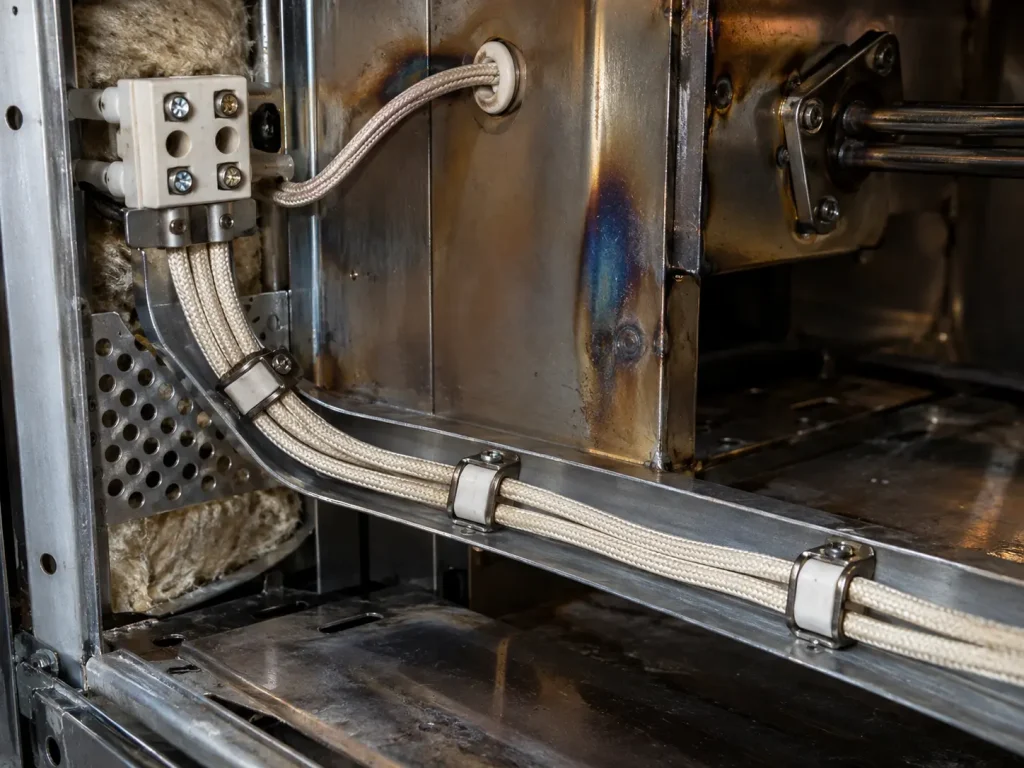
The second Use condition requires that the wiring be protected from mechanical abuse, which places a design obligation on the equipment rather than on the wire.
The mica and treated glass braid construction is not presented here as establishing suitability for exposed external wiring, abrasion without protection, impact, crushing, sharp-edge contact or open field installation. No mechanical rating is claimed. Where the routing path crosses a sheet-metal edge, a pass-through or a clamped position, the protection method is part of the equipment design and is worth stating in the enquiry.
AWG Is Not Ampacity
The official Use notes that acceptability, including current-carrying capacity, has been determined by Underwriters Laboratories. That is a statement about the Style’s evaluation. It is not a published ampacity table, and none is provided here.
No amperes by AWG, heater wattage by AWG, recommended oven power, current limit or conductor load chart appears on this page. Conductor size is selected according to the equipment design and the applicable acceptability requirements.
Finished OD Must Be Confirmed Separately
There is no single finished outside diameter for a 24 AWG, 12 AWG, 10 AWG or 4 AWG Style 5128 construction, and OD is not calculated here from the mica and braid thickness figures.
Where an oven drawing controls installation space, request nominal finished OD, maximum OD, tolerance, pass-through dimensions and the terminal or sleeve interface, taken from the approved construction.
Conductor Material and Finish Are RFQ Fields
The Style information used for this page establishes conductor AWG and solid or stranded form. It does not establish a universal conductor material or plating statement, so bare copper, tinned copper, nickel-plated copper and nickel conductor are none of them assumed here.
Where the BOM controls conductor material or finish, state it in the enquiry so it can be confirmed against the qualified construction.
Optional Stainless-Steel Braid
Style 5128 permits an optional shield: stainless steel, alloy 304, applied as a braid over the treated glass braid. It is a Style-supported construction field that must be specified when required — state yes or no.
No performance characteristic is attributed to it here. Chemical resistance, abrasion resistance, EMI shielding performance, grounding performance, corrosion resistance and mechanical protection rating are not established by the Style-level information and would need separate evidence for a specific construction.
Optional Multi-Conductor Assembly
Two or more qualified conductors may be cabled together, with a maximum assembly outside diameter of 1.500 inches. A mica-glass binder and/or fiberglass fillers may be employed, and the assembly may have an overall treated glass braid.
This is an option within the Style, not a description of every Style 5128 product. Single-conductor and multi-conductor requirements should be stated explicitly in the enquiry.
Oven Routing Questions Worth Answering Before Quotation
For an oven internal-wire enquiry, the details that most often decide whether a construction matches are these:
- Fixed routing location and proximity to the heat zone
- Mechanical protection method at the routing position
- Conductor AWG and routing envelope
- Termination location
- Whether movement occurs during operation
- Required lead length
No temperature gradient or distance recommendation is offered here — those come from the equipment’s own thermal design.
Termination Requirements
The Style does not define a universal terminal type, lug, crimp contact, strip length, connector or termination temperature rating, and none are invented here. Where prepared leads are required, supply the applicable terminal or assembly drawing.
Official AWM Use Boundary
The official Use for Style 5128 is: Internal Wiring of high-temperature equipment where not subjected to repeated flexing and protected from mechanical abuse. (The acceptability, including current-carrying capacity, has been determined by Underwriters Laboratories Inc.).
Industrial and OEM oven assemblies are examples of high-temperature equipment where an appropriate Style 5128 construction may be evaluated when those Use conditions are satisfied. That is not the same as being UL approved specifically for ovens, UL certified oven wire, or an approved oven-heating-element wire, and none of those descriptions is used here.
What UL 5128 Does Not Automatically Define
- Conductor material and conductor plating
- Strand count, strand diameter and conductor resistance
- Ampacity
- Finished OD and dimensional tolerance
- Minimum bend radius and repeated-flex life
- Terminal and connector compatibility
- External mechanical protection
- Reel length, MOQ, stock and production lead time
Common Oven-Wire RFQ Mismatches
- Style 5128 specified, AWG omitted. The Style covers 24–4 AWG across two construction bands.
- Called “450°C wire” with no voltage stated. The Style rating is 450°C and 300 Vac.
- 24–12 AWG and 11–4 AWG bands confused. Different minimum average thickness requirements apply.
- Mica thickness plus braid thickness treated as finished OD. They are separate minimum averages, not a dimension.
- Movement condition not stated. The Use excludes repeated flexing.
- Mechanically exposed routing position. The Use requires protection from mechanical abuse.
- Conductor material assumed uniform. Material and finish are not fixed by this Style summary.
- Terminal information and maximum OD both omitted. Neither can be inferred where routing is restricted.
Each of these leaves the enquiry matching more than one construction, or matching a construction the Use conditions do not support — both of which surface later as approval problems rather than quotation problems.
RFQ Checklist
- UL AWM Style 5128
- Conductor AWG; solid or stranded
- Conductor material / finish, if controlled
- 450°C requirement
- 300 Vac requirement
- Mica tape or other required qualified construction
- 24–12 AWG or 11–4 AWG construction band
- Optional stainless-steel braid required: yes / no
- Single conductor or multi-conductor requirement
- Finished OD / maximum OD, if controlled
- Wire identification or color requirement
- Fixed routing location
- Repeated movement present: yes / no
- Mechanical protection method
- Terminal / connector details
- Cut length or reel requirement
- Quantity, packaging and destination
- Documentation requirements
- Actual oven / high-temperature equipment application context
Applicable RoHS / REACH documentation can be confirmed according to the ordered construction. UL marking is applied according to the confirmed ordered construction, and material is supplied as UL-recognized component wire under qualified manufacturing scope.