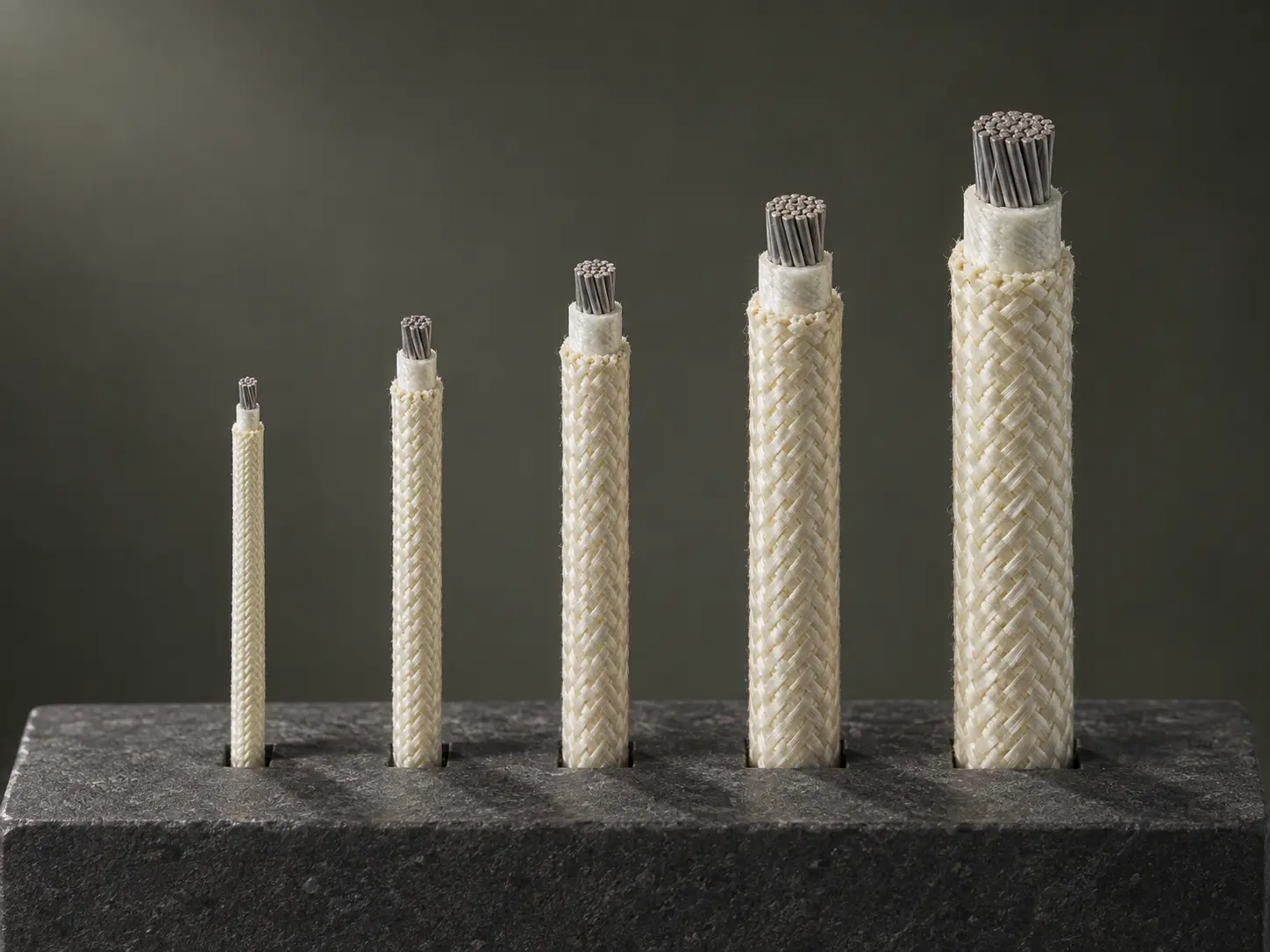
UL AWM Style 5360 Single-Conductor Mica Wire for Vietnam and Indonesia Sourcing
This page covers sourcing the 200°C rating option of UL AWM Style 5360 mica tape and glass braid wire for buyers in Vietnam and Indonesia. It is written for procurement teams, distributors, maintenance buyers and equipment OEM buyers whose drawing, existing wire specification or approved BOM calls for Style 5360 at 200°C.
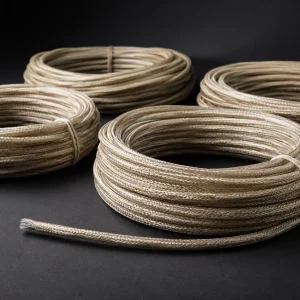
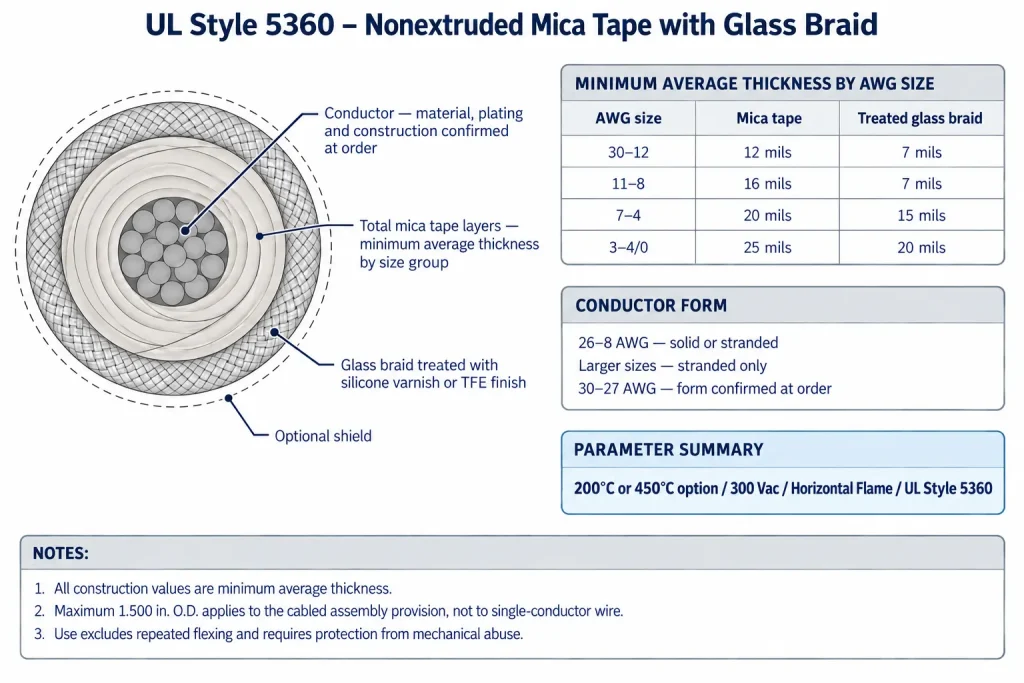
Style 5360 is described in the Style record as a single conductor with other-than-extruded insulation. The insulation is nonextruded mica tape with glass braid, the braid treated with silicone varnish or TFE finish, and the voltage rating is 300 Vac with a Horizontal Flame designation. The conductor range runs from 30 AWG to 4/0 AWG, with conductor form limits that differ by size.
One point needs stating at the top, because it is often misreported: Style 5360 is not a 200°C-only Style. The record provides a 200°C or 450°C rating option. This page focuses on sourcing the 200°C option, and the 450°C option is disclosed here accurately rather than redirected to a different Style.
Technical Reference — UL AWM Style 5360
| Parameter | Requirement |
|---|---|
| UL AWM Style | 5360 |
| Product Description | Single conductor with other-than-extruded insulation |
| Page-Specific Temperature Option | 200°C |
| Other Style Temperature Option | 450°C |
| Voltage Rating | 300 Vac |
| Flame | Horizontal Flame |
| Style Conductor Range | 30 AWG–4/0 AWG |
| Conductor Form | Solid or stranded in sizes 26–8 AWG; larger sizes stranded only. The record states no form for 30–27 AWG, and none is inferred here |
| Insulation | Nonextruded mica tape with glass braid |
| Glass Braid Treatment | Silicone varnish or TFE finish |
| Cabled Assembly Provision | A single conductor, or two or more conductors described by the Style, may be cabled together with a maximum O.D. of 1.500 inches |
| Assembly Elements | A mica glass binder and/or fiberglass fillers may be employed; the assembly may have an overall treated glass braid |
| Optional Shield | 36–30 AWG Type “A” Nickel or 27 percent minimum nickel coated copper |
| Marking | General |
| Official Use | Internal wiring where not subjected to repeated flexing and protected from mechanical abuse, and where the acceptability, including current-carrying capacity, has been determined by Underwriters Laboratories Inc. |
| AWG size | Total mica tape layers — minimum average thickness | Treated glass braid — minimum average thickness |
|---|---|---|
| 30–12 | 12 mils | 7 mils |
| 11–8 | 16 mils | 7 mils |
| 7–4 | 20 mils | 15 mils |
| 3–4/0 | 25 mils | 20 mils |
Ten points to clarify about the tables above:
- 200°C is this page’s sourcing focus. The Style rating is 200°C or 450°C, and the applicable option is confirmed for the ordered construction.
- Neither rating carries a duty or service-duration qualifier in the record.
- 300 Vac is the Style voltage rating. No DC rating appears in the record.
- The conductor form limits differ by size, and the 30–27 AWG form is not stated in the record. For those sizes the form is confirmed against the proposed qualified construction.
- All eight construction values are minimum average thickness requirements. The record states no minimum-at-any-point value for this Style.
- The thickness groups are size-dependent, and values from one group do not apply to another.
- The braid treatment is silicone varnish or TFE finish. It is a braid finish, not the primary insulation identity.
- 1.500 inches is the maximum O.D. under the cabled assembly provision. It is not the outer diameter of ordinary single-conductor wire.
- The optional 36–30 AWG Type “A” Nickel or 27 percent minimum nickel coated copper item belongs to the shield provision, not to the main conductor.
- Main conductor material, plating, strand count, strand diameter, lay length, finished OD, conductor resistance, bend radius and ampacity are not defined by the Style.
The 200°C Option and the 450°C Option
The Style record gives 200°C or 450°C as rating options for Style 5360. A construction carries the option confirmed for it, so an enquiry that names only the Style leaves the rating open.
This page targets the 200°C option because that is the sourcing requirement it serves. That focus does not narrow the Style: it is not correct to describe Style 5360 as a 200°C Style, to call 200°C its maximum, or to say that a 450°C requirement must move to a different Style. Where a buyer in Vietnam or Indonesia needs the 450°C option, it is available within Style 5360 itself and is quoted as such.
Neither option is described here as continuous, sustained or continuous-duty, and no service life or thermal margin is derived from either. A high temperature rating is also not a fire-survival property: the flame designation in the record is Horizontal Flame, and VW-1, FT1, vertical flame, fire-resistant and circuit-integrity descriptions are not part of this record.
300 Vac Is a Rating, Not a Circuit Assignment
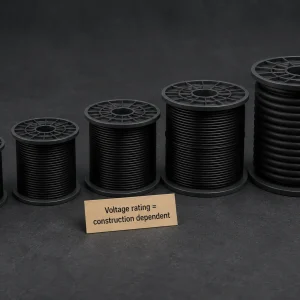
The voltage rating is 300 Vac. It is not written as 300 Vdc or as a combined AC/DC rating.
A voltage rating describes the wire. It does not establish that the wire belongs in any particular circuit, so this page does not conclude that 300 Vac makes Style 5360 suitable for millivolt sensor signals, 24 V DC circuits, 120 V or 230 V control circuits, ignition circuits or valve circuits. Those are equipment-design decisions made against the customer’s own specification. The Style record assigns no circuit function to the wire at any voltage level.
Nonextruded Mica Tape with Glass Braid in Four Size Groups
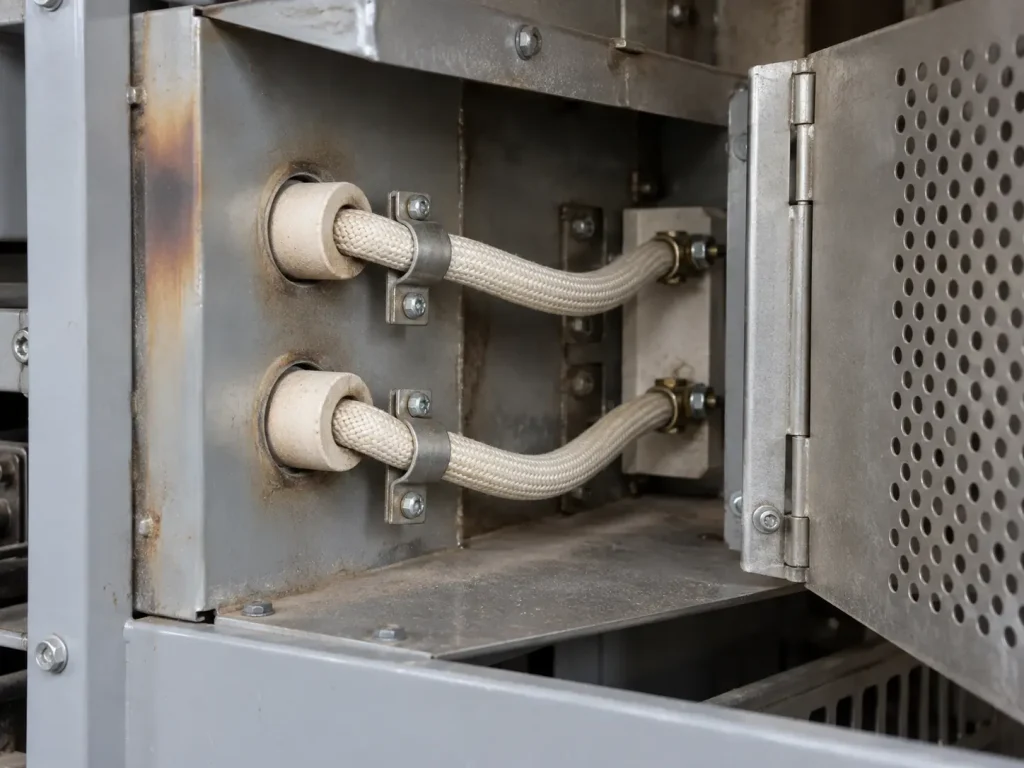
The insulation is one construction: nonextruded mica tape with glass braid. Both elements belong to the definition, and describing the product as mica tape alone leaves out half of it.
The requirement splits into four conductor-size groups. For 30–12 AWG, total mica tape layers must meet 12 mils minimum average and the treated braid 7 mils. For 11–8 AWG the figures are 16 mils and 7 mils. For 7–4 AWG they are 20 mils and 15 mils. For 3–4/0 AWG they are 25 mils and 20 mils. Note that the mica requirement increases at every step while the braid requirement stays at 7 mils across the first two groups, so the two are not read as a single proportional build.
Every figure is a minimum average value. The record contains no minimum-at-any-point requirement for Style 5360, so quoting one would add a requirement the Style does not contain. The braid is treated with silicone varnish or TFE finish, and this page does not restate those treatments as silicone insulation, PTFE insulation or a TFE primary insulation system.
Conductor Range and the Form Limits
The Style range is 30 AWG–4/0 AWG. A listing that shows only a handful of mid-range sizes understates it, and the range is not narrowed here to the sizes a legacy page happened to list.
Conductor form is where Style 5360 is more specific than many PVC Styles, and the wording matters:
- sizes 26–8 AWG: solid or stranded
- sizes larger than 8 AWG, through 4/0 AWG: stranded only
- sizes 30–27 AWG: the record states no form, and none is assumed on this page
For a 30–27 AWG requirement, the conductor form is confirmed against the proposed qualified construction rather than answered from the Style text. Flattening all of this into “30 AWG–4/0 AWG, solid or stranded” would misstate two of the three cases.
Style scope is also not inventory. Not every size, rating option or configuration is regularly produced or held, and commercial availability is confirmed per enquiry.
Main Conductor Material Versus the Optional Shield
The Style does not define the main conductor material or finish. Copper, tinned copper, nickel-plated copper, bare copper, silver-plated copper and nickel conductors are constructions a buyer may specify, not properties this page can assert for Style 5360 generally.
The optional 36–30 AWG Type “A” Nickel or 27 percent minimum nickel coated copper item in the record belongs to the shield provision. Reading it as the conductor specification produces a claim the record does not support, and it is not a recommendation for conductor plating at 200°C or at 450°C. If a particular main conductor material or finish is required, it is specified in the RFQ and confirmed separately.
The same applies to strand count, strand diameter and lay construction, and to any stranding class or flexibility grade, none of which appear in the record.
The Cabled Assembly Provision
The record states that a single conductor, or two or more conductors described by the Style, may be cabled together with a maximum O.D. of 1.500 inches. A mica glass binder and/or fiberglass fillers may be employed, and the assembly may have an overall treated glass braid.
Two readings follow. First, the 1.500 inch figure is a limit on that cabled configuration. It is not the outer diameter of ordinary single-conductor wire and says nothing about the OD of any particular size. Second, the binder, the fillers and the overall braid are configuration-dependent elements, not automatic inclusions, so a buyer requiring any of them states it in the RFQ.
This page primarily represents single-conductor wire sourcing, and the provision is disclosed here as Style scope.
“Single Conductor” Is a Product Description, Not a Routing Method
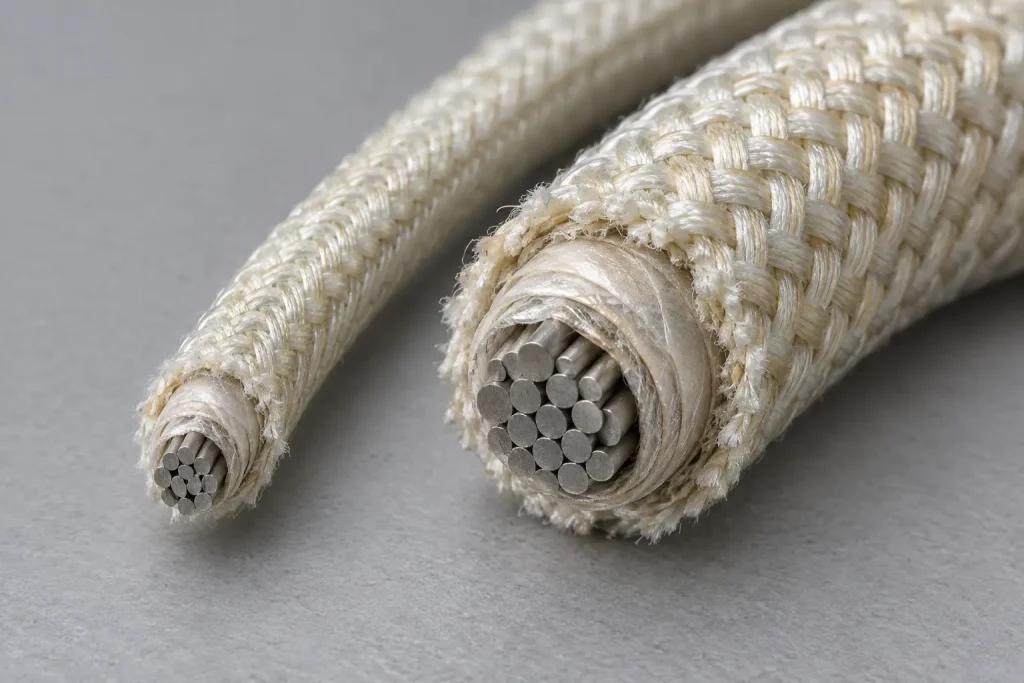
The Product Description is “Single conductor with other-than-extruded insulation.” That describes the product, not an installation architecture. The Style record says nothing about one penetration per circuit, one conduit per wire, maintenance access, circuit isolation or fault tracing, and it does not present separate routing as a property of the Style. Those are equipment-design choices made by the buyer, and the cabled assembly provision above shows that the Style itself does not confine the product to separate individual runs.
Official Use and Its Three Limitations
The official Use is “Internal wiring where not subjected to repeated flexing and protected from mechanical abuse, and where the acceptability, including current-carrying capacity, has been determined by Underwriters Laboratories Inc.”
Repeated flexing is excluded. Style 5360 is not presented for continuous flexing, dynamic cable routing, drag chains, hinged routes, moving equipment doors or robotic motion.
Protection from mechanical abuse is required. The wire is not presented for unprotected exposed routing, abrasive locations, field cable or portable cable, and the glass braid does not remove this requirement.
Acceptability, including current-carrying capacity, is determined by Underwriters Laboratories Inc. This page therefore publishes no ampacity, no current-by-AWG table and no heater-current guidance, and derives no current value from conductor size, the temperature option or the 300 Vac rating.
The Use is also not extended to building or field wiring, external equipment wiring or portable cord. Heating equipment such as ovens, kilns, furnaces and dryers may be the buyer’s context, but the Style record does not establish thermocouple, RTD, sensor, control-system, ignition, pharmaceutical or validation suitability. Thermocouple extension and compensating cables in particular depend on controlled conductor alloy and thermoelectric characteristics that this Style record does not address at all.
Dimensions, Resistance and Bending
The Style publishes minimum average thicknesses. It does not publish a finished outer diameter for any size, an OD tolerance, a conductor resistance or a minimum bend radius.
Finished OD depends on the actual conductor construction and diameter, how the mica tape is applied, the braid construction, any optional shield, and manufacturing dimensions. Calculating it from a generic conductor diameter plus the minimum thicknesses does not produce a valid product dimension. Where routing clearance controls the purchase, buyers should state the maximum finished OD, the OD tolerance and the available clearance, and the proposed construction is then checked against those figures.
Where conductor resistance is controlled, the buyer states the limit and it is verified against the proposed construction rather than taken from a generic table. Where bending is critical, supplier-specific handling data for the actual construction is requested, since no bend radius appears in the record.
Vietnam and Indonesia Sourcing Context
Vietnam and Indonesia are the commercial setting for this page: buyer locations, OEM sourcing markets, maintenance procurement markets, component distribution markets and shipment destinations. Enquiries typically come from buyers requesting the 200°C option by AWG, from buyers supplying an existing wire specification, drawing or BOM, from buyers who require a specific qualified mica and glass braid construction, and from buyers controlling finished OD or an assembly requirement.
No regional maintenance practices, end-user industries or named facilities are claimed for either market. Destination city or port, Incoterm, packaging and quantity are quotation variables handled per enquiry rather than published as fixed terms.
Bulk Wire Versus Processed Leads
This page represents Style 5360 wire supplied as bulk wire. Supply does not automatically include cutting, stripping, crimping, terminals, connectors, sleeving, finished leads or assemblies. Any processing requirement must be specified separately with lengths, termination details and drawings.
What Style 5360 Does and Does Not Define
Style 5360 defines:
- 200°C or 450°C rating options
- 300 Vac voltage rating
- Horizontal Flame
- conductor range 30 AWG–4/0 AWG, with form limits by size
- nonextruded mica tape with glass braid, the braid treated with silicone varnish or TFE finish
- minimum average mica tape thickness of 12, 16, 20 and 25 mils by size group
- minimum average treated glass braid thickness of 7, 7, 15 and 20 mils by size group
- a cabled assembly provision with a maximum O.D. of 1.500 inches, with optional binder, fillers and overall braid
- an optional shield provision
- Marking: General
- the Use limitations on repeated flexing, mechanical abuse and acceptability including current-carrying capacity
Style 5360 does not universally define:
- main conductor material, plating, strand count, strand diameter or lay length
- conductor form for 30–27 AWG
- finished OD, OD tolerance or minimum bend radius
- conductor resistance, ampacity or current rating
- metric cross-section for any size
- thermocouple, RTD, sensor, PLC, ignition or valve circuit suitability
- equipment ambient temperature at any routing position
- an installation routing architecture
- colour or identification, reel length, MOQ, stock, lead time, production capacity or shipping term
Common Procurement Errors
- Describing Style 5360 as a 200°C Style, or treating 200°C as its maximum rating.
- Writing “200°C continuous” or adding any duty qualifier.
- Sending a 450°C requirement to a different Style on the assumption that Style 5360 cannot carry it.
- Describing the insulation as mica tape only, leaving out the glass braid.
- Quoting a minimum-at-any-point value the record does not contain.
- Applying one size group’s mica or braid thickness across the whole range.
- Assuming every size is solid or stranded, or inferring a form for 30–27 AWG.
- Assuming the main conductor is tinned or nickel-plated copper.
- Reading the optional shield provision as the main conductor specification.
- Publishing generic mm² cross-sections, strand counts or conductor resistance as SKU data.
- Treating 1.500 inches as the outer diameter of single-conductor wire.
- Deriving ampacity from conductor size, the temperature option or the 300 Vac rating.
- Presenting the wire as thermocouple, RTD, PLC or sensor wire.
- Using the wire where it is subjected to repeated flexing.
- Relying on the braid instead of protecting the wire from mechanical abuse.
- Assuming every size, rating option and configuration is stocked.
RFQ Checklist — Style 5360 for Vietnam and Indonesia
Style, rating and construction
- UL AWM Style 5360 requirement
- Required temperature option: 200°C or 450°C
- Required AWG within 30 AWG–4/0 AWG
- 300 Vac requirement
- Required conductor form where the Style permits a choice
- Whether the optional shield is required
- Whether a cabled assembly is required, with the number of conductors and the required overall construction
Conductor
- Main conductor material and finish / plating
- Strand count and strand diameter, if controlled
- Maximum conductor resistance, if controlled
Dimensions
- Maximum finished OD and OD tolerance, if controlled
- Available routing clearance, if relevant
Application references
- Exact internal-wiring location
- Confirmation that repeated flexing is not expected
- Confirmation that the wire will be protected from mechanical abuse
- The circuit requirement for engineering review, rather than a self-derived ampacity
- Customer drawing, BOM and existing wire specification
Commercial
- Colour or identification requirement, if controlled
- Quantity and packaging
- Vietnam or Indonesia destination city or port and requested Incoterm
- Required compliance and shipping documentation
UL Marking and Documentation
CableApex is an international sales and export company and does not hold a UL File for Style 5360. Supplied wire is UL-recognized component wire where supplied under a qualified manufacturing scope, with UL marking according to the confirmed ordered construction. The Style record lists Marking as General.
Applicable RoHS / REACH documentation can be confirmed according to the ordered construction.
Commercial, origin, compliance and transport documents are identified during quotation and confirmed according to the order. They are not supplied as a fixed package with every shipment.