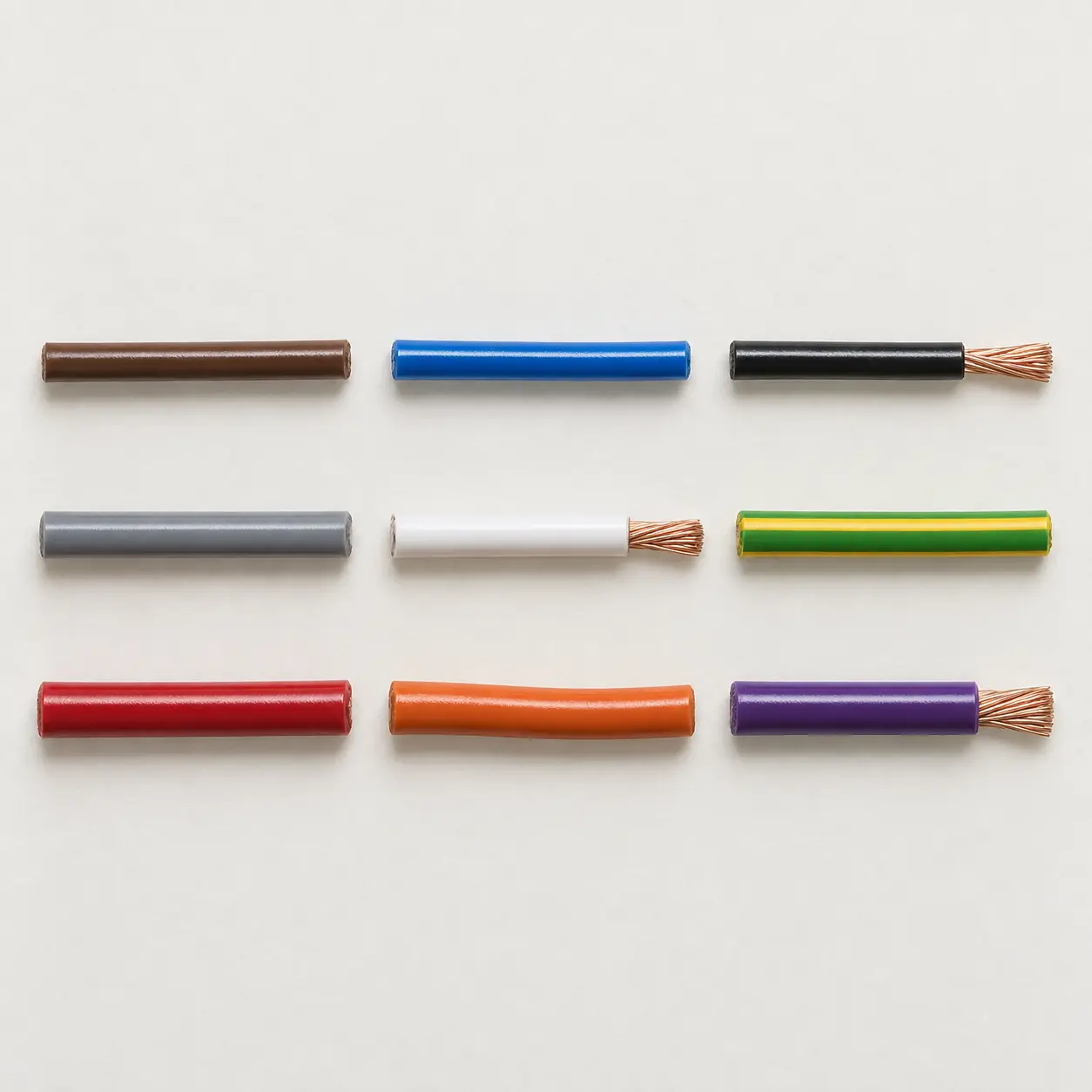
UL 3266 for Internal Wiring Inside OEM Appliances
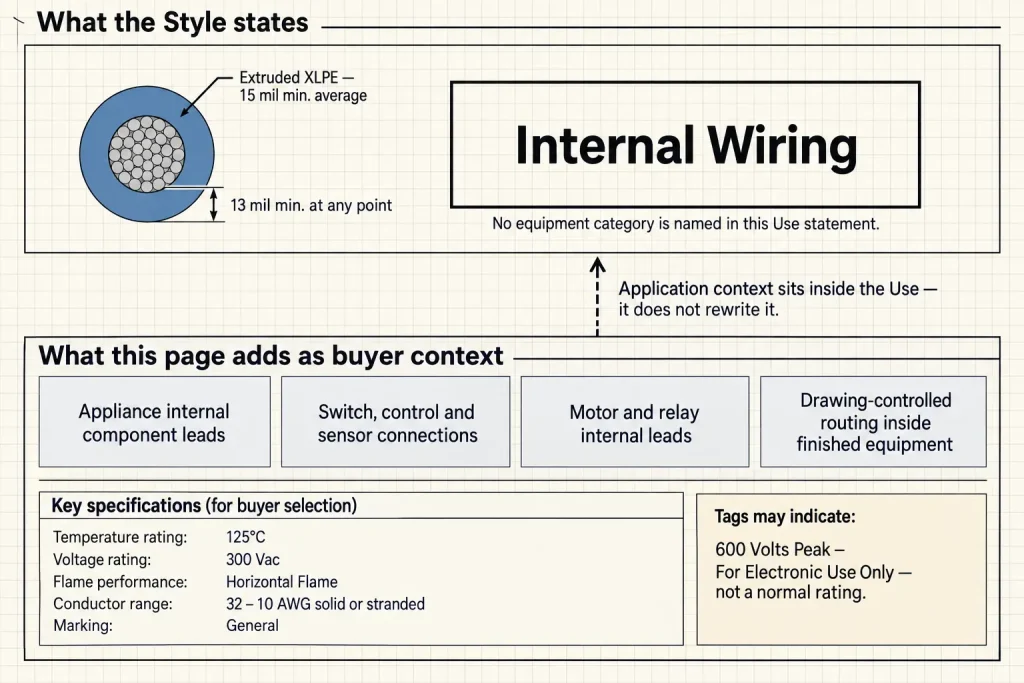
UL AWM Style 3266 is a single conductor with extruded insulation, rated 125°C and 300 Vac with Horizontal Flame, across a 32 AWG through 10 AWG conductor range in solid or stranded form. The insulation is extruded XLPE at 15 mils minimum average thickness and 13 mils minimum at any point.
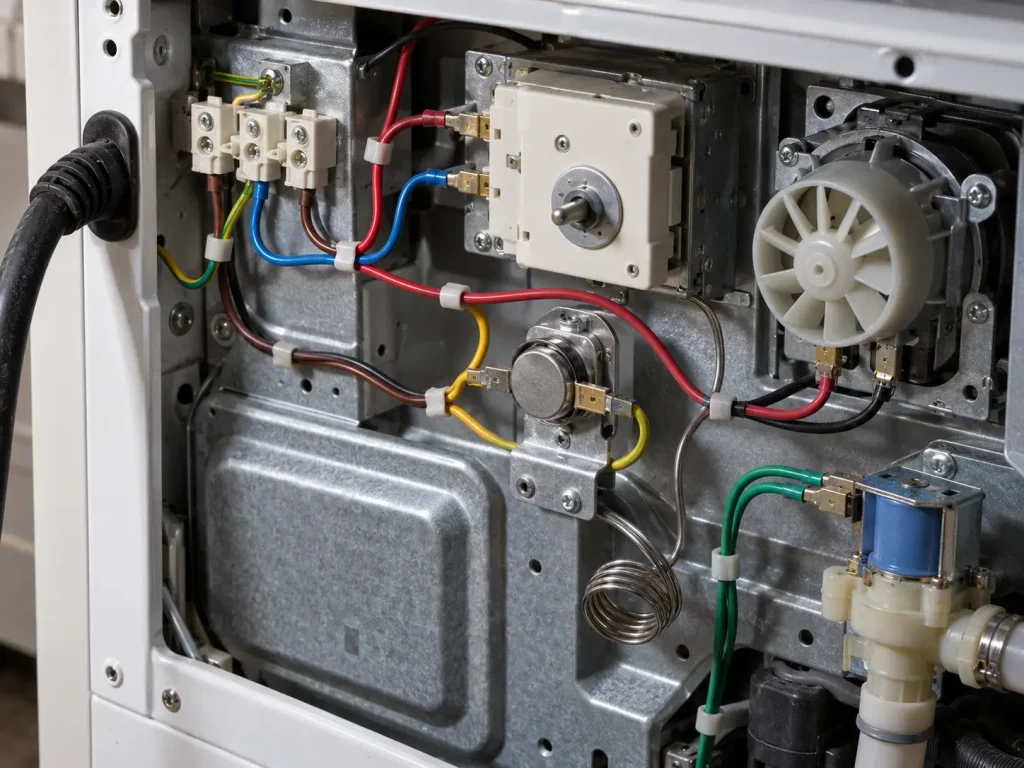
This page covers that construction as internal component wiring inside OEM appliances — leads running between switches, controls, motors, relays, sensors, terminals and other internal components where the appliance design specifies an appropriate internal wire.
The official Use for Style 3266 is internal wiring. Appliance internal wiring is the purchasing context of this page, and the section below explains why that distinction is worth reading carefully.
The Official Use Is “Internal Wiring” — Not “Internal Wiring of Appliances”
These two phrases look close enough to be treated as the same thing in a specification, and they are not.
The Use stated for Style 3266 is internal wiring. It names no equipment category. Other AWM Styles do name one — some state internal wiring of appliances, some name specific equipment types directly in the Use wording — and for those Styles the equipment category is part of the official statement. For Style 3266 it is not.
The practical consequence is that appliance manufacturers may specify Style 3266 as internal wire inside finished equipment, and doing so is a design decision made against the appliance’s own requirements. It is not something the Style wording confers. Nothing here should be read as UL approval for appliances, as UL-certified appliance wire, as Style 3266 being approved for all appliances, or as UL listing appliance wiring as the Style 3266 Use.
Writing “Internal Wiring of Appliances” into a specification as though it were the UL wording introduces an error that can survive several revisions before anyone checks it.
Verified UL Style 3266 Construction
| Parameter | Style-level information |
|---|---|
| UL AWM Style | 3266 |
| Construction | Single conductor with extruded insulation |
| Temperature rating | 125°C |
| Voltage rating | 300 Vac |
| Flame | Horizontal Flame |
| Conductor size range | 32 AWG–10 AWG |
| Conductor form | Solid or Stranded |
| Insulation | Extruded XLPE |
| Minimum average insulation thickness | 15 mils |
| Minimum thickness at any point | 13 mils |
| Marking | General |
| Official Use | Internal Wiring |
| Optional tag — not a voltage rating | Qualifying tagged constructions may indicate: 600 Volts Peak – For Electronic Use Only |
The two insulation figures are separate requirements: 15 mils governs the average across the wall, 13 mils sets a floor at every individual point on it.
The 600 Volts Peak Tag Is Not a Normal Rating
The Style information states that tags may indicate “600 Volts Peak – For Electronic Use Only.” That notation accompanies the Use statement, not the rating.
The normal Style rating is 300 Vac. Style 3266 is not described here as rated 600V, as “300V / 600V wire”, as 600 Vac, as 600V continuous, or as 600V appliance wire. The tag does not apply universally to every Style 3266 construction, and where an appliance design references the peak notation, both the qualification of the ordered construction and the fit of the application to “for electronic use only” are confirmed against that construction.
125°C Is a Wire Rating, Not an Appliance Temperature
Style 3266 is rated 125°C. That figure describes the wire.
It does not follow that every internal location in an appliance operates at 125°C, and 125°C is not an appliance operating temperature. Internal temperatures vary substantially between one position and another inside the same product — near a motor, beside a control board, adjacent to a heat-generating component, or in still air away from all of them.
The equipment designer evaluates the temperature at the actual wire location against the required wire specification. The rating also does not guarantee service life at any appliance hot spot, and no service life, thermal-aging life or thermal-cycle figure appears on this page.
Where a position genuinely requires a higher-temperature construction, that is a different specification question and a different product family, not something this Style answers by margin.
Conductor Requirements Are RFQ Fields
The Style-level evidence establishes the 32–10 AWG range and the solid or stranded form. It establishes nothing else about the conductor.
Copper, tinned copper, bare copper, silver-plated copper and nickel-plated copper are none of them established at Style level, and no strand count, strand diameter, conductor diameter, lay length, conductor resistance or ampacity is stated here. Where an appliance drawing requires a specific conductor material, plating or stranding, each is a confirmation field in the enquiry.
Selecting AWG
Style 3266 permits 32 AWG through 10 AWG. No gauge is chosen here, and no ampacity figure is published, because the Style record establishes none.
The required conductor size comes from the appliance electrical design, the applicable engineering requirements and the buyer’s specification. Conductor size does then affect dimensional and termination requirements downstream — a heavier conductor changes what fits and what terminates — but those consequences are evaluated against the actual construction and the drawing, and no values for them are stated here.
Dimensional Confirmation
The 15 mil and 13 mil figures are insulation-wall requirements. They do not establish one universal finished outside diameter for Style 3266, and no OD value is published or derived from them.
Style 3266 is also not described here as universally thin-wall, compact or small-diameter wire, and no automatic fit advantage is claimed for it in compact appliances.
Where appliance routing space is controlled, confirm the maximum finished OD, routing-channel clearance, connector cavity, terminal barrel interface, clip or grommet clearance and bundle-space limitation. These are RFQ or drawing-controlled requirements against the ordered construction.
Terminations and Appliance Assembly
Style 3266 alone does not determine terminal, connector, ferrule, crimp specification, strip length, wire seal, cut length or finished lead assembly.
Where the requirement is processed leads rather than bulk wire, those details are separately specified and confirmed. Cutting, stripping, crimping, terminals, connectors and finished harnesses are not presented here as automatically included.
Bulk Wire and a Finished Appliance Lead
This product page concerns Style 3266 single-conductor wire.
It should not be confused with a finished appliance wiring harness, a multi-core cable, a terminated appliance lead, a power cord or a building wire. A finished appliance harness may contain multiple individual wires plus terminals, connectors and additional components controlled by the appliance design — the single conductor is one input to that assembly, not the assembly itself.
Application Boundary
The official Use is internal wiring. Style 3266 is not building wiring, field wiring, branch-circuit wiring, facility wiring, conduit wiring, raceway wiring, tray cable, an external appliance power cord, portable cord or general power distribution cable.
An appliance being an OEM electrical product does not expand that Use, and the external cord that supplies an appliance is a separate product category from the wire inside it.
What Style 3266 Does Not Define
- Conductor material and conductor plating
- Strand count and conductor resistance
- Ampacity
- Finished OD and OD tolerance
- Colour
- Cut length, terminal, connector and harness layout
- Packaging, reel length, MOQ, stock and lead time
Each must be confirmed through the ordered construction, the customer drawing or separately verified SKU documentation.
Substitution
UL 3271 and UL 3321 are separate AWM Styles with their own verified constructions and ratings, and they are not presented here as automatically more suitable whenever a higher voltage is required. Silicone and fluoroplastic constructions are likewise not offered as better choices on the basis of material preference alone.
A substitution assessment considers the required UL Style, the normal voltage rating, the temperature rating, the AWG, the conductor requirements, the insulation construction, the dimensions, the termination requirements, the marking and the equipment specification. Material family on its own is not evidence of interchangeability.
Common RFQ Mismatches
- “UL3266 appliance wire” requested with no AWG. The Style spans 32–10 AWG.
- Tinned copper assumed from the Style number. Conductor material is not set at Style level.
- Style 3266 read as appliance-approved wire. The Style names no equipment category.
- Official Use written as “Internal Wiring of Appliances.” The Use is internal wiring.
- 15 mil insulation read as one fixed OD. It is a wall requirement, not a diameter.
- “600 Volts Peak” read as a normal 600V rating. The normal rating is 300 Vac.
- Bulk wire not distinguished from a finished appliance harness. Different scopes.
- Terminal or connector requirements not provided. The Style determines none of them.
- Maximum OD omitted where internal space is controlled. Fit cannot be confirmed without it.
Appliance RFQ Checklist
- UL AWM Style 3266 requirement
- AWG within 32–10 AWG
- Solid or stranded requirement
- Required conductor material
- Required conductor finish or plating
- Detailed stranding, if controlled
- Insulation colour
- Finished OD or maximum OD, if controlled
- Appliance type
- Internal installation location
- Temperature requirement at the wire location
- Customer drawing or existing specification
- Cut length, if applicable
- Strip length
- Terminal or connector interface
- Marking requirement
- Quantity
- Packaging requirement
- Destination
- Required compliance documentation
These are buyer inputs. No configuration is presented as automatically available.
UL Marking and Documentation
Material is supplied as UL-recognized component wire where supplied under qualified manufacturing scope, and UL marking is applied according to the confirmed ordered construction. The Style-level marking designation is General.
CSA AWM, FT1, VW-1 and dual UL / CSA certification are not claimed here; any additional certification depends on the ordered construction. Applicable RoHS / REACH documentation can be confirmed according to the ordered construction.
Flame Classification
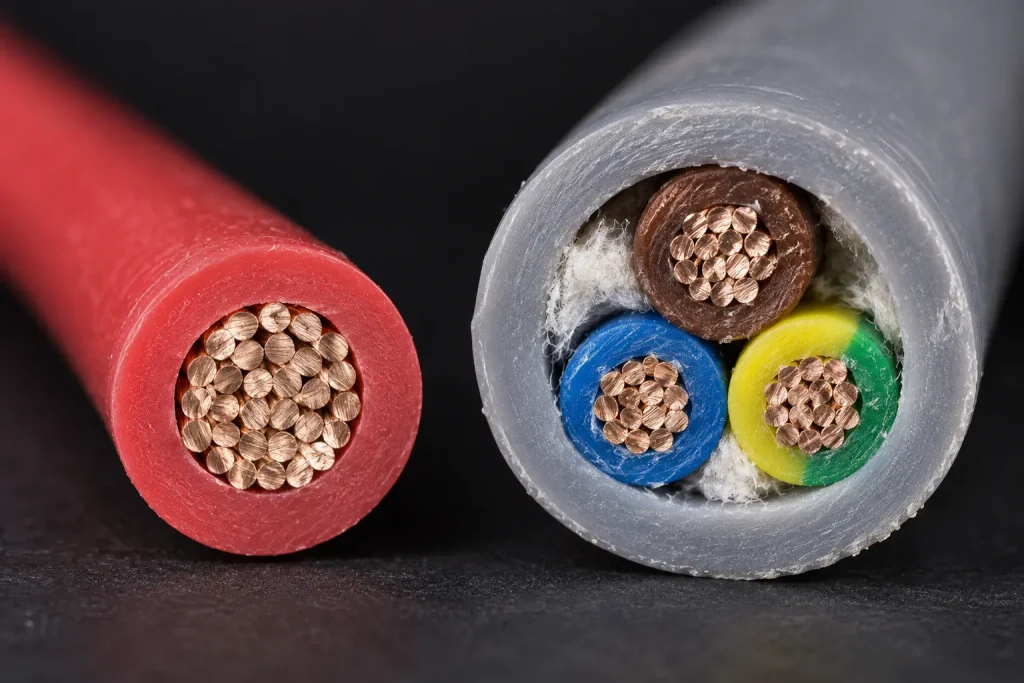
The verified Style-level flame designation is Horizontal Flame. VW-1 and FT1 are separate classifications, are not claimed here, and Horizontal Flame is not converted into either. Any separately confirmed vertical-flame construction is order-specific rather than a universal Style 3266 rating.