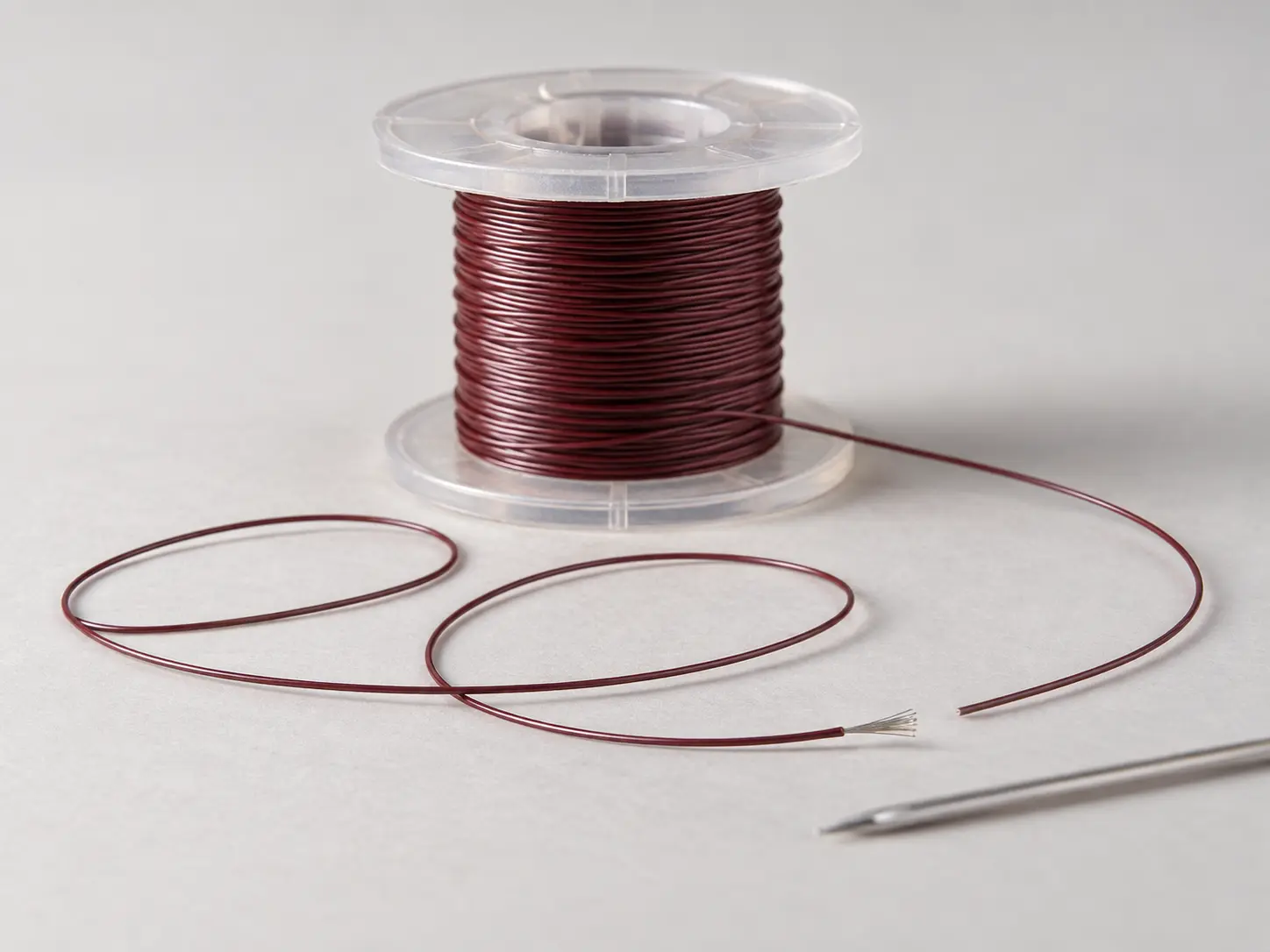
UL 1007 in 26 AWG for Fixed Internal Appliance Wiring
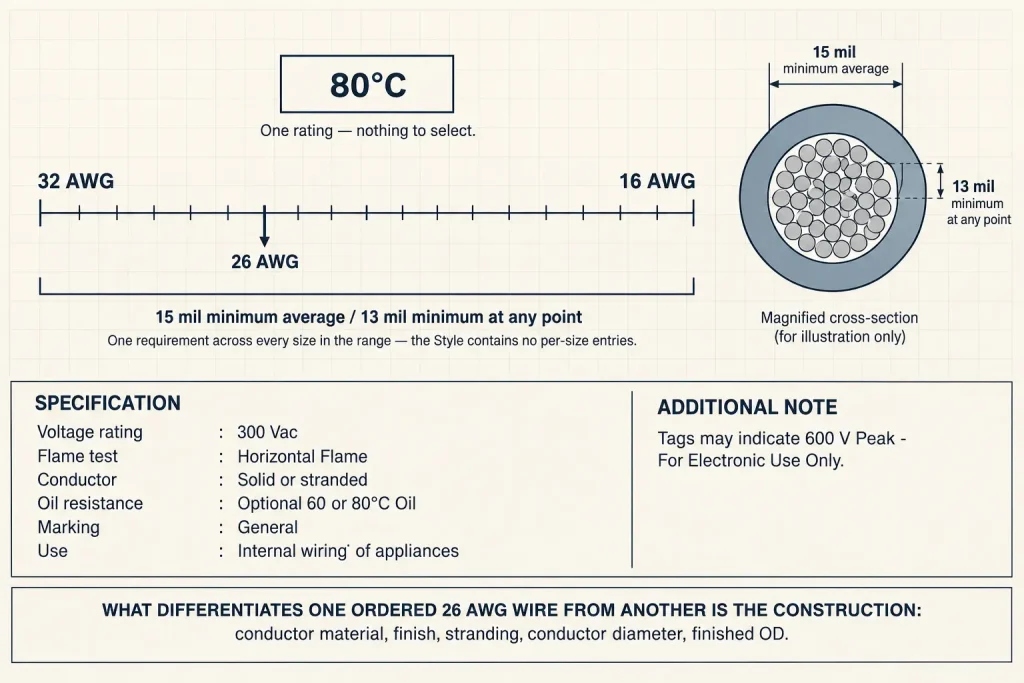
UL AWM Style 1007 is a single conductor with extruded PVC insulation, rated 80°C and 300 Vac with Horizontal Flame. The Style conductor range is 32 AWG through 16 AWG, solid or stranded, with an insulation requirement of 15 mils minimum average thickness and 13 mils minimum at any point.
This page is positioned around one conductor size: 26 AWG. It sits within that range, and the Style-level requirements that apply to it are exactly the ones listed above.
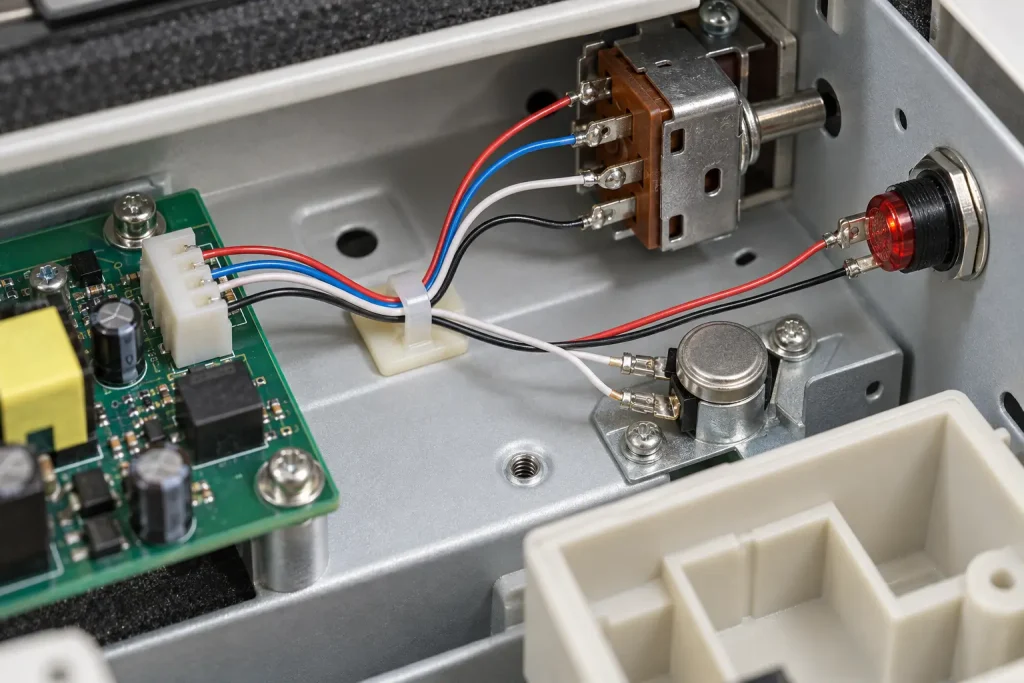
The official Use is internal wiring of appliances, and every application statement here stays inside it.
Verified UL Style 1007 Specification
| Parameter | Style-level information |
|---|---|
| UL AWM Style | 1007 |
| Construction | Single Conductor with Extruded Insulation |
| Temperature rating | 80°C |
| Voltage rating | 300 Vac |
| Flame | Horizontal Flame |
| Optional oil rating | 60°C or 80°C Oil |
| Style conductor range | 32 AWG–16 AWG |
| Conductor form | Solid or Stranded |
| Insulation | Extruded PVC |
| Minimum average thickness | 15 mils |
| Minimum thickness at any point | 13 mils |
| Marking | General |
| Official Use | Internal wiring of appliances |
| Optional tag — not a voltage rating | 600 V Peak – For Electronic Use Only |
The complete Style range appears above for accuracy. It does not mean this page is intended to cover every conductor size.
The Style Has No Size-Specific Parameters
This is worth stating plainly, because it determines what a size-specific page can honestly offer.
Style 1007 applies one insulation requirement across its entire conductor range. A 26 AWG construction and a 16 AWG construction carry the same 15 mil minimum average and 13 mil minimum-at-any-point figures, the same single 80°C rating, the same 300 Vac rating, the same permitted conductor forms, the same optional Oil rating and the same Use. The Style record contains no per-size entries at all.
So nothing in the Style distinguishes 26 AWG from any other size within the range. What distinguishes one ordered 26 AWG wire from another is the construction behind it — the conductor material, the finish, the stranding, the actual conductor diameter and the resulting finished OD, none of which the Style fixes.
A request reading “UL1007 26 AWG” has therefore identified a Style and a size, and has not yet identified a product.
What Fine-Gauge Procurement Actually Turns On
Since the Style-level requirements are settled, the questions that decide a 26 AWG order sit entirely outside them.
Stranding. At fine gauges, strand construction varies considerably between constructions and is frequently controlled by the drawing because of crimp compatibility. The Style specifies none, so it belongs in the enquiry.
Actual conductor diameter. A solid 26 AWG conductor and a stranded 26 AWG conductor do not occupy the same space, and stranded configurations differ among themselves. The Style establishes no conductor diameter.
Termination interface. Fine-gauge terminals, contacts and connector cavities have their own conductor requirements, and none of them is answered by the Style number.
Finished OD. This follows from the conductor construction and the extrusion rather than from the insulation requirement, and it is the figure most often needed and least often supplied.
Those four fields are where a 26 AWG enquiry becomes quotable. No values for any of them are published here.
What the 15/13 Mil Requirement Means
The two figures are separate requirements. The first governs the average across the wall; the second sets a floor at every individual point on it.
Neither is a nominal value, and neither is a finished diameter. The requirement is not a 15 mil nominal wall, not an exact 15 mil wall and not a uniform insulation thickness — a compliant construction satisfies both minimums without producing one fixed figure.
Why 26 AWG Is Specified
The basis for selecting 26 AWG is documentary: the customer drawing, the existing wire specification, the appliance electrical design, or the approved bill of materials.
No electrical or physical justification is offered here. Style 1007 publishes no ampacity, and no current value is derived from AWG alone. Nothing on this page states that 26 AWG suits a particular current, suits low-current circuits, saves space, routes more densely, fits compact assemblies or is appropriate for any named circuit function.
Wire-size suitability is established by the complete appliance design. This page supplies the Style-level requirements that apply once the size has been fixed elsewhere.
No Universal Current Rating
No ampacity is published for Style 1007 in 26 AWG. No maximum amps, continuous current, recommended current, signal-level suitability, power capacity or wattage figure appears here.
Style 1007 Product iQ defines no universal ampacity, and a current value is not inferred from the conductor size.
26 AWG Appliance Contexts
The commercial contexts this page addresses are 26 AWG fixed internal appliance leads, component-to-component appliance wiring, drawing-controlled internal appliance wiring specifying 26 AWG, internal appliance connections where the drawing calls for 26 AWG, and bulk 26 AWG wire for appliance internal lead production.
Not every appliance uses 26 AWG, and UL does not separately approve any of these examples through the Style. They describe why a buyer arrives at this page, not what the Style certifies.
The official Use does not extend to building wiring, field wiring, branch circuits, tray, conduit, raceway, control panels, machine wiring, external appliance cords or general electrical equipment wiring.
Conductor Material, Finish and Stranding
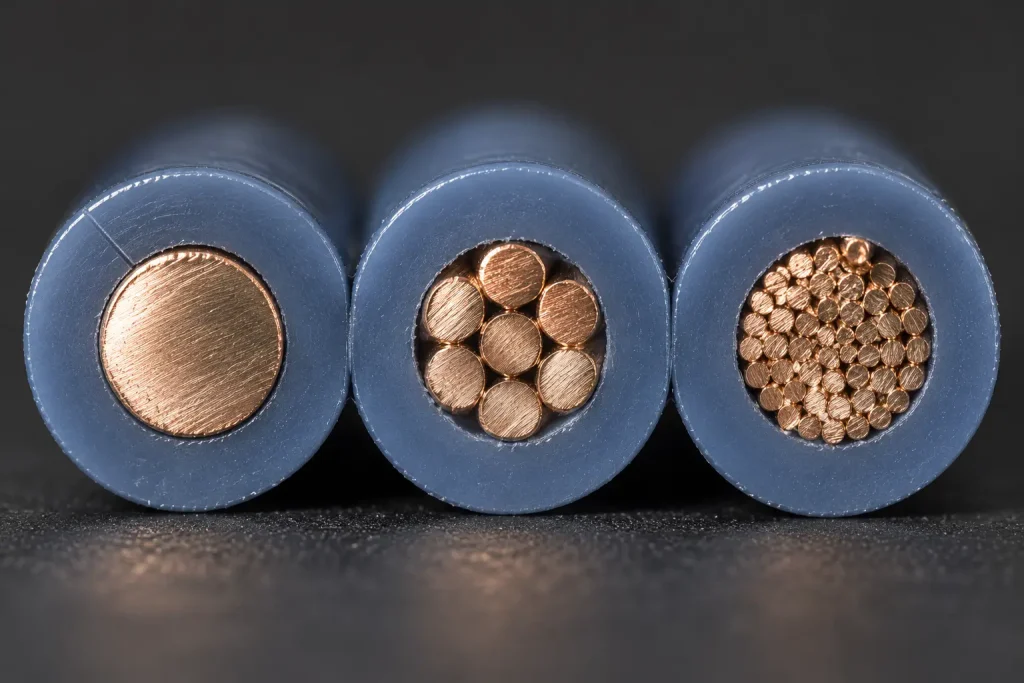
Style 1007 establishes the conductor size range and the solid or stranded form. It establishes nothing else about the conductor.
Copper, bare copper, tinned copper, silver-plated copper and nickel-plated copper are none of them established at Style level. So 26 AWG stranded copper and 26 AWG tinned copper are not presented here as the universal construction of this page — each is an RFQ requirement confirmed against the applicable qualified construction.
No strand count is published — not 7/34, not 19/38, not any other configuration — and no strand diameter or conductor diameter is stated. No verified SKU datasheet has been supplied for this page, so detailed stranding remains an RFQ field. No ohm/km, ohm/1000 ft or maximum DC resistance value is published either, since AWG alone does not establish one.
Solid or Stranded
Both forms are permitted at Style level, so the 26 AWG product is not assumed here to be stranded.
The wire is not described as flexible, high-flex or extra-flexible, because the Style data establishes no flex class, flex-cycle rating or bend radius. Conductor form should be stated in the enquiry where the drawing fixes it.
Temperature and Voltage
Style 1007 has one verified temperature rating: 80°C. There is no 90°C or 105°C option and nothing to select, so temperature does not appear as an RFQ confirmation field on this page.
The verified voltage rating is 300 Vac. Style 1007 is not described here as 600V wire, 600 Vac wire or 300/600V wire, and the rating is not characterised as low voltage, since that is a relative term rather than a Style parameter.
The 600 V Peak Tag
The Style permits a tag stating 600 V Peak – For Electronic Use Only. That is not the normal continuous voltage rating.
Normal Style rating: 300 Vac.
Optional tag: 600 V Peak – For Electronic Use Only.
It is not written here as 600 Vac, 600V continuous, 300/600V wire or a 600V appliance wire, and not every construction carries it. Where a design references the peak notation, the ordered construction is what confirms whether it applies.
PVC Insulation
The verified insulation is extruded PVC. No PVC hardness, flame-retardant formulation, abrasion performance, chemical resistance, UV resistance, water resistance or cut-through performance figure is published, and no performance is inferred from generic PVC properties.
Optional Oil Rating
Style 1007 includes an optional 60°C or 80°C Oil rating. Not all Style 1007 constructions carry it, and PVC does not automatically confer the optional UL rating.
Where oil exposure is relevant at the lead position, the applicable optional rating is specified in the enquiry and confirmed for the ordered construction.
Horizontal Flame
The verified Style designation is Horizontal Flame. VW-1, FT1 and vertical flame are not claimed here, and any additional flame requirement remains order-specific unless separately confirmed.
Finished OD
Style 1007 defines no universal 26 AWG finished outside diameter, and none is published here. Generic published dimensions for 26 AWG wire found elsewhere are not treated as CableApex product specifications.
Actual OD depends on the actual conductor construction, the solid or stranded form, the actual conductor diameter, the PVC extrusion and manufacturing tolerance. Where the buyer controls dimensions, supply the maximum finished OD, the OD tolerance, the terminal entry and the routing clearance.
Termination
No claim is made here that 26 AWG is easy to terminate or easy to handle. Style 1007 establishes no terminal compatibility, crimp performance, strip force, solderability, connector fit or termination retention.
Where the appliance drawing controls termination, request the terminal part number, the connector, the strip length, the conductor material, the conductor finish and the stranding as applicable.
Routing
No routing advantage is attributed to 26 AWG here — not denser routing, easier routing, better bend behaviour or suitability for constrained layouts.
Actual routing depends on the finished OD, the conductor construction, the equipment design, the terminal layout and the harness arrangement. Style 1007 provides no bend-radius value, and none is invented.
Bulk Wire and Processed Leads
This page primarily represents single-conductor Style 1007 wire. Nothing here implies that a quotation includes cutting, stripping, crimping, terminals, connectors or finished harnesses.
Where processed 26 AWG leads are required, those requirements are separately specified and confirmed, and stating which is needed in the first enquiry avoids quoting the wrong scope.
What Style 1007 Does Not Define
- Conductor material, plating, strand count, strand diameter, lay length and conductor diameter
- Conductor resistance, ampacity, current rating and power rating
- Finished OD and OD tolerance
- Bend radius and flex life
- Terminal, connector, cut length and colour
- MOQ, stock, lead time and production capacity
Each requires the customer specification, verified SKU documentation, the applicable qualified construction, or commercial confirmation.
Common Procurement Errors
- 26 AWG assumed to define one universal strand count. The Style defines none.
- All 26 AWG Style 1007 assumed to be tinned copper. Conductor material is not set at Style level.
- 26 AWG assumed to have a different insulation requirement from larger sizes. One requirement covers the whole range.
- Style 1007 assumed to offer 90°C or 105°C. The Style rating is 80°C only.
- 600 V Peak treated as a normal 600 Vac rating. The Style rating is 300 Vac.
- The 15 mil minimum-average requirement called an exact nominal wall.
- One universal finished OD assumed.
- Ampacity published from 26 AWG alone.
- Termination compatibility assumed from the conductor size.
- Internal wiring of appliances expanded into general equipment wiring.
26 AWG RFQ Checklist
- UL AWM Style 1007 requirement
- 26 AWG confirmation
- Solid or stranded requirement
- Conductor material
- Conductor finish or plating
- Detailed stranding, if controlled
- Actual conductor diameter, if controlled
- 300 Vac requirement
- Optional Oil rating, if required
- Insulation colour
- Maximum finished OD, if controlled, and OD tolerance
- Terminal or connector requirement
- Cut length, if processed leads are requested
- Bulk wire or processed lead requirement
- Appliance type
- Wire location inside the appliance
- Customer drawing
- Current wire specification
- Quantity, packaging and destination
- Required compliance documentation
Temperature does not appear on this list. With a single Style rating of 80°C there is nothing to select.
Selection
No statement is made here that a smaller AWG would be sufficient, that a larger AWG provides more capability, or that another Style or insulation family would be better suited. AWG selection comes from the equipment design.
UL 1015 is a separate AWM Style with its own ratings, conductor range, insulation requirements and Style definition, and it is not presented here as an upgrade path from Style 1007. Each AWM Style is evaluated individually against its Use, temperature, voltage, construction and the customer’s actual specification.
UL Marking and Documentation
Material is supplied as UL-recognized component wire where supplied under qualified manufacturing scope, and UL marking is applied according to the confirmed ordered construction. The Style-level marking designation is General.
CSA AWM, FT1, VW-1 and dual UL / CSA certification are not claimed here; any additional certification depends on the ordered construction. Applicable RoHS / REACH documentation can be confirmed according to the ordered construction.