UL 1331 FEP Appliance Wire 22 AWG — 600 Vac at 150°C, Where the Full 200°C Class Is Not Required
UL 1331 in 22 AWG is a single-conductor appliance wiring material with extruded FEP insulation, rated 150°C maximum at 600 Vac with a horizontal flame rating. At 22 AWG the insulation falls in the style’s first bracket at 20 mils minimum average thickness, 18 mils minimum at any point. It carries the same voltage class, the same conductor span and the same FEP insulation as UL 1330, differing chiefly in temperature rating — which makes the choice between them a question worth settling deliberately rather than by defaulting to the higher number. CableApex supplies UL 1331 22 AWG as a UL Recognized Component — file on record.
Specifying Temperature Class Against Measured Conditions
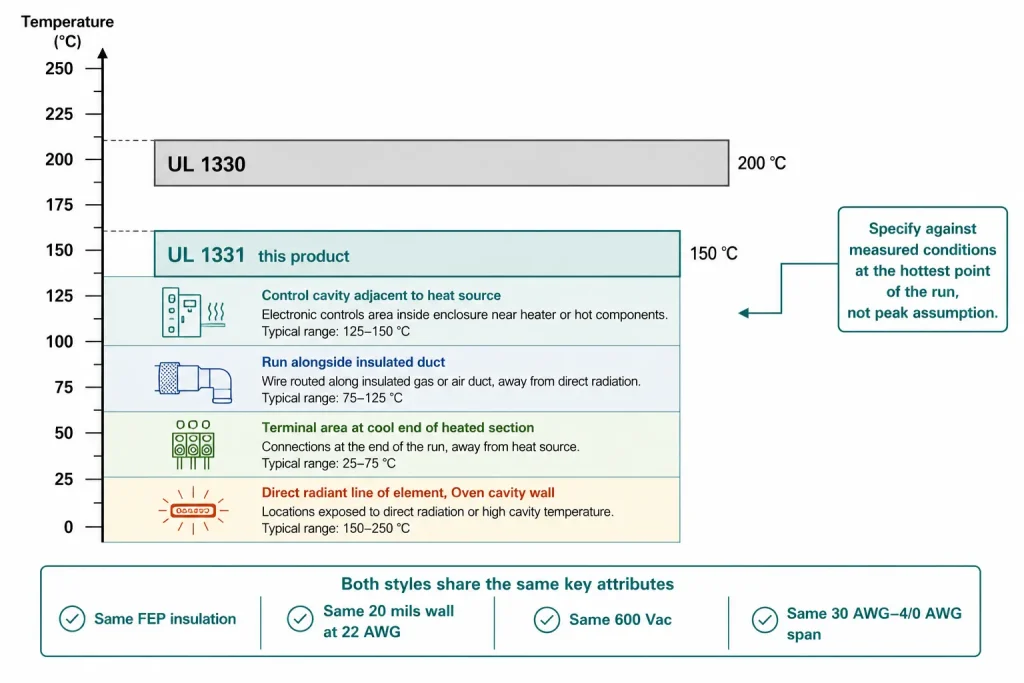
Temperature rating on an AWM style is a maximum, not a target. The relevant question when choosing between a 150°C and a 200°C style is what the conductor actually experiences at its hottest point in the assembly — which is a combination of local ambient temperature inside the enclosure, radiant heat from nearby elements or motors, and the conductor’s own I²R rise under load. For a 22 AWG control or signal lead carrying modest current, the self-heating contribution is small, so the governing factor is almost entirely the thermal environment the lead is routed through.
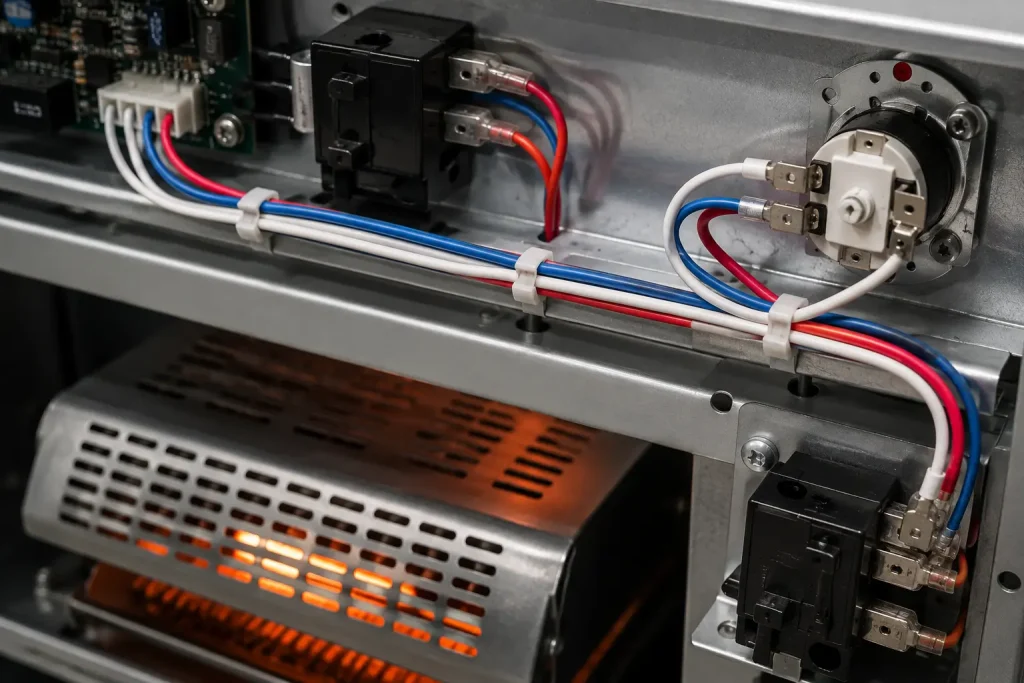
Where that environment is a warm compartment adjacent to a heat source but not in direct radiant line of one — a control cavity above a motor, a run alongside an insulated duct, a terminal area at the cool end of a heated section — a 150°C maximum typically leaves adequate margin without paying for a class the design does not use. Where the lead passes close to a heating element, sits inside an oven cavity wall, or is routed through a zone that has been measured above 150°C under worst-case operating conditions, UL 1330 at 200°C is the correct style and the higher class is doing real work. The decision benefits from a thermal survey of the actual assembly rather than an assumption in either direction.
UL 1331 and UL 1330 at 22 AWG
| At 22 AWG | UL 1331 (this page) | UL 1330 |
|---|---|---|
| Temperature rating | 150°C maximum | 200°C maximum |
| Voltage rating | 600 Vac | 600 Vac |
| FEP wall | 20 mils avg / 18 mils min | 20 mils avg / 18 mils min |
| Conductor span | 30 AWG–4/0 AWG | 30 AWG–4/0 AWG |
| Litz conductor | Available | Not listed |
| Oil rating options | 60°C or 80°C | 80°C |
| FEP covering minimum | 2 mils | 10 mils or heavier |
| Gasoline immersion tag | Gasoline resistant option | Immersion and vapour tags |
UL 1331 22 AWG Specifications
| Item | Specification |
|---|---|
| UL Style | 1331 — single conductor with extruded insulation |
| Temperature Rating | 150°C maximum |
| Voltage Rating | 600 Vac |
| Conductor | 22 AWG, solid or stranded, or Litz cable conductor of R/C (OBMW2) magnet wire rated minimum 150°C (style range 30 AWG–4/0 AWG) |
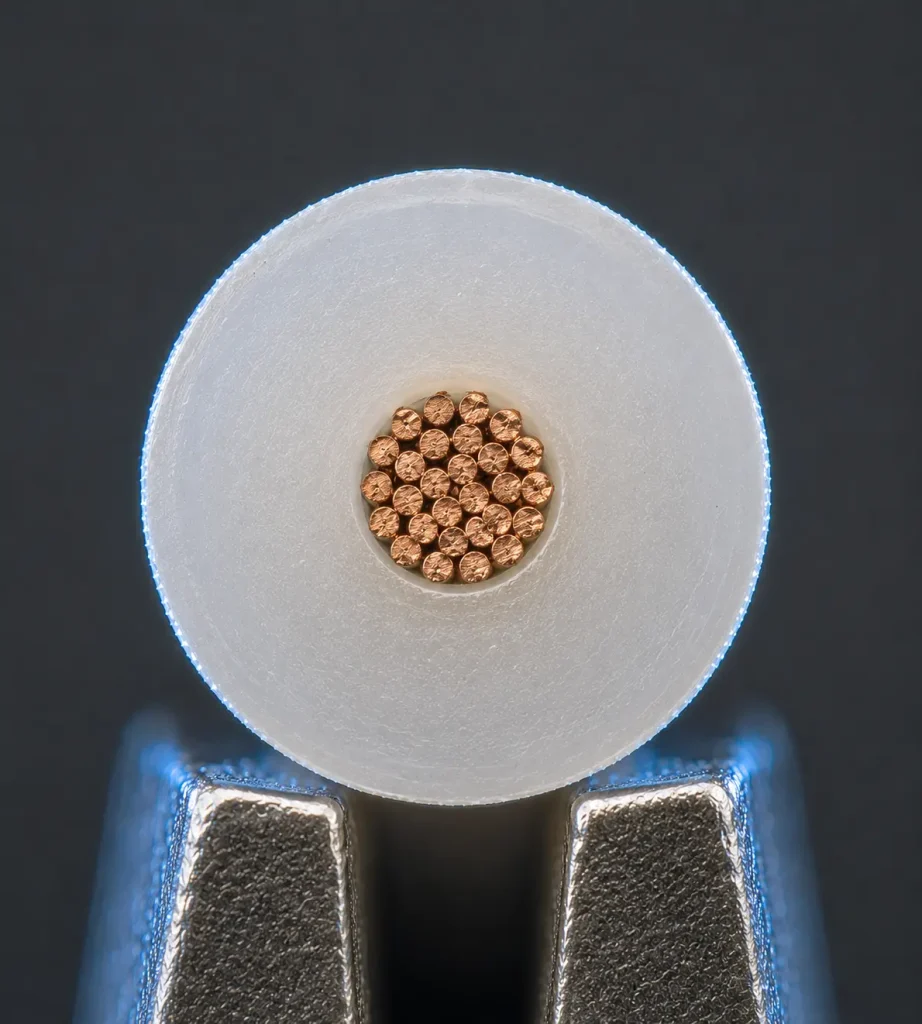
| Insulation | Extruded FEP, 20 mils minimum average thickness, 18 mils minimum at any point |
| Optional Covering | Extruded FEP, 2 mils minimum thickness; or glass braid, 7 mils minimum thickness |
| Flame Rating | Horizontal flame; VW-1 vertical flame test available |
| Oil Rating | Optional — 60°C or 80°C oil resistant |
| Gasoline Resistance | Optional |
| UL Recognition | UL Recognized Component — file on record |
| Marking | Per UL Subject 758 marking requirements; Litz product additionally marked “Litz conductors are manufactured using solderable magnet wire” |
| Permitted Use | Internal wiring of appliances |
| RoHS / REACH | Documentation available on request |
What 150°C Still Buys at 22 AWG
Choosing UL 1331 over UL 1330 gives up 50°C of headroom but concedes nothing on the characteristics that make a fluoropolymer wire worth specifying in the first place. The insulation is the same extruded FEP with the same chemical and fuel resistance, the same low dielectric constant, the same low surface friction and the same 20 mils wall at this gauge. The 600 Vac rating is unchanged. And in three respects the 150°C style offers more: Litz conductor construction, which UL 1330 does not list; a choice of two oil-resistance temperatures rather than one; and a 2 mils minimum FEP covering that permits dual-layer or colour-identification constructions with far less diameter increase. Against a 105°C PVC style, a 150°C FEP wire remains a substantial step up in every dimension that matters.
Applications
Within its permitted use — internal wiring of appliances — UL 1331 22 AWG suits control circuit conductors, sensor and thermostat leads, and light-duty internal power connections at 600 Vac in warm zones where measured conditions stay within the 150°C maximum. In Litz construction the same gauge serves high-frequency winding lead-outs. The 2 mils FEP covering supports colour-identified circuit groups within a dense harness; the glass braid covering adds abrasion protection where the lead contacts metalwork. Where lubricant or fuel contact is expected, specify the applicable 60°C or 80°C oil rating or gasoline resistance. For applications outside internal appliance wiring, confirm application suitability before specifying.
Key Features
- 150°C maximum at 600 Vac — full FEP performance without an unused temperature class
- Same 20 mils wall, conductor span and voltage rating as the 200°C style
- Litz conductor, dual oil temperatures and 2-mil covering not available in UL 1330
- Chemical, fuel and lubricant resistance inherent to the fluoropolymer
- Horizontal flame; VW-1 vertical flame test available
- UL Recognized Component — file on record
Request a Quote
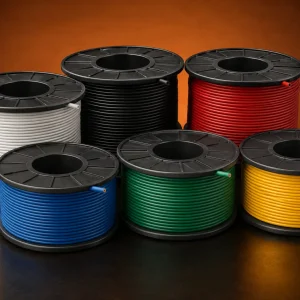
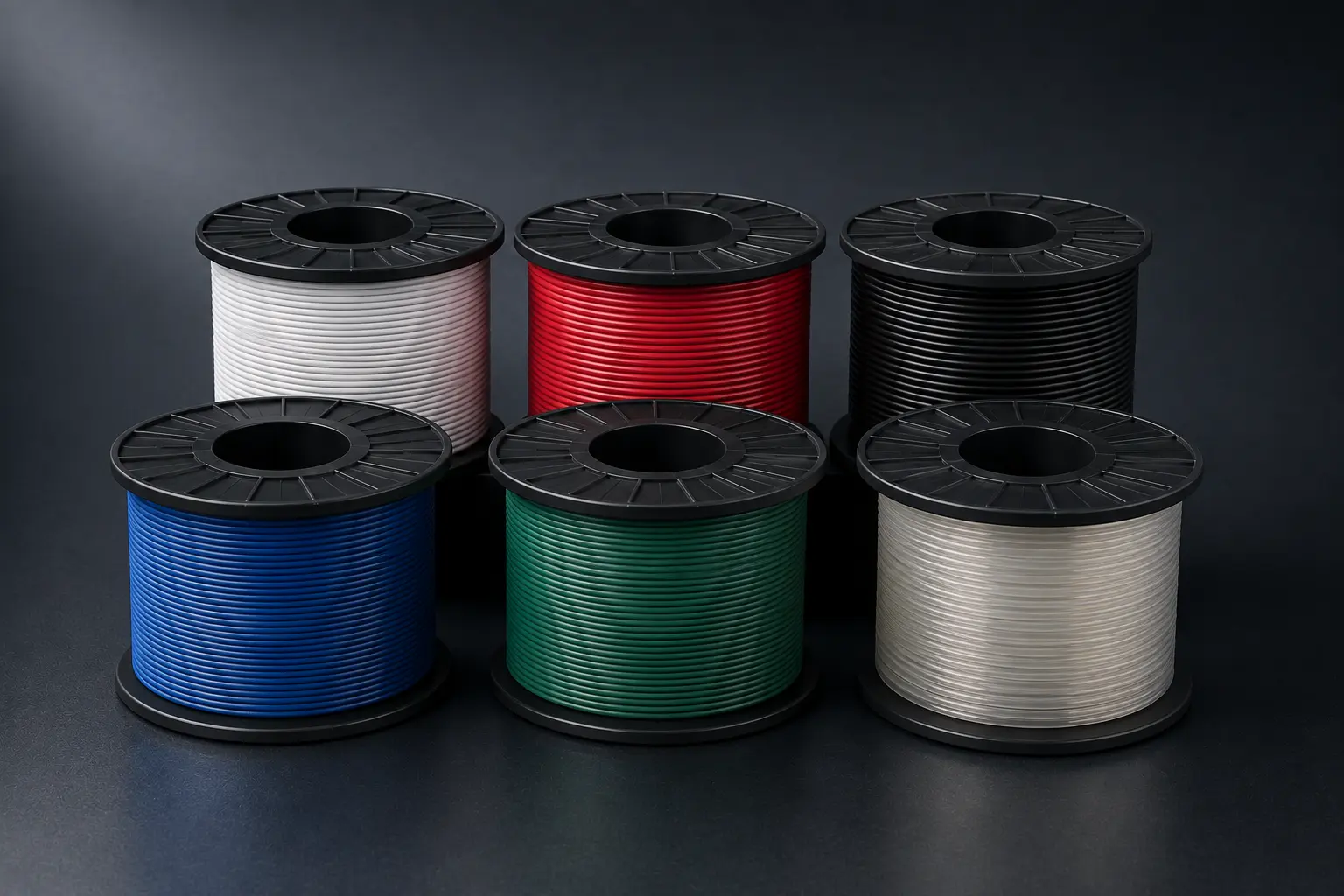
CableApex supplies UL 1331 22 AWG from 100 m per color and responds to B2B inquiries within 12 hours. Specify conductor construction (solid, stranded or Litz), colors, covering type and any oil or gasoline requirements through the form below. If the operating temperature at the hottest point of the run is uncertain, state the application and we can confirm whether this style or the 200°C alternative is the closer match.