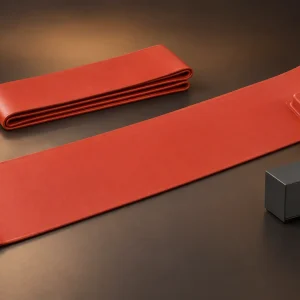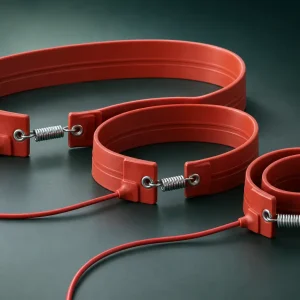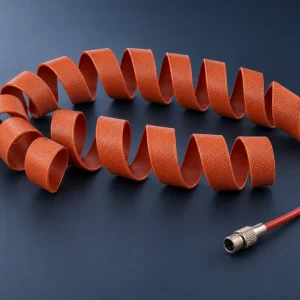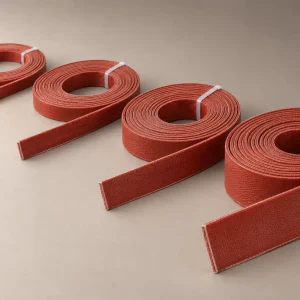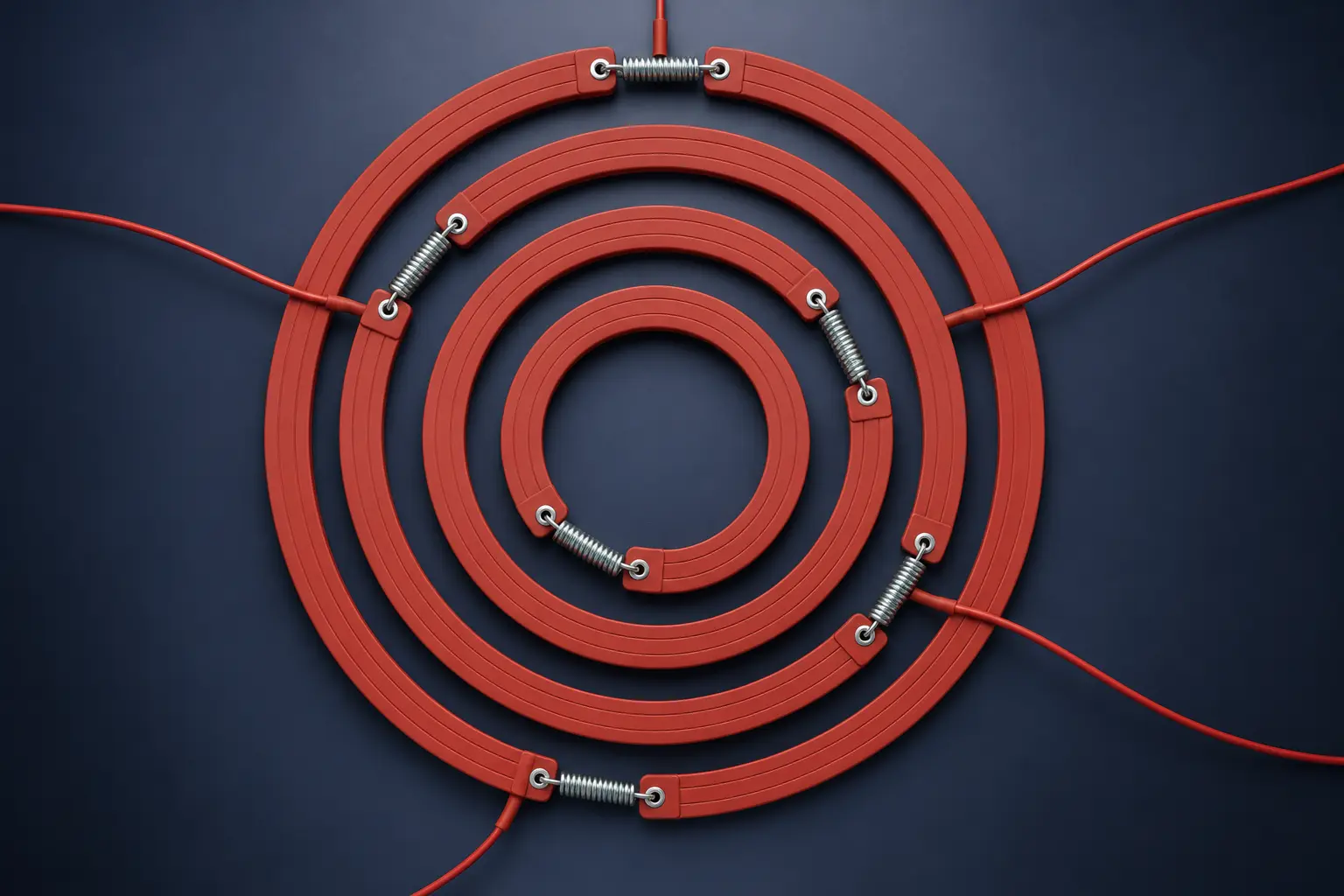
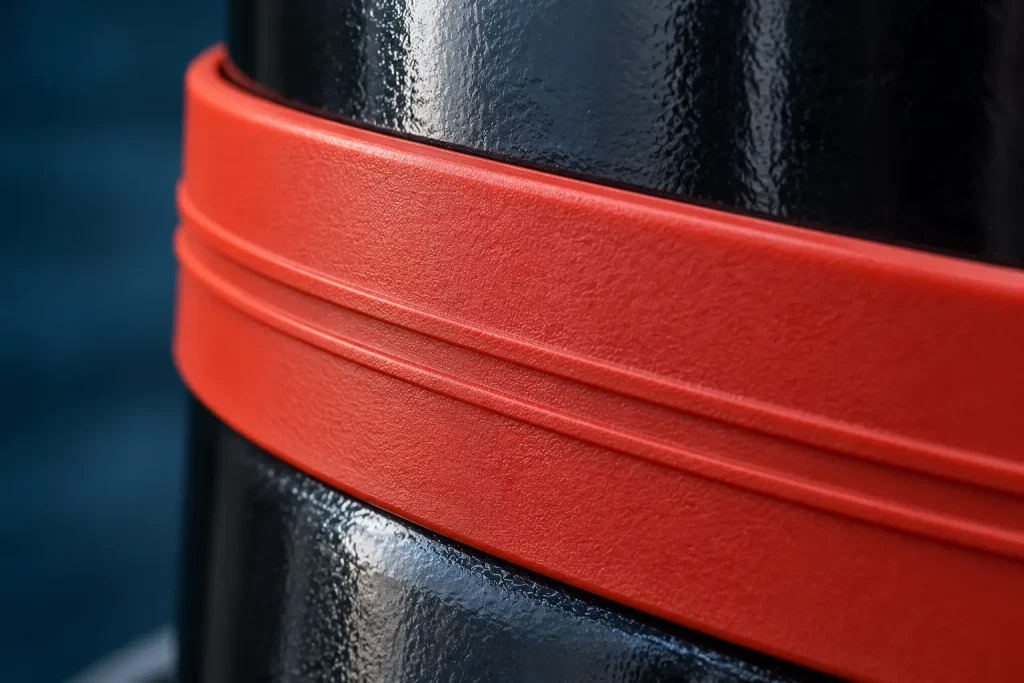
This scroll compressor crankcase heater is a 30 mm flat silicone rubber belt that closes around the lower shell of a scroll compressor with a steel tension spring. The construction is listed for supply voltages from 24 V to 265 V, so one belt design can be built for a 24 V control transformer, a 110–120 V supply or a 220–240 V supply. Standard lengths run from 430 mm to 1,000 mm, and the listed working temperature range is -30 to +200°C.
This page is written for buyers who already know the compressor and need the belt built for a particular electrical supply. It covers voltage builds and current draw, how the length is matched to a scroll compressor shell, and how to brief a custom length or lead.
Key Features
- Built for any supply from 24 V to 265 V
- 30 mm flat silicone rubber belt
- 430–1,000 mm standard lengths, custom on request
- 43–100 W on standard 220 V lengths
- -30 to +200°C working temperature
- Spring closure, no drilling or brackets
- 1 m power lead as standard
- Tinned copper braid shield on the lead as an option
Voltage Builds
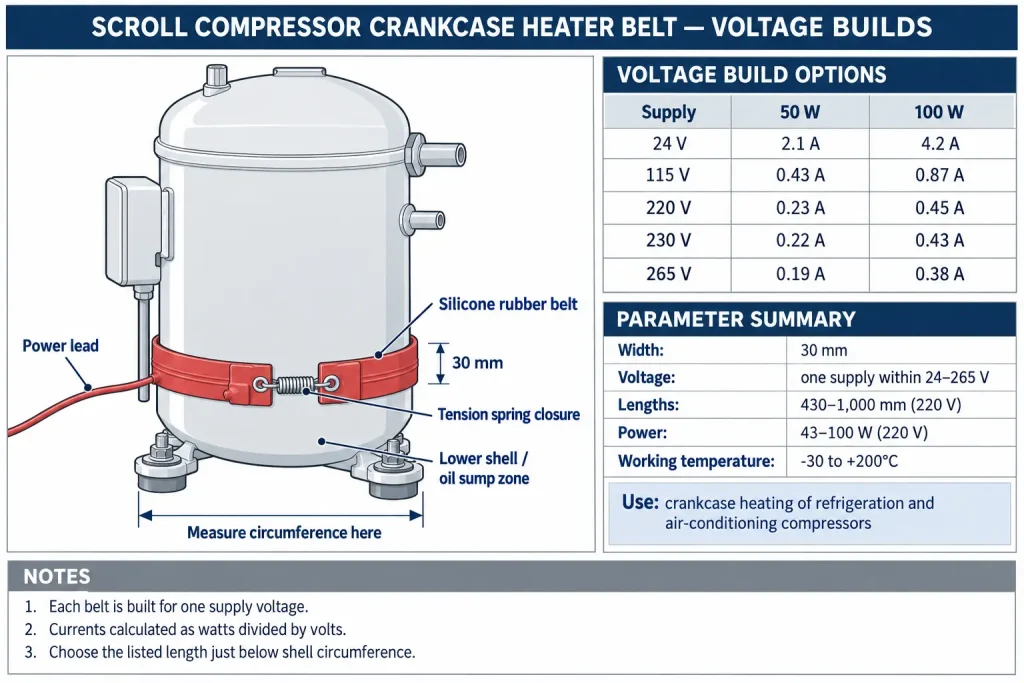
A crankcase heater belt is a resistive load, and its resistance is set when the belt is built, for one specific supply voltage. The listed range of 24–265 V tells you which supplies the construction can be built for. It does not mean one belt works across that whole range. The table shows the common supply points and what each one means for the order.
| Supply | Typical source | Current at 50 W | Current at 100 W |
|---|---|---|---|
| 24 V | Control transformer in the unit | approx. 2.1 A | approx. 4.2 A |
| 110–120 V | Single-phase mains, 120 V regions | approx. 0.43 A at 115 V | approx. 0.87 A at 115 V |
| 220 V | Listed standard build | approx. 0.23 A | approx. 0.45 A |
| 230–240 V | Single-phase mains, 230 V regions | approx. 0.22 A at 230 V | approx. 0.43 A at 230 V |
| 265 V | Upper end of listed range | approx. 0.19 A | approx. 0.38 A |
Currents are calculated as wattage divided by voltage, for a belt built to deliver that wattage at that voltage. Confirm the wattage of each non-220 V build at enquiry.
The 24 V row matters most in practice. The same wattage at 24 V draws roughly ten times the current of a 230 V belt. Check the control transformer’s VA rating and the lead’s current capacity before choosing a low-voltage build, especially on longer belts.
What Happens on the Wrong Supply
Because the resistance is fixed when the belt is built, connecting it to a different voltage changes the heat output with the square of the voltage ratio. A 220 V belt connected to 110 V delivers about one quarter of its rated wattage, so it barely warms the shell. A 110 V belt connected to 220 V tries to deliver about four times its rated wattage, which overheats it. A 24 V belt on mains supply fails immediately. The supply voltage is therefore the first line of every enquiry, ahead of length.
Matching the Belt to a Scroll Compressor Shell
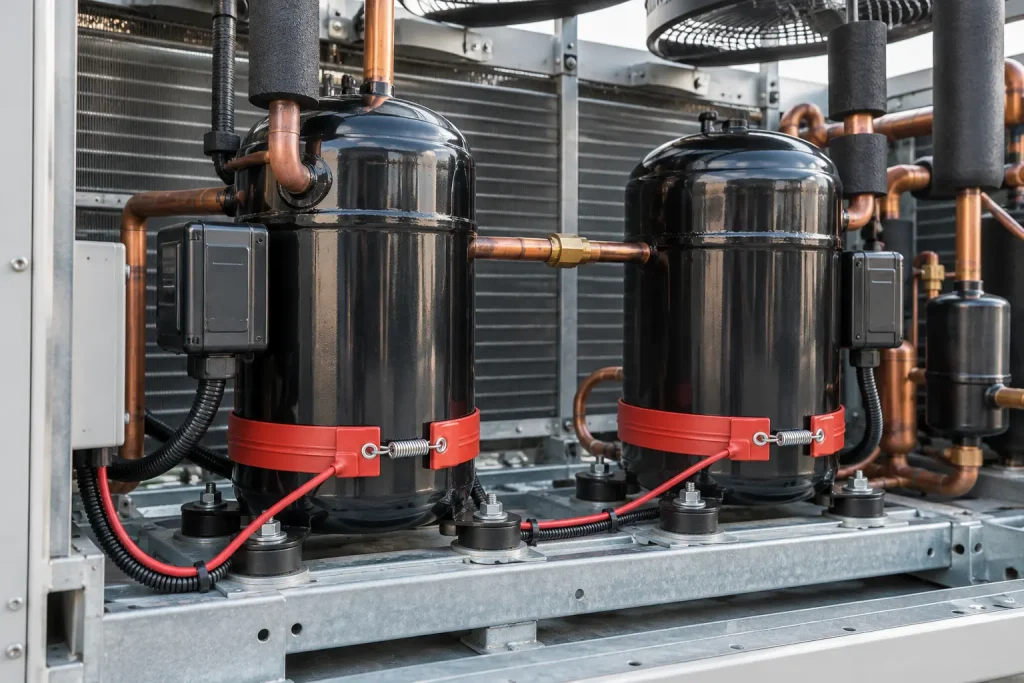
Scroll compressors used in air-conditioning and refrigeration units usually have a vertical cylindrical shell with the oil sump at the bottom. The belt goes around the lower part of that shell, below the terminal box and clear of the suction and discharge connections. Because the shell is a plain cylinder at that height, a flat 30 mm belt can sit in full contact all the way round, provided the length is right.
| Step | What to record | Why it matters |
|---|---|---|
| 1 | Shell circumference at the belt height | Sets the belt length; choose the standard length just below it |
| 2 | Clear band height on the shell | The belt needs at least 30 mm of smooth shell free of welds and feet |
| 3 | Supply voltage at the heater terminals | Fixes the belt’s built-in resistance |
| 4 | Distance to the connection point | Decides whether the 1 m standard lead is enough |
| 5 | Wattage required by the compressor or unit maker | Checked against the wattage of the chosen length |
On the 220 V standard list, the lengths step in small increments between 430 and 580 mm, which covers the smaller shell diameters common in residential and light commercial units, then move to 650, 820 and 1,000 mm for larger shells. Where the measured circumference falls between two listed lengths, choose the shorter one so the spring keeps the belt under tension. If neither length fits, ask for a custom length.
Specification
| Parameter | Value |
|---|---|
| Product type | Flat silicone rubber crankcase heater belt |
| Belt width | 30 mm |
| Supply voltage | Built for one supply within 24–265 V; 220 V on listed sizes |
| Standard lengths (220 V) | 430, 450, 480, 500, 530, 550, 580, 650, 820 and 1,000 mm |
| Power (220 V) | 43–100 W, approx. 100 W per metre |
| Working temperature | -30 to +200°C |
| Closure | Steel tension spring between two eyelet tabs |
| Power lead | 1 m standard; other lengths on request |
| Lead options | Alternative core wire; alternative outer diameter; tinned copper braid shield |
| Listed use | Crankcase heating of refrigeration and air-conditioning compressors |
| Certification | Not stated for this item; confirm required documents per order |
Briefing a Custom Length or Lead
Custom belts follow the same 30 mm construction. To quote one, the supplier needs the finished belt length, the supply voltage and the target wattage. If no wattage is given, the standard sizes deliver roughly 100 W per metre, and that is a reasonable starting point to discuss. For the lead, give the length to the connection point and say whether the ends should be left bare, stripped and tinned, or fitted with terminals. If the lead runs alongside signal wiring inside the unit, request the tinned copper braid shield.
Tandem or multiple-compressor units need one belt per compressor. When the compressors have different shell sizes, list each compressor separately with its own circumference so that each belt is built to the right length rather than averaged.
What This Heater Specification Covers
This specification defines the belt’s dimensions, supply voltage, wattage, working temperature range, closure and lead. It does not state the heating requirement of any particular scroll compressor model, and it does not include a thermostat or switching device. When the belt is energised, and whether it switches off during compressor running, is decided by the equipment’s control design. Compressor or unit documentation remains the reference for the required wattage.
Common Procurement Errors
- Quoting a voltage range instead of a voltage. “24–265 V” describes what can be built. Each order needs one supply voltage per belt.
- Overlooking current draw on 24 V builds. A low-voltage belt can draw several amps, which the control transformer and lead must carry.
- Averaging belt sizes across a tandem unit. Compressors with different shells need different belt lengths.
- Choosing the longer of two lengths. A belt that is too long cannot be tensioned and loses contact with the shell.
- Omitting the lead end finish. Bare leads, tinned ends and terminals are different builds and should be specified up front.
RFQ Checklist
- Supply voltage at the heater (one value per belt)
- Shell circumference at the belt position, for each compressor
- Selected standard length or custom length
- Target wattage, or confirmation that approx. 100 W/m is acceptable
- Lead length, lead construction and shield requirement
- Lead end finish: bare, tinned or terminals
- Certification or test documents required for your market
- Quantity per voltage and length combination
Certification and Documentation
No certification is stated for this heater in the current specification. Any approval or test report required by your market or customer should be named at enquiry, so that availability can be confirmed for the ordered voltage and length before quotation. Applicable RoHS / REACH documentation can be confirmed according to the ordered construction.
Related Categories
Find other belt, band and pad formats in the Silicone Rubber Heaters category, part of the wider High Temperature Wire Cable range.