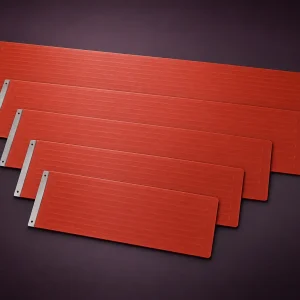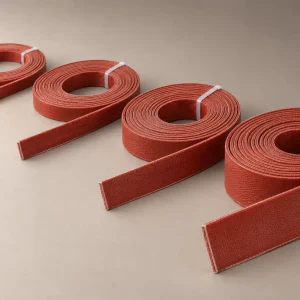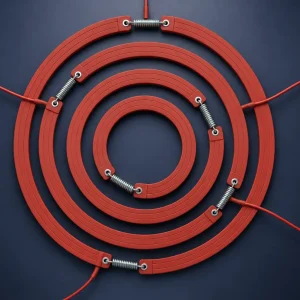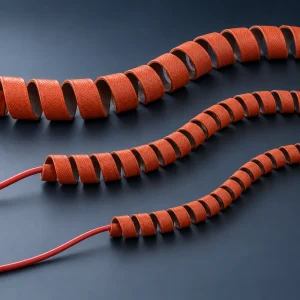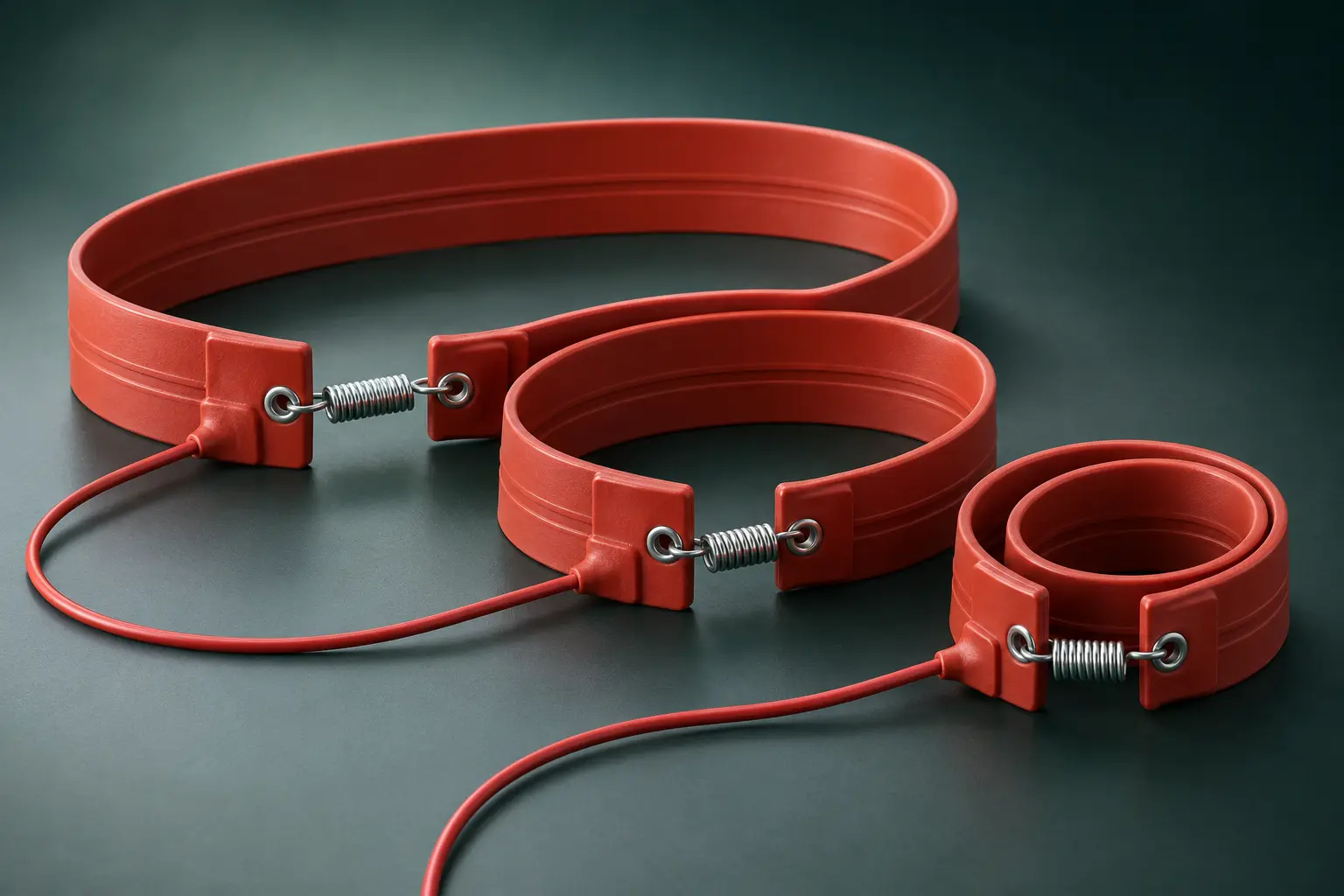
This compressor crankcase heater is a flat silicone rubber heating belt, 30 mm wide, that wraps around the lower shell of a refrigeration or air-conditioning compressor and is held in place by a steel tension spring hooked between two eyelet tabs. Standard belts run from 430 mm to 1,000 mm long at 220 V, with power stepping from 43 W to 100 W in line with belt length, and the listed working temperature range is -30 to +200°C. Each belt is supplied with a 1 m power lead.
The belt is ordered by three numbers: the length that matches the compressor shell circumference, the supply voltage, and the wattage that comes with that length. The sections below set out the listed sizes, how to measure a compressor for the right belt, and what to confirm before an order is placed.
Key Features
- 30 mm wide flat silicone rubber belt
- Ten standard lengths from 430 mm to 1,000 mm
- Approximately 100 W per metre on standard lengths
- 220 V standard; 24–265 V range on request
- Working temperature -30 to +200°C
- Steel tension spring with metal-eyelet end tabs
- 1 m power lead fitted as standard
- Shielded lead and alternative lead constructions available
Specification
| Parameter | Value |
|---|---|
| Product type | Flat silicone rubber crankcase heater belt |
| Outer material | Silicone rubber |
| Belt width | 30 mm |
| Standard lengths | 430, 450, 480, 500, 530, 550, 580, 650, 820 and 1,000 mm |
| Extended lengths | 2,000, 3,000, 4,000 and 5,000 mm (100 W listed; confirm wattage at enquiry) |
| Power | 43–100 W on standard lengths |
| Supply voltage | 220 V on listed sizes; 24–265 V range, specified per order |
| Working temperature | -30 to +200°C |
| Closure | Steel tension spring hooked between two end tabs with metal eyelets |
| Power lead | 1 m, as standard |
| Lead options | Alternative core wire; alternative outer diameter; tinned copper braid shield |
| Listed use | Crankcase heating of refrigeration and air-conditioning compressors |
| Certification | Not stated for this item; confirm required documents per order |
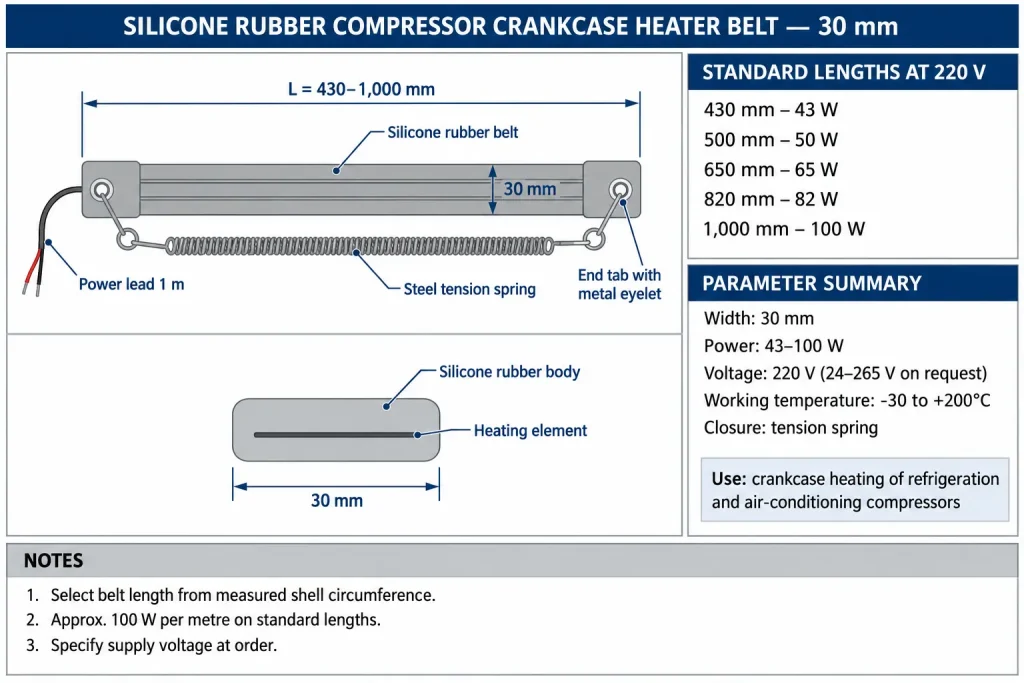
Belt Length, Power and Watt Density
On the standard sizes, wattage rises in step with length: 43 W at 430 mm, 50 W at 500 mm, 65 W at 650 mm, 82 W at 820 mm and 100 W at 1,000 mm. That works out to approximately 100 W for every metre of belt, so moving to a longer belt to fit a larger shell does not change the heat delivered per centimetre of contact. The extended 2,000–5,000 mm belts are listed at 100 W regardless of length, which means a much lower watt density. Treat those as a separate configuration and confirm the wattage before ordering.
| Belt length | Power at 220 V | Shell diameter it closes around* |
|---|---|---|
| 430 mm | 43 W | approx. 145–155 mm |
| 450 mm | 45 W | approx. 150–160 mm |
| 480 mm | 48 W | approx. 160–170 mm |
| 500 mm | 50 W | approx. 165–175 mm |
| 530 mm | 53 W | approx. 175–185 mm |
| 550 mm | 55 W | approx. 180–190 mm |
| 580 mm | 58 W | approx. 190–200 mm |
| 650 mm | 65 W | approx. 215–225 mm |
| 820 mm | 82 W | approx. 265–275 mm |
| 1,000 mm | 100 W | approx. 325–335 mm |
*Indicative only. The figures are calculated from belt length plus the stretch taken up by the spring and tabs. Confirm the fit against your measured shell circumference before ordering.
How to Measure a Compressor for the Right Belt
Measure the circumference of the compressor shell at the height where the belt will sit, normally the lower part of the shell around the oil sump, using a flexible tape. Pick the standard belt whose length falls just short of that circumference, so the tension spring closes the gap and holds the belt in firm contact all the way round. A belt that is longer than the circumference leaves the tabs touching or overlapping, and the spring then has nothing to pull against. A belt that is far too short over-stretches the spring.
Check the shell along the belt path before installation. Welded seams, mounting feet, terminal boxes and suction or discharge stubs can all interrupt a flat band. The 30 mm width fits on most shell bands, but the belt needs a continuous smooth surface for its full length to keep even contact.
Voltage and Lead Configuration
The listed standard sizes are 220 V belts. The construction is listed for a 24–265 V range, so belts for 24 V control circuits or for 110–120 V and 230–240 V mains can be specified. The supply voltage must be stated at enquiry: a belt built for 220 V will not give its rated output on 110 V, and a low-voltage belt must never be connected to mains.
The standard lead is 1 m. Where the belt is wired into a condensing unit’s control box some distance from the compressor, give the lead length you need. Alternative lead constructions are also available, including a tinned copper braid shield over the lead where the installation calls for it.
Why the Crankcase Is Heated
When a refrigeration or air-conditioning compressor stands idle, especially in a cold outdoor unit, refrigerant tends to migrate to the coldest point in the system and dissolve in the crankcase oil. At the next start, the sudden drop in pressure makes that refrigerant flash out of the oil. The oil foams, and lubrication of bearings and moving parts suffers during the first moments of running. A crankcase heater keeps the oil sump slightly warmer than the rest of the system during the off-cycle, which limits how much refrigerant collects there. The belt format suits this job because it puts a band of low, even heat directly against the shell around the sump, without any modification to the compressor itself.
Installation Notes
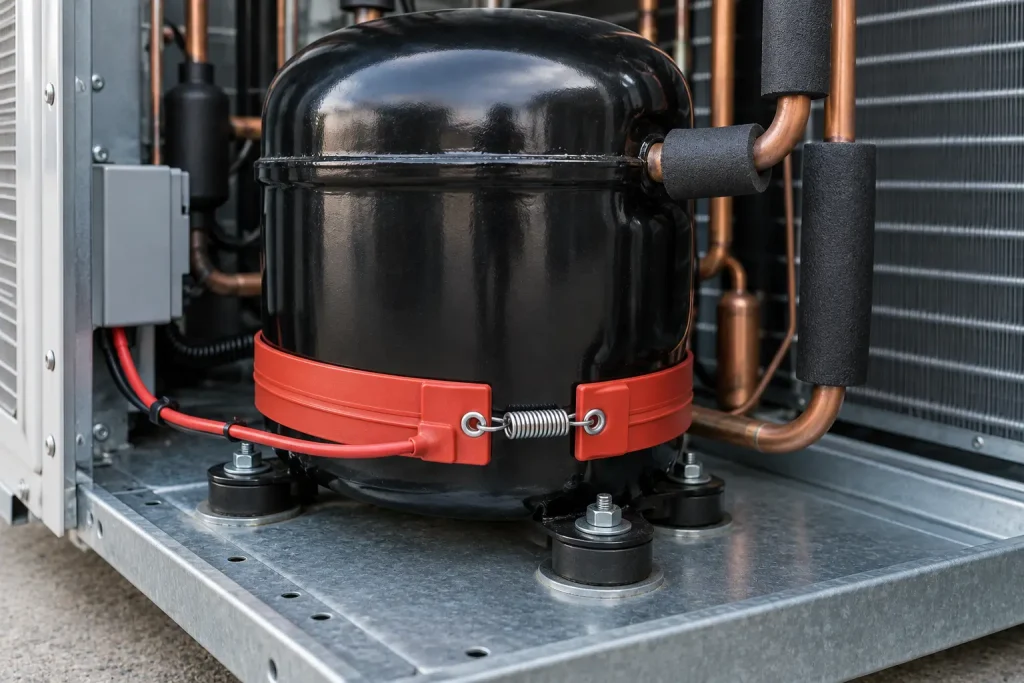
- Clean the shell surface where the belt will sit, and remove loose paint flakes, oil film and debris so the silicone face contacts the metal evenly.
- Position the belt as low on the shell as the mounting feet allow, so it sits around the oil sump rather than the motor section.
- Hook the tension spring through the eyelets and check that the belt is in contact all the way round with no twist.
- Route the 1 m lead away from hot discharge lines and moving fan parts, and secure it so it cannot chafe against sheet-metal edges.
- Connect the belt through the equipment’s control circuit and protective device as designed by the equipment manufacturer.
What This Heater Specification Covers
The figures on this page define the belt itself: width, length, wattage at a stated voltage, working temperature range, closure method and lead length. They do not set the crankcase heating wattage a particular compressor model needs. That figure comes from the compressor or equipment manufacturer, and it should be checked against the wattage of the belt length that fits. The belt has no built-in thermostat. Whether it runs continuously or is switched off while the compressor runs depends on the equipment’s own control circuit.
Common Procurement Errors
- Ordering by compressor horsepower instead of shell circumference. Compressors of similar capacity can have very different shell diameters, so the belt length must come from a measurement.
- Assuming the extended belts keep the same watt density. The 2,000–5,000 mm belts are listed at 100 W in total, far below the roughly 100 W/m of the standard sizes.
- Leaving voltage unstated. Standard stock is 220 V. A 24 V, 115 V or 240 V belt is a different build.
- Not specifying the lead. The 1 m standard lead may not reach the control box, and a shielded lead has to be requested.
- Mounting on an uneven surface. Fitting the belt across a weld bead or bracket reduces contact and creates local hot spots.
RFQ Checklist
- Compressor shell circumference (or diameter) at the belt position
- Required belt length from the standard list, or a custom length
- Supply voltage (24–265 V range)
- Required wattage, if specified by the equipment manufacturer
- Lead length and lead construction, including shield if needed
- Termination at the free end of the lead (bare ends, terminals or connector)
- Certification or test documents required for your market
- Quantity per length
Certification and Documentation
No certification is stated for this heater in the current specification. If your market or customer requires a specific approval or test report, state it at enquiry so that availability can be confirmed for the ordered configuration before quotation. Applicable RoHS / REACH documentation can be confirmed according to the ordered construction.
Related Categories
This belt is part of the Silicone Rubber Heaters range, which sits within the High Temperature Wire Cable category.