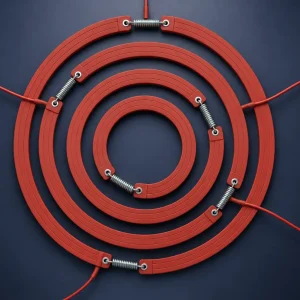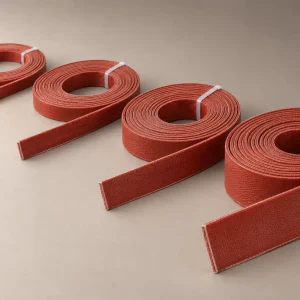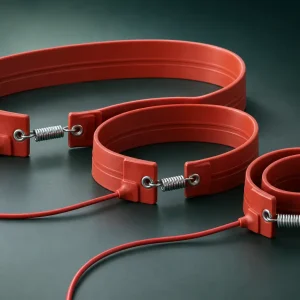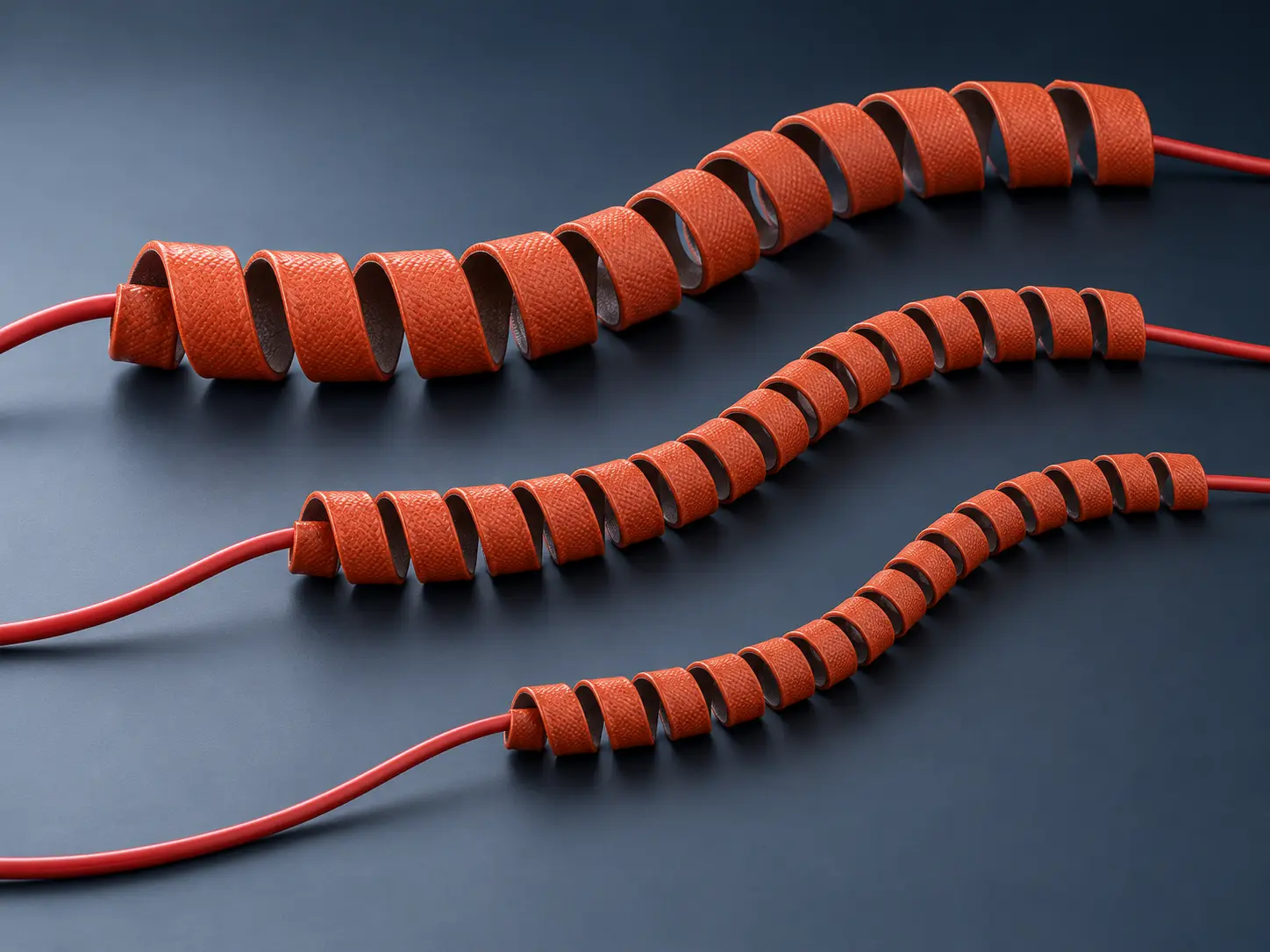
This high temp heat trace is a pre-formed spiral silicone rubber heating tape made for small-bore tubes, instrument lines and thin pipes. The tape is moulded into a self-coiling helix, so it springs open, wraps itself around the tube and stays in place without being wound by hand. Coil inner diameters of 6, 8, 10 and 12 mm cover tubes and lines in that size range, with standard lengths from 250 mm to 2,000 mm and power from 15 W to 140 W. The silicone construction is listed for -60 to +200°C, and the heater can be built for any supply from 12 V to 220 V.
The heater is ordered by four choices: the coil diameter that matches the tube, the length of tube to be heated, the supply voltage, and the control package. The sections below set out the listed sizes, how power scales with diameter and length, what the optional thermostat and thermocouple do, and what to confirm before an order is placed.
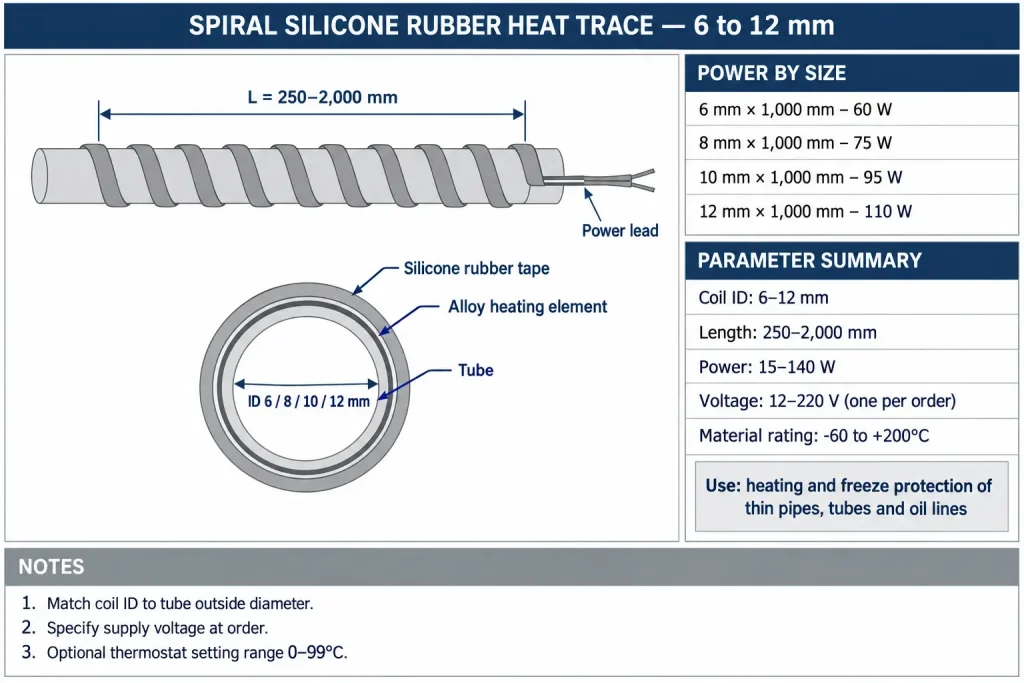
Key Features
- Pre-formed self-coiling spiral, no hand winding
- Coil inner diameters 6, 8, 10 and 12 mm
- Lengths 250–2,000 mm; power 15–140 W
- Any supply voltage from 12 V to 220 V, built to order
- Silicone construction rated -60 to +200°C
- Alloy heating element in silicone rubber insulation
- Optional digital thermostat with plug
- Optional K-type thermocouple lead
Specification
| Parameter | Value |
|---|---|
| Product type | Pre-formed spiral silicone rubber heating tape (heat trace) |
| Construction | Alloy heating element insulated in silicone rubber, moulded into a helix |
| Coil inner diameter | 6, 8, 10 and 12 mm |
| Standard lengths | 250–2,000 mm, depending on diameter (see table below) |
| Power | 15–140 W on standard sizes |
| Supply voltage | 12–220 V, specified per order |
| Material temperature rating | -60 to +200°C |
| Typical surface temperature in use | 40–150°C, depending on wattage, tube, insulation and control |
| Cold resistance | 1–1,500 Ω across the range, set by length, wattage and voltage |
| Control options | Bare heater; heater with digital thermostat and plug; separate digital thermostat (0–99°C setting, 15 A); separate K-type thermocouple lead |
| Listed use | Heating and freeze protection of thin pipes, tubes and oil lines |
| Certification | Not stated for this item; confirm required documents per order |
Standard Sizes and Power
Power is listed for each combination of coil diameter and length. Within one diameter, wattage rises roughly in proportion to length, so a longer heater delivers about the same heat per metre of tube. Larger diameters carry more power per metre, because a wider coil puts more tape around each centimetre of tube.
| Coil inner diameter | Length and power | Approx. power per metre* |
|---|---|---|
| 6 mm | 250 mm 15 W; 500 mm 30 W; 1,000 mm 60 W; 1,500 mm 90 W; 2,000 mm 120 W | 60 W/m |
| 8 mm | 500 mm 40 W; 900 mm 65 W; 1,000 mm 75 W; 1,500 mm 110 W | 72–80 W/m |
| 10 mm | 500 mm 50 W; 1,000 mm 95 W; 1,500 mm 140 W | 93–100 W/m |
| 12 mm | 1,000 mm 110 W | 110 W/m |
*Calculated from the listed length and wattage. Confirm at enquiry whether the listed length is the coiled length along the tube or the straight length of tape, as this changes the heat delivered per metre of tube.
How to Choose the Coil Diameter
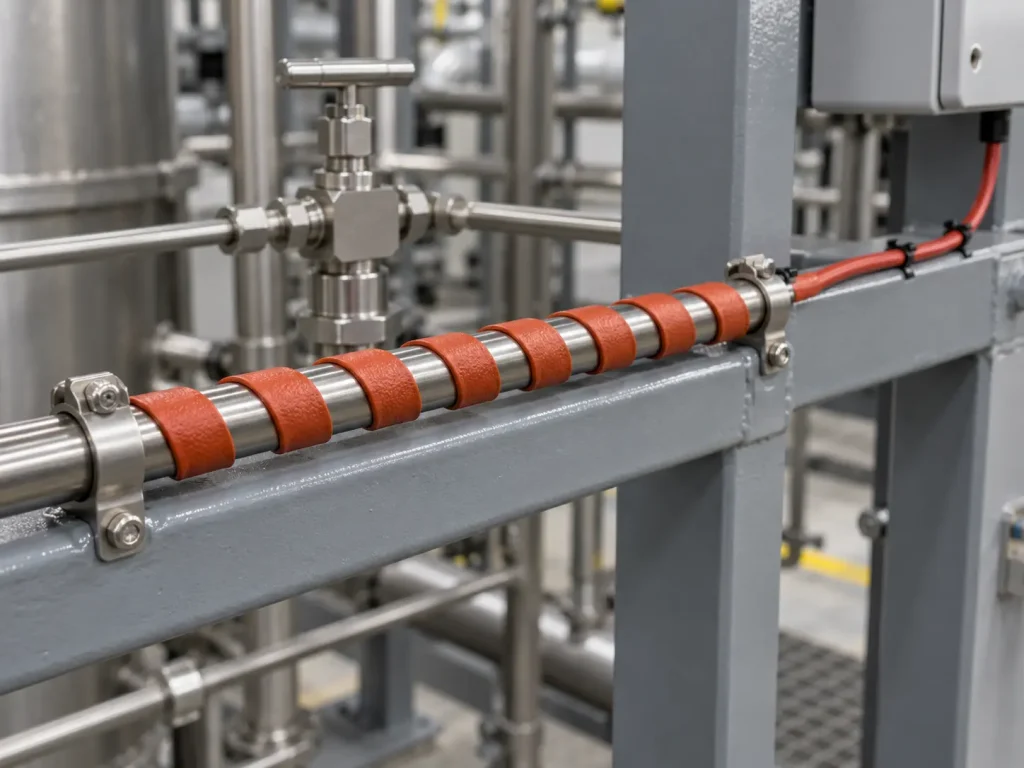
The coil inner diameter should match the outside diameter of the tube or line, not its nominal bore. Measure the outside of the tube with a calliper. A spiral of the matching size closes onto the tube with light, even contact along its whole length. A spiral that is much smaller has to be forced open and may not seat evenly, and one that is larger sits loose, leaving air gaps that slow heat transfer and let the tape run hotter than the tube.
Where a line changes diameter, or where fittings and small valves interrupt it, a single spiral may not suit the whole run. Give the outside diameters and the length of each section at enquiry so that the heater can be matched to the line, or split into separate heaters.
Voltage and Current
The same physical heater can be built for any supply from 12 V to 220 V, but each build is for one voltage only. The voltage must therefore be stated with the order. A 220 V heater connected to 12 V produces almost no heat, and a 12 V heater connected to mains will fail at once.
Low-voltage builds draw much more current for the same power, which affects the wiring and the control. At 220 V the largest standard size, 140 W, draws about 0.64 A. At 12 V a 120 W heater draws about 10 A and a 140 W heater about 11.7 A. Supply leads, connectors, fuses and any switching device on a 12 V or 24 V system must be sized for that current.
| Power | Current at 12 V* | Current at 24 V* | Current at 220 V* |
|---|---|---|---|
| 15 W | 1.25 A | 0.63 A | 0.07 A |
| 60 W | 5.0 A | 2.5 A | 0.27 A |
| 95 W | 7.9 A | 4.0 A | 0.43 A |
| 140 W | 11.7 A | 5.8 A | 0.64 A |
*Calculated as power divided by voltage, at rated output.
Temperature Rating and Control
Two temperature figures apply to this heater and they mean different things. The -60 to +200°C range is the rating of the silicone construction: the tape can be stored, installed and run in that range without damage. The 40–150°C range is the surface temperature the tape typically reaches in use, which depends on its wattage, the tube it sits on, any insulation over it and how it is controlled.
The heater has no built-in thermostat and runs at full power whenever it is energised. The optional digital thermostat switches the heater on a 0–99°C setting and is rated 15 A. It can be supplied fitted to the heater with a plug, or separately. A K-type thermocouple lead is also available for use with a separate controller. Where the line must be held above 99°C, specify a controller and sensor suited to that set point rather than the standard thermostat.
Plug and Termination
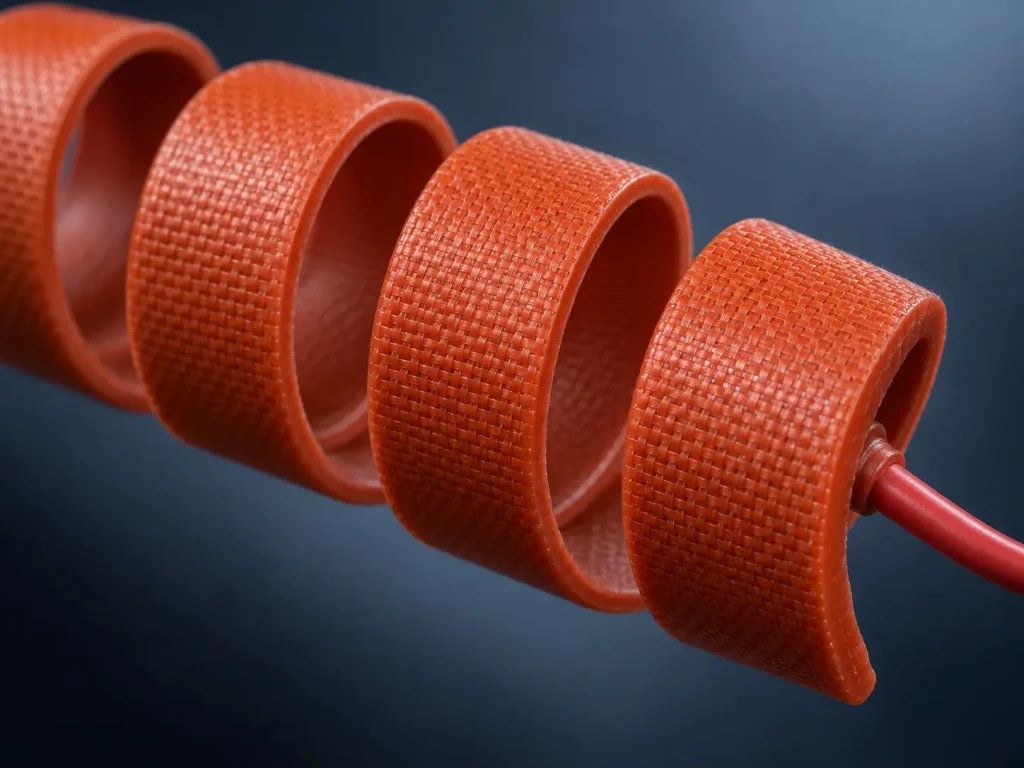
The thermostat-and-plug packages are listed with either a plain plug or a plug with a leakage protection device. Plug standards differ by country, so state the plug type required, or order the heater with bare lead ends for connection by a qualified installer to a local plug or control panel. For 12 V and 24 V builds, give the connection method used on your system.
Installation Notes
- Clean the tube surface and remove loose scale or oil film so the silicone sits in direct contact with the tube.
- Open the spiral by hand and let it close onto the tube; avoid stretching it beyond its formed pitch.
- Keep turns evenly spaced and do not let the tape overlap itself, which creates hot spots.
- Where thermal insulation is fitted over the heater, allow for the higher tape temperature that results.
- Route the lead away from moving parts and sharp edges, and connect it through suitable overcurrent and earth-leakage protection.
Common Procurement Errors
- Ordering by nominal pipe size. The spiral must match the tube’s outside diameter.
- Leaving voltage unstated. Each heater is built for one voltage between 12 V and 220 V.
- Undersizing low-voltage wiring. A 140 W heater at 12 V draws nearly 12 A.
- Expecting the standard thermostat to hold more than 99°C. Higher set points need a different controller.
- Not stating the plug type. The plug fitted as standard may not suit the destination market.
RFQ Checklist
- Tube or line outside diameter, and length to be heated
- Coil inner diameter and length from the standard list, or a custom size
- Supply voltage (12–220 V)
- Required wattage, if different from the standard size
- Control package: bare heater, thermostat with plug, separate thermostat or thermocouple
- Plug type or bare-end termination, and lead length
- Required set point or holding temperature
- Certification or test documents required for your market
- Quantity per size
Certification and Documentation
No certification is stated for this heater in the current specification. If your market or customer requires a specific approval or test report, state it at enquiry so that availability can be confirmed for the ordered size, voltage and control package before quotation. Applicable RoHS / REACH documentation can be confirmed according to the ordered construction.
Related Categories
Flat heating tapes, crankcase belts, drum and cylinder bands and heating pads are listed in the Silicone Rubber Heaters category, part of the High Temperature Wire Cable range.