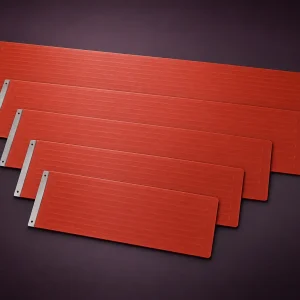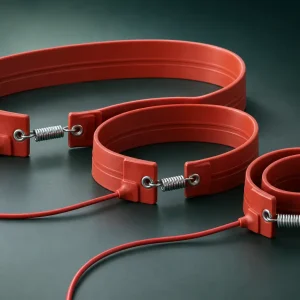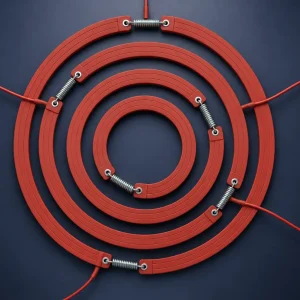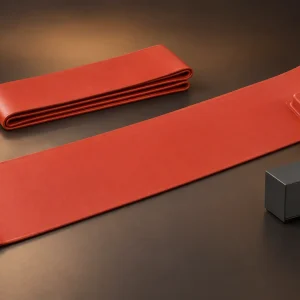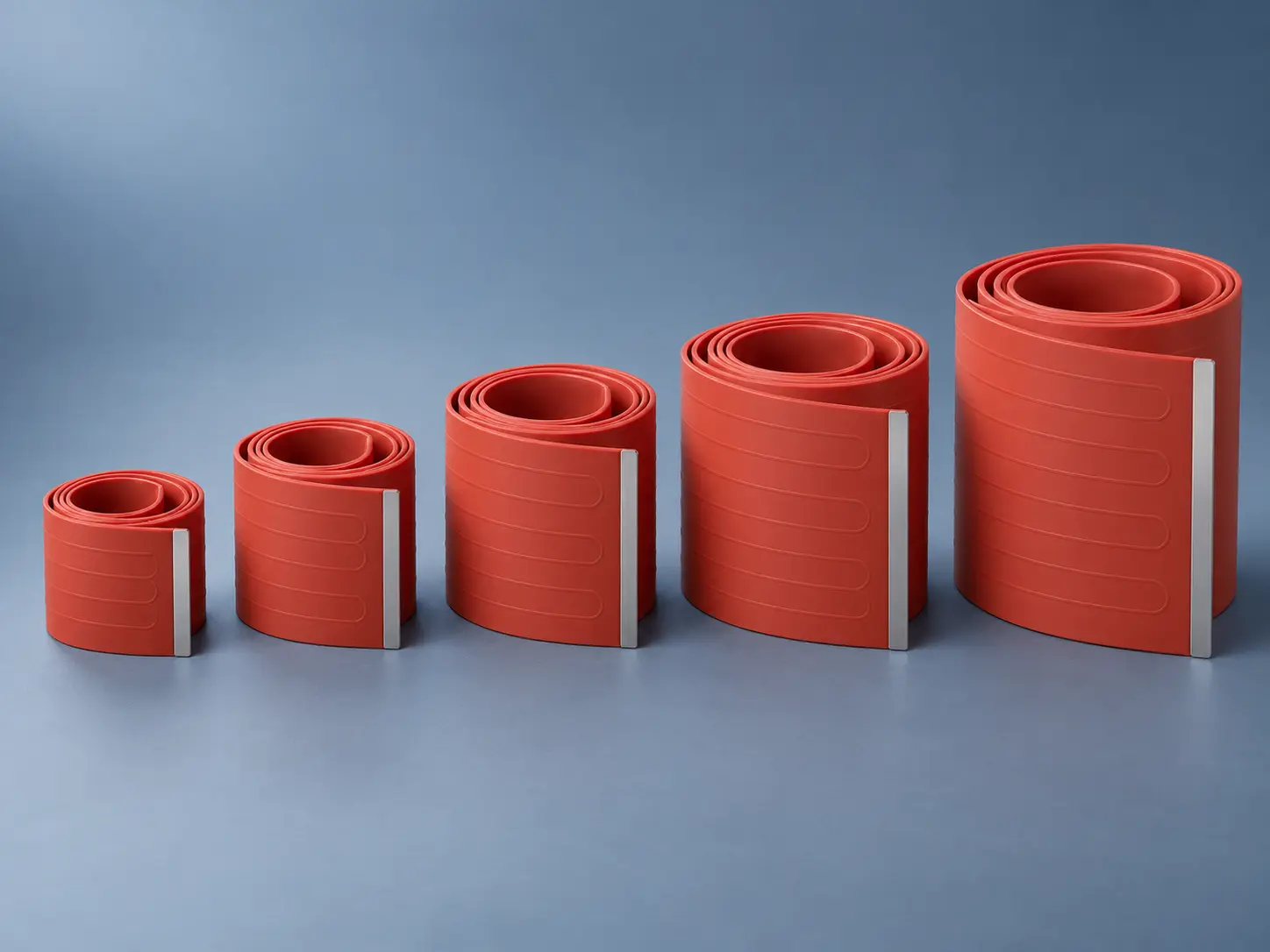
This LPG cylinder heater is a flat silicone rubber band that wraps around the steel wall of a liquefied petroleum gas cylinder and is held in place by steel tension springs. It warms the cylinder wall from outside so that the cylinder can keep supplying gas in cold weather. Five standard sizes cover 5 kg, 10 kg, 15 kg and 50 kg cylinders, from 80 × 760 mm at 180 W up to 200 × 1250 mm at 500 W, all for a 220 V supply. Each band carries an adjustable knob thermostat with a temperature sensor, an indicator light and an earth (ground) conductor, and is supplied with a leakage-protection plug. The listed working temperature is 0 to 200°C.
Because LPG cylinders are pressure vessels, this page treats the heater as an auxiliary warming device whose setting must stay well within the cylinder’s own temperature limits. It sets out the sizes, explains why low wattage is deliberate, and lists what to confirm under local gas regulations before use.
Key Features
- Sizes for 5 kg, 10 kg, 15 kg and 50 kg cylinders
- 180–500 W at 220 V; custom wattage on request
- Adjustable knob thermostat with separate temperature sensor
- Indicator light shows when the band is energised
- Earth (ground) conductor and leakage-protection plug
- Waterproof sealed lead exit
- Steel tension spring closure
- Working temperature 0 to 200°C
Why a Cylinder Needs Warming
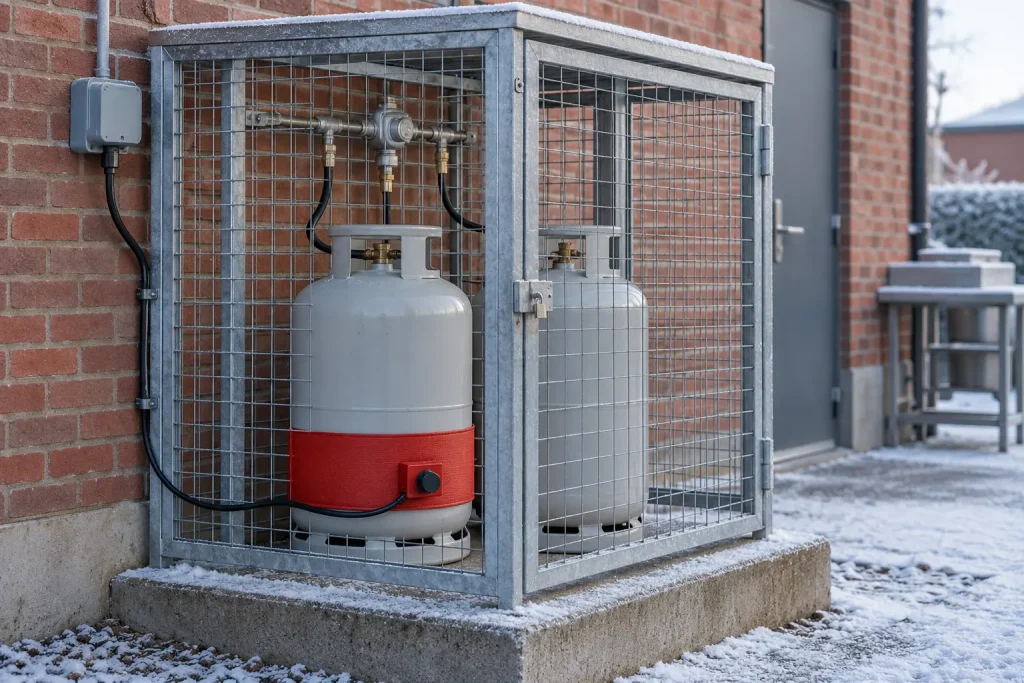
An LPG cylinder supplies gas by evaporating the liquid inside it, and evaporation absorbs heat from the cylinder wall. In cold weather, or when gas is drawn quickly, the liquid cools, its vapour pressure falls and the gas flow drops. Frost forming on the outside of the cylinder is the familiar sign. Restaurants, food stalls, workshops and small heating installations then see weak flames even though the cylinder is far from empty. A low-wattage heating band replaces some of the heat lost to evaporation and helps keep the pressure up. Its job is to bring the cylinder back towards normal ambient temperature, not to heat it.
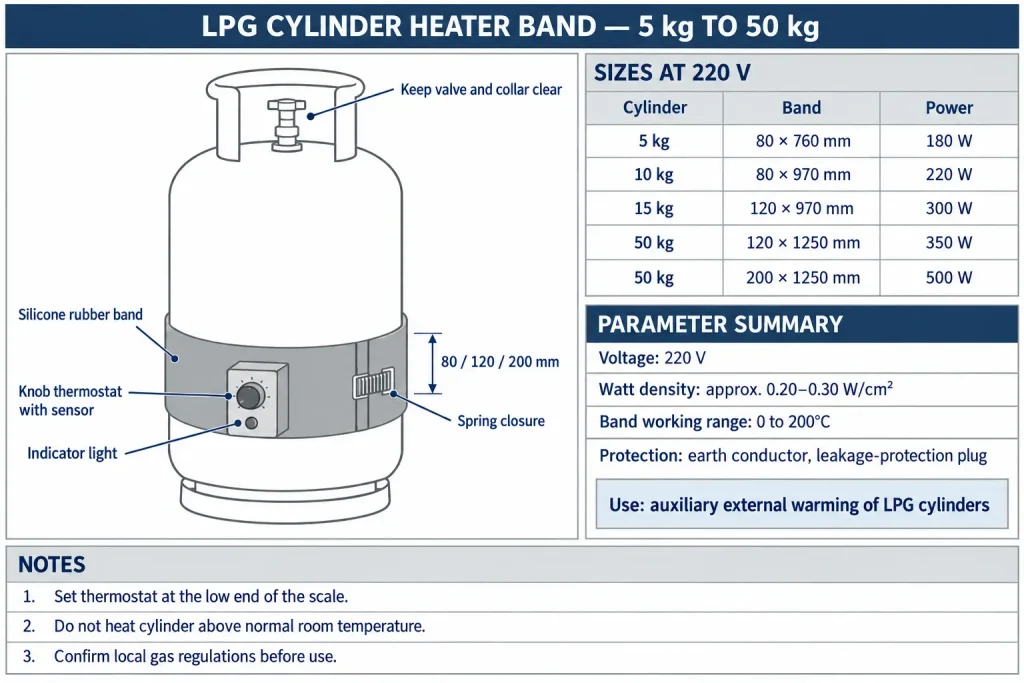
Sizes and Power
| Cylinder class | Band (height × length) | Power at 220 V | Watt density* | Current* |
|---|---|---|---|---|
| 5 kg | 80 × 760 mm | 180 W | approx. 0.30 W/cm² | approx. 0.8 A |
| 10 kg | 80 × 970 mm | 220 W | approx. 0.28 W/cm² | approx. 1.0 A |
| 15 kg | 120 × 970 mm | 300 W | approx. 0.26 W/cm² | approx. 1.4 A |
| 50 kg | 120 × 1250 mm | 350 W | approx. 0.23 W/cm² | approx. 1.6 A |
| 50 kg, taller band | 200 × 1250 mm | 500 W | approx. 0.20 W/cm² | approx. 2.3 A |
*Calculated from band area and rated power, and from power divided by 220 V.
These cylinder bands run at roughly 0.20–0.30 W/cm², about half the watt density of the drum heater bands in the same range. That is deliberate. A gas cylinder needs gentle, even warming over a large area of wall rather than fast heat input, and the lower density keeps the band surface cooler for any given thermostat setting. For the 50 kg class, the taller 200 mm band spreads 500 W over more of the wall than the 120 mm band, and it is the better choice where cylinders are drawn hard in sustained cold.
Temperature Setting and Cylinder Limits
The 0–200°C figure is the band material’s working range, and it is not a target for the cylinder. LPG cylinders are generally designed to be stored and used at no more than ordinary ambient temperatures, commonly with an upper limit of about 50°C. Pressure inside the cylinder rises steeply as the contents warm. The thermostat should therefore be set at the low end of its scale, so that the band only offsets the cooling caused by evaporation. Check the setting against the cylinder supplier’s limits and local rules, and never use the band to heat a cylinder above normal room temperature.
- Fit the band around the lower, liquid-filled part of the cylinder wall, clear of the valve, collar and foot ring.
- Do not cover the valve, the pressure relief device or the regulator with the band or its lead.
- Use the band only on a cylinder standing upright in a ventilated location, as the gas installation rules require.
- Switch off and unplug before changing or moving the cylinder.
Electrical Protection Built Into the Band
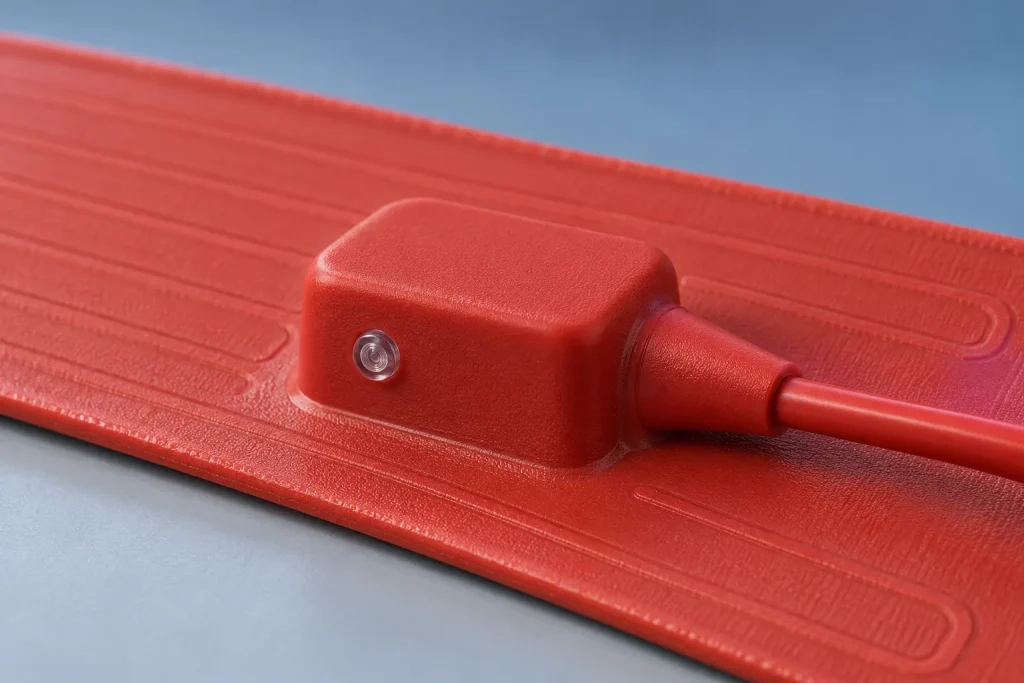
The band carries several features intended for outdoor and damp locations, where cylinders are usually kept. A dedicated earth conductor runs with the supply lead, and the lead leaves the band through a sealed waterproof joint. The band is supplied with a leakage-protection plug that disconnects the supply if current leaks to earth. An indicator light on the thermostat housing shows when the band is powered. The temperature sensor sits on the band separately from the knob housing, so the thermostat responds to the heated surface. Connect the band only to a properly earthed socket.
Specification
| Parameter | Value |
|---|---|
| Product type | Silicone rubber LPG cylinder heating band |
| Cylinder classes | 5 kg, 10 kg, 15 kg, 50 kg |
| Band sizes | 80 × 760, 80 × 970, 120 × 970, 120 × 1250, 200 × 1250 mm; custom on request |
| Power | 180, 220, 300, 350 and 500 W respectively; custom up to 2,000 W listed |
| Supply voltage | 220 V |
| Working temperature | 0 to 200°C (band material) |
| Heating element | Nickel-chromium alloy wire, evenly laid |
| Temperature control | Adjustable knob thermostat with separate temperature sensor |
| Protection features | Earth conductor; leakage-protection plug; indicator light; waterproof lead joint |
| Closure | Steel tension springs at the band ends |
| Listed use | Auxiliary external warming of LPG / gas cylinders |
| Certification | Not stated for this item; confirm required documents per order |
What This Heater Specification Covers
The specification defines the band’s size, rated power at 220 V, working temperature range, control and electrical protection features. It does not establish that external heating of gas cylinders is permitted at a given site. Rules on heating LPG cylinders, on electrical equipment near gas installations and on hazardous-area classification differ between countries and installation types, and some jurisdictions restrict or prohibit external heating of cylinders. Confirm application suitability with your gas supplier, the cylinder owner and local regulations before specifying or installing the band.
Common Procurement Errors
- Choosing a drum band for a cylinder. Drum bands run at roughly twice the watt density. Use a cylinder band sized for the cylinder.
- Ordering by cylinder weight without measuring. Cylinders of the same fill weight vary in diameter between countries and makers. Measure the circumference where the band will sit.
- Assuming a 110 V supply. Standard bands are built for 220 V. Other supplies need a separate build, confirmed at enquiry.
- Replacing the leakage-protection plug. The plug is part of the band’s electrical protection. Specify the plug type your market needs rather than cutting it off.
- Skipping the regulatory check. Confirm local gas rules before ordering for a commercial kitchen or public site.
RFQ Checklist
- Cylinder fill weight and measured circumference
- Clear wall height between the collar and the foot ring
- Band size from the standard list, or a custom size
- Supply voltage and required plug type for your market
- Installation location (indoor, outdoor, cylinder cage or cabinet)
- Local gas-safety and electrical requirements that apply
- Certification or test documents required for your market
- Quantity per size
Certification and Documentation
No certification is stated for this heater in the current specification. Gas-related applications often require specific approvals, so name the approval or test report your market requires at enquiry. Availability can then be confirmed for the ordered size and plug before quotation. Applicable RoHS / REACH documentation can be confirmed according to the ordered construction.
Related Categories
Drum bands, crankcase belts, heating tapes and pads are listed in the Silicone Rubber Heaters category, part of the High Temperature Wire Cable range.