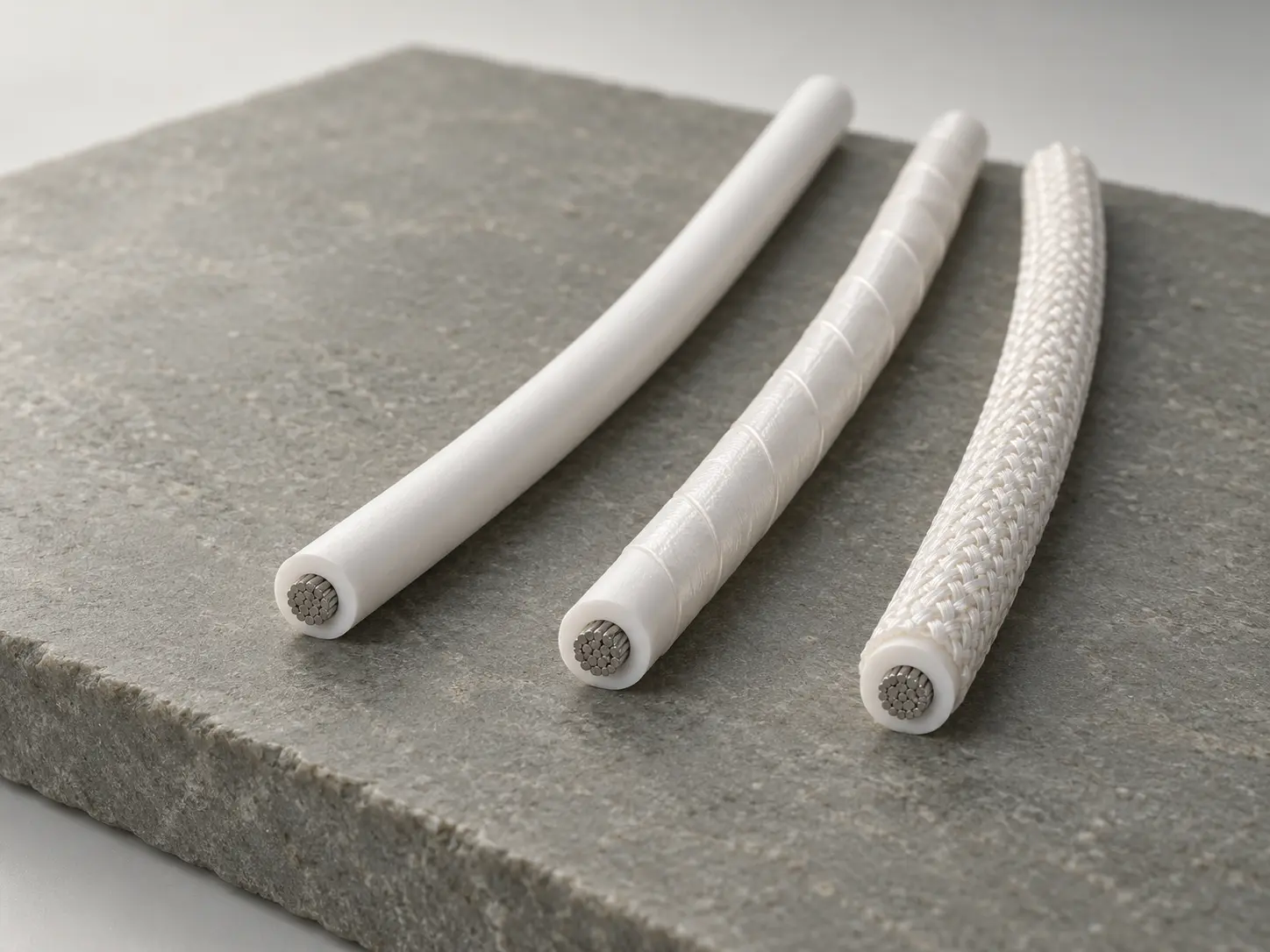
UL 1659 250°C 600V PTFE/TFE Wire for Internal Wiring
This page covers UL AWM Style 1659 as a construction type: a single conductor with extruded PTFE / TFE insulation, rated 250°C and 600 Vac with a Horizontal Flame designation. It is written for equipment and appliance OEM engineering and procurement teams working from a drawing, BOM or wire specification.
The conductor range is 26 AWG–4/0 AWG, solid or stranded round, Marking is General, and the official Use is “Internal wiring.” Alongside those fixed parameters the Style carries four separate optional provisions: an oil resistance rating at 80°C, a gasoline resistance rating, a mica tape wrap and a treated glass braid.
Those four options are where most Style 1659 specifications lose accuracy, because each is independent of the others and none is included by default. The sections below take the fixed parameters first, then the options, then the fields that belong to the ordered construction.
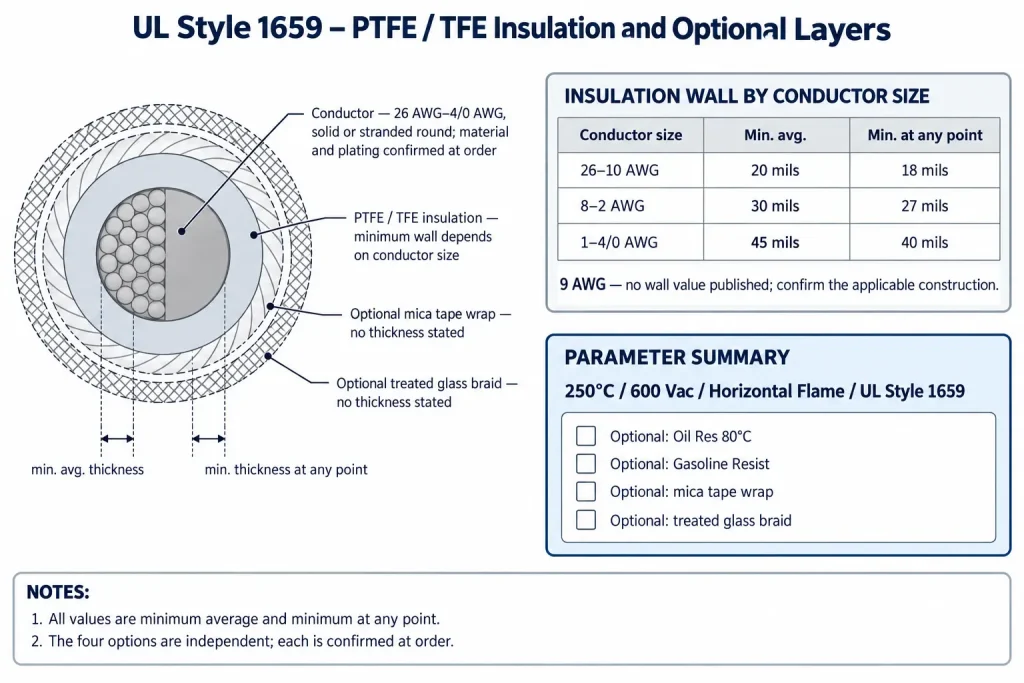
Confirmed UL Style 1659 Construction and Ratings
| Parameter | Requirement |
|---|---|
| UL AWM Style | 1659 |
| Product Description | Single conductor with extruded insulation |
| Temperature Rating | 250°C |
| Voltage Rating | 600 Vac |
| Flame | Horizontal Flame |
| Optional Oil Resistance | Oil Res 80°C (optional) |
| Optional Gasoline Resistance | Gasoline Resist (optional) |
| Style Conductor Range | 26 AWG–4/0 AWG |
| Conductor Form | Solid or stranded round |
| Insulation | PTFE, TFE |
| Optional Covering | Mica tape wrap (optional) |
| Optional Braid | Treated glass braid (optional) |
| Marking | General |
| Official Use | Internal wiring. |
| Documentation | UL marking and compliance documents according to the confirmed ordered construction |
| RoHS / REACH | Applicable RoHS / REACH documentation can be confirmed according to the ordered construction |
| Conductor size | Minimum average thickness | Minimum thickness at any point |
|---|---|---|
| 26–10 AWG | 20 mils | 18 mils |
| 8–2 AWG | 30 mils | 27 mils |
| 1–4/0 AWG | 45 mils | 40 mils |
Ten points to clarify about the tables above:
- The insulation is PTFE / TFE. FEP, PFA and ETFE are different materials and are not this Style.
- The temperature rating is 250°C, stated without a duty qualifier, and the voltage rating is 600 Vac. The record gives no DC rating.
- The oil resistance rating is optional and is stated at 80°C, separate from the 250°C Style temperature rating.
- The gasoline resistance rating is also optional and independent of the oil rating.
- The mica tape wrap and the treated glass braid are separate optional elements, each supplied only where specified and confirmed.
- Each wall group gives two independent minimums rather than a range or a nominal wall.
- The published groups are 26–10 AWG, 8–2 AWG and 1–4/0 AWG. 9 AWG falls outside all three, so for a 9 AWG requirement the applicable qualified construction must be confirmed rather than assigned to a neighbouring group.
- The conductor is round, solid or stranded. Material, plating, strand count, strand diameter and lay length are not defined by the Style.
- Finished OD, OD tolerance, conductor resistance, metric cross-section and ampacity are not defined by the Style.
- The Style range is not a stock list, and availability of a given size and configuration is confirmed per enquiry.
PTFE / TFE as the Material Identity
The insulation entry reads PTFE, TFE, and that is what a qualified Style 1659 construction is built to. PTFE and TFE belong to the fluoropolymer family, but this page keeps the specific identity rather than substituting the family name, and it does not transfer properties published for FEP, PFA or ETFE to this Style.
The distinction has practical weight when a listing, a legacy drawing or a competing quotation describes Style 1659 with a different fluoropolymer. That discrepancy should be resolved before an order, because it indicates either a mislabelled Style or a different construction. Where a design genuinely requires another fluoropolymer, that points to a different AWM Style, quoted under that Style’s own record.
Beyond the optional oil and gasoline ratings, the record states no chemical, solvent, moisture, low-friction, dielectric constant or outgassing property, so none is attributed to the insulation here.
Wall Thickness by Conductor Size, and the 9 AWG Gap
The wall is set in three groups: 20 mils minimum average and 18 mils minimum at any point for 26–10 AWG; 30 mils and 27 mils for 8–2 AWG; 45 mils and 40 mils for 1–4/0 AWG. Within each group both conditions apply together, and neither value is a nominal build.
The gap at 9 AWG deserves explicit handling. The first group ends at 10 AWG and the second begins at 8 AWG, so the record publishes no wall requirement for 9 AWG. Rounding that size into either neighbouring group supplies a value the record does not give; the applicable construction is confirmed with the supplier before the requirement is fixed.
Minimum wall values also do not produce a finished outer diameter. Actual OD depends on the conductor material and form, the actual conductor dimensions, the applicable group, whether the optional mica tape wrap or treated glass braid is applied, the extrusion and manufacturing tolerance. Where connector entry, sleeve fit or routing clearance is controlled, state a maximum finished OD and OD tolerance in the RFQ.
Four Independent Options
The record carries four optional provisions, and they do not travel together. A construction may have any, all or none of them, and each must be stated in the enquiry to be included.
Oil Res 80°C. An oil resistance rating at 80°C. That temperature belongs to the rating and does not follow the 250°C Style temperature rating, so an oil requirement at a higher temperature is not established by this Style.
Gasoline Resist. A gasoline resistance rating, independent of the oil rating. Neither implies the other, and neither is a general chemical compatibility statement.
Mica tape wrap. An optional wrap. The record states no thickness and no function for it, so no fire-survival, circuit-integrity, mechanical or dielectric property is claimed here.
Treated glass braid. An optional braid. The record likewise assigns it no function, so no abrasion resistance or mechanical protection is claimed.
Because the two construction options change the finished build, an enquiry that requires either should also state any dimensional limit that follows from it.
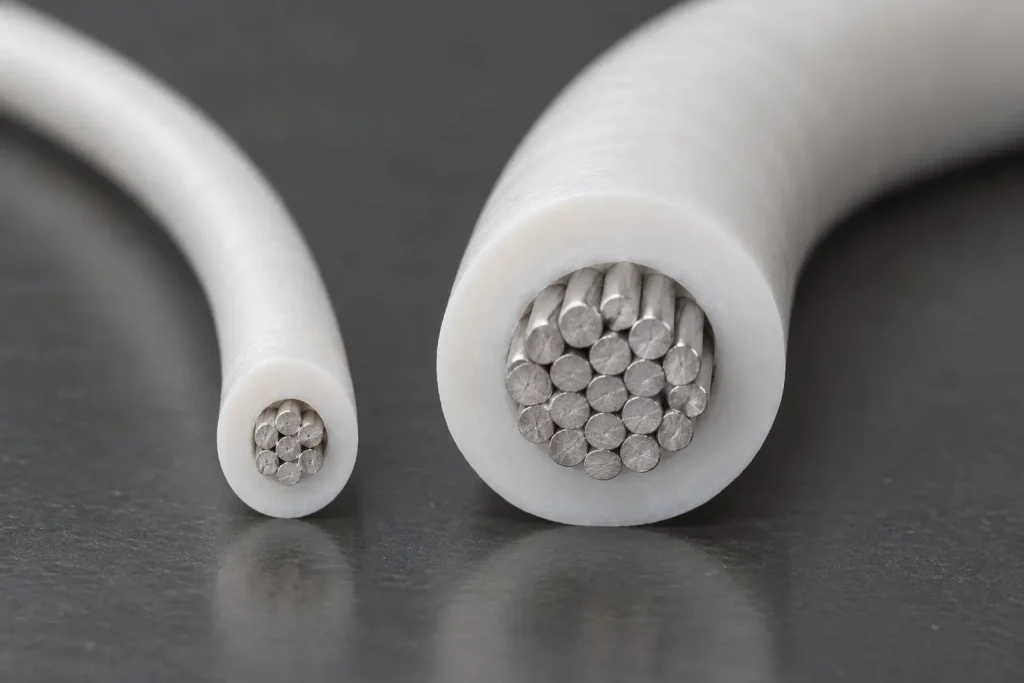
Conductor Range and Construction
The Style covers 26 AWG through 4/0 AWG, solid or stranded round, spanning fine internal leads through to heavy conductors. Listings showing a wider span describe sizes the Style does not cover.
The following are RFQ fields rather than Style values:
- solid or stranded form
- conductor material
- plating or surface finish, such as silver-plated or nickel-plated constructions where the drawing requires one
- strand count, strand diameter and lay construction, where controlled
- maximum conductor resistance, where controlled
- metric cross-section, where a drawing specifies mm² rather than AWG
No stranding class, flexibility grade or flex life is applied here. Conductor size assigns no circuit function or current capacity either: the record gives no ampacity, and none is inferred from conductor size, the 250°C rating or the 600 Vac rating. Current-carrying capacity is evaluated through the buyer’s equipment design and the applicable approval process.
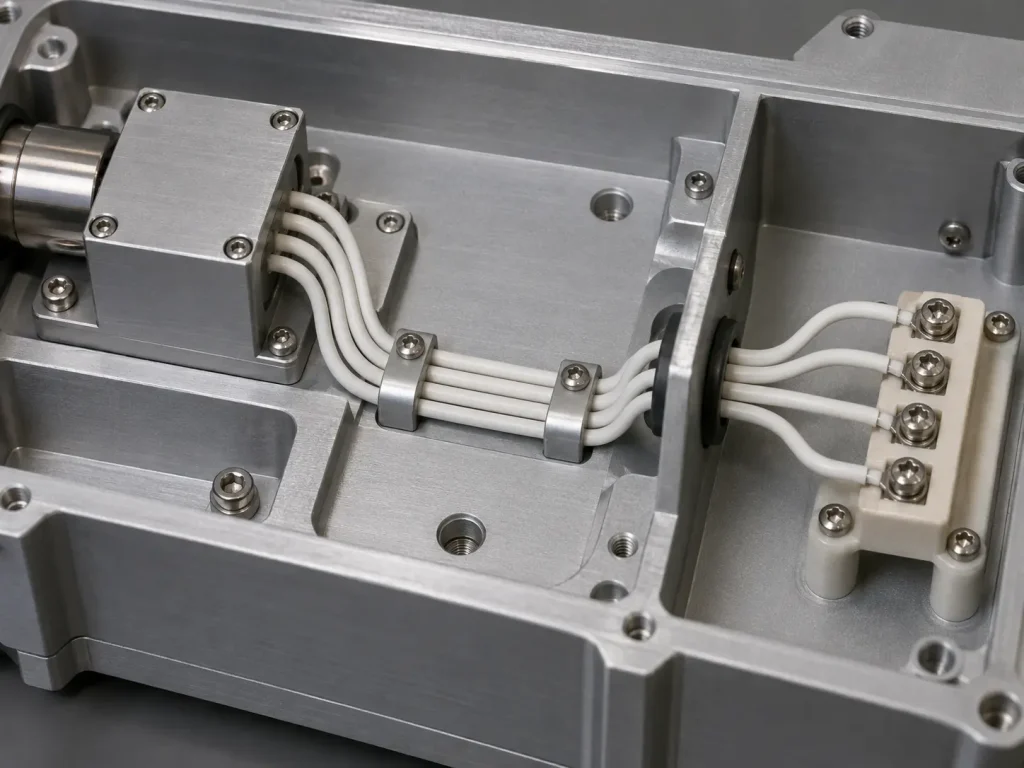
Official Use: Internal Wiring
The official Use is “Internal wiring.” The record attaches no equipment category to it, so this page neither narrows it to appliances nor widens it into building or field wiring, branch-circuit or facility wiring, conduit or tray installations, external equipment wiring, portable cord, or interconnection between separate enclosures.
Enquiries often arrive from contexts such as high-temperature equipment interiors, sensor and instrumentation assemblies, heating equipment, laboratory or semiconductor equipment, or aerospace and defence programmes. Those are buyer enquiry contexts that can be reviewed against the drawing, and they do not change the Use or establish suitability for any industry qualification. Compliance of a finished product is established at the equipment level and is not conferred by the Style designation of one internal wire.
How to Specify UL 1659
A Style designation is a construction requirement, not a complete purchase specification. A complete enquiry adds:
- the UL AWM Style 1659 requirement
- the AWG within 26 AWG–4/0 AWG
- solid or stranded round conductor
- conductor material and plating, where controlled by the drawing
- strand construction and maximum conductor resistance, where controlled
- whether the optional Oil Res 80°C rating is required
- whether the optional Gasoline Resist rating is required
- whether the optional mica tape wrap is required
- whether the optional treated glass braid is required
- insulation colour and any identification requirement
- the marking requirement, including any customer-specific marking to be reviewed
- maximum OD and OD tolerance, where controlled
- the internal wiring location
- the drawing, BOM or equipment specification
- documentation requirements, quantity and packaging preference
- the destination and the requested Incoterm
Customer-specific marking is reviewed against the ordered construction rather than offered as a standing feature. No price, currency, pricing formula or price validity period is published on this page, and a quotation is issued as a separate quotation document.
What Style 1659 Does and Does Not Define
Style 1659 defines:
- 250°C temperature rating and 600 Vac voltage rating
- Horizontal Flame
- optional Oil Res 80°C and optional Gasoline Resist ratings
- conductor range 26 AWG–4/0 AWG, solid or stranded round
- PTFE / TFE insulation with minimum wall requirements of 20/18 mils for 26–10 AWG, 30/27 mils for 8–2 AWG and 45/40 mils for 1–4/0 AWG
- an optional mica tape wrap and an optional treated glass braid
- Marking: General
- Use: Internal wiring.
Style 1659 does not universally define:
- conductor material, plating, strand count, strand diameter or lay length
- a wall requirement for 9 AWG
- a thickness or function for the optional mica tape wrap or treated glass braid
- finished OD, OD tolerance, bend radius, flex cycles or flex class
- conductor resistance, ampacity, current rating or metric cross-section
- a DC voltage rating
- chemical, solvent or moisture resistance beyond the optional oil and gasoline ratings
- dielectric constant, outgassing or low-friction properties
- aerospace, defence, medical, semiconductor or laboratory qualification
- customer-specific marking as a standing feature
- colour, reel length, MOQ, stock, lead time, production capacity or shipping term
Common Procurement Errors
- Describing the insulation as FEP, PFA or ETFE, or substituting “fluoropolymer” for the PTFE / TFE identity.
- Assigning 9 AWG to a neighbouring wall group instead of confirming the applicable construction.
- Applying one group’s wall values to a size in another group.
- Omitting the minimum-at-any-point value, or treating the minimum average as a nominal wall.
- Deriving a finished OD from the minimum wall values.
- Writing “250°C continuous”, or claiming a higher temperature rating.
- Stating a DC or peak voltage rating.
- Treating the optional oil or gasoline resistance as standard.
- Applying the 250°C rating to the oil resistance, which is stated at 80°C.
- Reading either resistance rating as general chemical compatibility.
- Treating the mica tape wrap or treated glass braid as included, or assigning either a performance function.
- Assuming the conductor is silver-plated or nickel-plated copper without stating it.
- Deriving ampacity from conductor size or the ratings.
- Extending “Internal wiring” into installation, field or external cable use.
- Treating component Style recognition as an industry or equipment-level qualification.
RFQ Information to Confirm
Style and ratings
- UL AWM Style 1659 requirement
- 250°C temperature rating requirement
- 600 Vac voltage rating requirement
- AWG within 26 AWG–4/0 AWG
- Whether the optional Oil Res 80°C rating is required
- Whether the optional Gasoline Resist rating is required
Conductor and construction
- Solid or stranded round conductor
- Conductor material and plating requirement, if controlled by the drawing
- Strand construction, if controlled
- Maximum conductor resistance or controlled mm² cross-section, if applicable
- Whether the optional mica tape wrap or treated glass braid is required
- Maximum OD and OD tolerance, if controlled
Identification and application references
- Insulation colour and identification requirement
- Marking requirement, including any customer-specific marking to be reviewed
- Internal wiring location
- The circuit requirement for engineering review, rather than a self-derived ampacity
- Drawing, BOM or equipment specification
Commercial
- Quantity and packaging preference
- Destination and requested Incoterm
- Requested UL marking and compliance documents, including any RoHS / REACH documentation requirement
UL Marking and Documentation
CableApex is an international sales and export company and does not hold a UL File for Style 1659. Supplied wire is UL-recognized component wire where supplied under a qualified manufacturing scope, with UL marking according to the confirmed ordered construction. The Style record lists Marking as General.
Applicable RoHS / REACH documentation can be confirmed according to the ordered construction. CSA, FT1, VW-1, CE and dual UL/CSA designations are not claimed here.
Commercial, origin, compliance and transport documents are identified during quotation and confirmed according to the order. They are not supplied as a fixed package with every shipment.