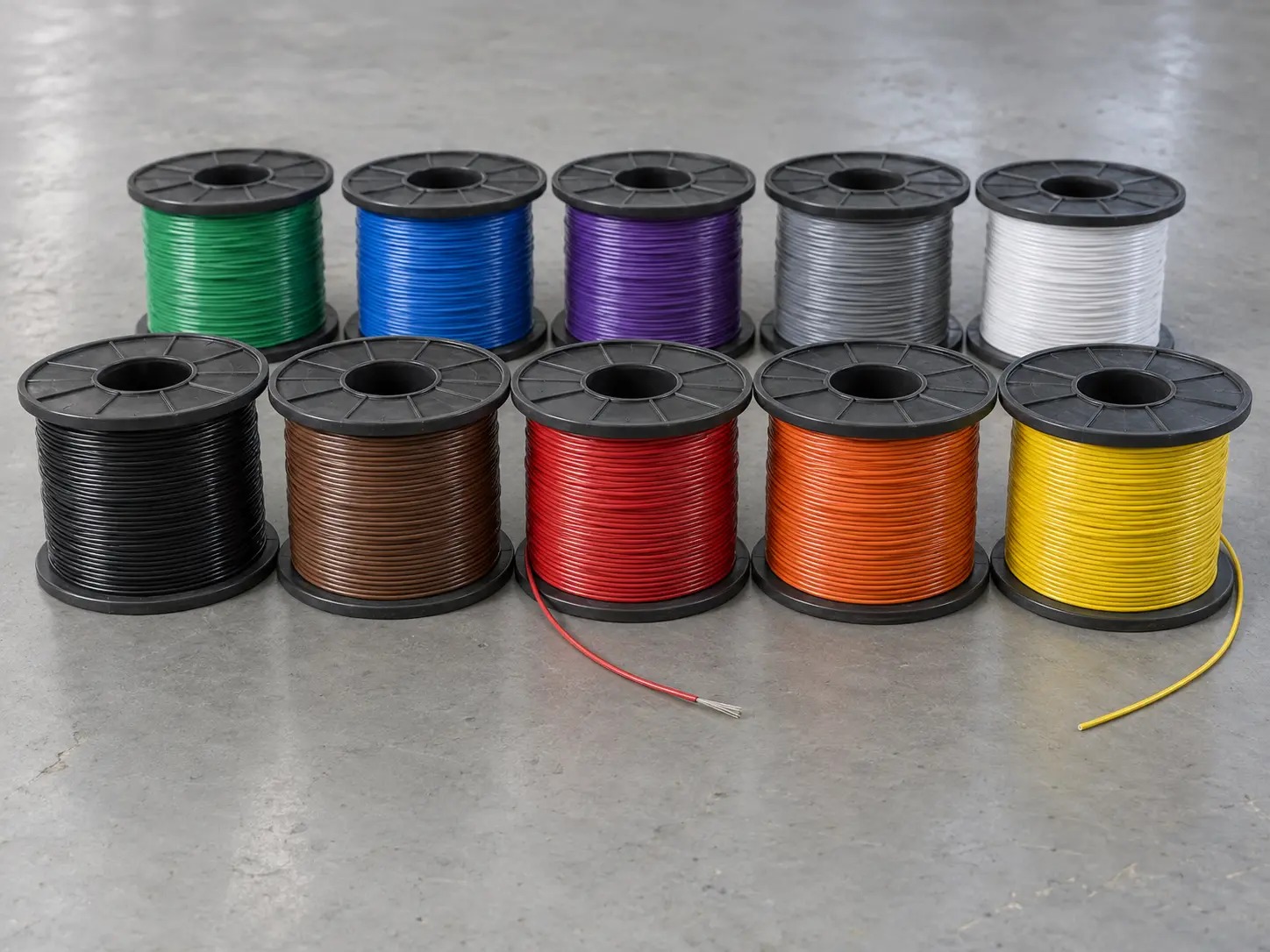
UL 1015 as Bulk Wire for Grouped Appliance Internal Leads
UL AWM Style 1015 is a single conductor with extruded PVC insulation, with 80°C, 90°C or 105°C rating options, voltage ratings of 600 Vac or 750 Vdc, and a Horizontal Flame designation. The Style conductor range is 30 AWG through 2000 kcmil, solid or stranded.
This page covers the supply of that wire in bulk, with a commercial focus on the 30–9 AWG group, for grouped fixed internal appliance leads and as input wire for appliance harness assembly.
Harness wire and grouped leads are commercial and assembly terms. They are not the formal UL Style name, and Style 1015 certifies no finished harness, complete wire assembly, bundle geometry, harness ampacity, connector system or terminal system. The official Use is internal wiring of appliances.
Verified UL Style 1015 Specification
| Parameter | Style-level information |
|---|---|
| UL AWM Style | 1015 |
| Construction | Single conductor with extruded insulation |
| Temperature rating | 80°C, 90°C or 105°C |
| Voltage rating | 600 Vac or 750 Vdc |
| Flame | Horizontal Flame |
| Optional oil rating | 60°C or 80°C Oil |
| Conductor range | 30 AWG–2000 kcmil |
| Conductor form | Solid or Stranded |
| Insulation | Extruded PVC |
| 30–9 AWG | 30 mil average / 27 mil minimum |
| 8–7 AWG | 45 mil average / 40 mil minimum |
| 6–2 AWG | 60 mil average / 54 mil minimum |
| 1–4/0 AWG | 80 mil average / 72 mil minimum |
| 250–500 kcmil | 95 mil average / 86 mil minimum |
| 550–1000 kcmil | 110 mil average / 99 mil minimum |
| 1100–2000 kcmil | 125 mil average / 112 mil minimum |
| Marking | General |
| Official Use | Internal Wiring of Appliances |
| Optional tag — not a voltage rating | 2,500 V peak – for electronic use only |
The full Style range remains 30 AWG through 2000 kcmil across all seven insulation groups. This page commercially focuses on the 30–9 AWG group for grouped appliance leads and harness input wire, and that commercial focus does not redefine the UL Style range.
Why This Page Focuses on 30–9 AWG
The 30–9 AWG group carries the Style’s 30 mil minimum average insulation requirement with 27 mils minimum at any point. It is the group most appliance control and interconnection circuits fall into, which makes it the practical starting point for buyers sourcing multiple internal leads, colour-coded circuits or bulk wire for harness assembly.
That is a procurement observation, not a performance claim. Nothing here states that 30–9 AWG provides better harness flexibility, easier bundling, a smaller bundle diameter, faster assembly, cleaner layouts, lower weight or higher wiring density. Actual harness geometry depends on the ordered conductor construction and the complete appliance design.
Style 1015 does not end at 9 AWG, larger sizes are equally part of it, and 30–9 AWG is not the only Style 1015 construction.
The Style Defines the Wire, Not the Harness
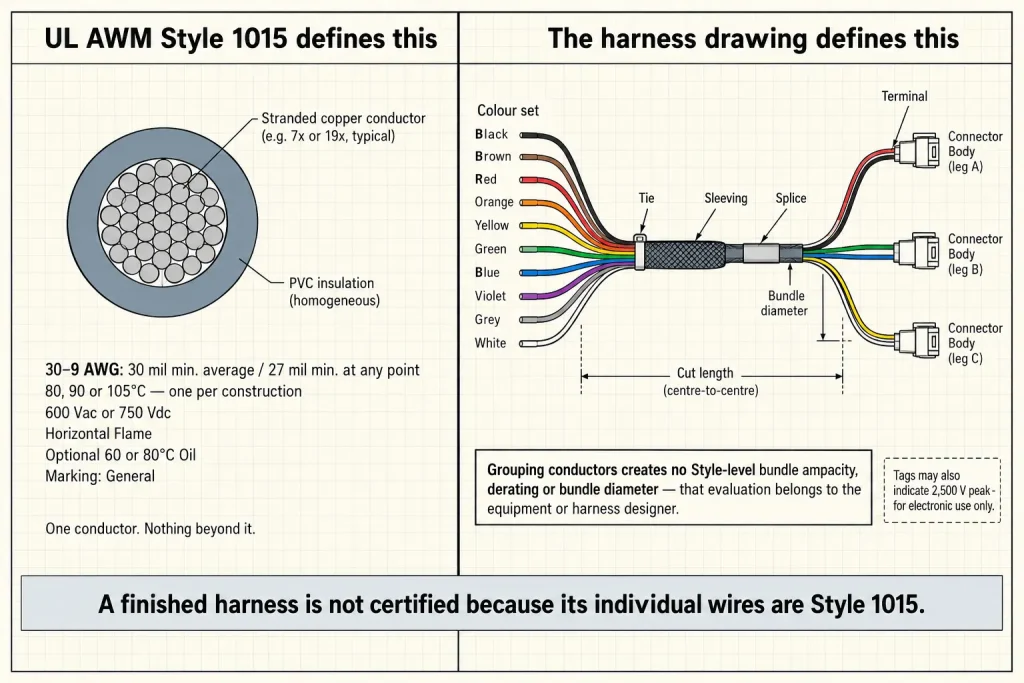
Style 1015 defines a single-conductor construction. A harness is an assembly built from many of them.
The Style does not define the number of conductors, the colours within the assembly, branch geometry, bundle diameter, ties, sleeving, terminals, connectors, splices or cut lengths. Those belong to the harness drawing and the assembler.
A finished harness is therefore not certified because the wires in it are Style 1015. The correct descriptions are bulk single-conductor wire for harness assembly, or wire used as grouped fixed internal leads within appliances — not a UL1015 certified harness, a UL-recognized complete harness, or Style 1015 harness certification.
Grouping Does Not Change the Style Rating
Bundling several Style 1015 wires together creates an assembly. It does not create a new rating, and the Style provides nothing that applies specifically to grouped conductors.
No claim is made here that grouping establishes bundle ampacity, a bundle current rating, a temperature derating, a bundle diameter, bundle flame performance or a harness current capacity. No derating factor is invented.
Grouped conductors can interact thermally, and that interaction is real — but quantifying it belongs to the equipment or harness designer working from the actual circuit loads and the enclosure conditions, not to the Style number the individual wires carry.
No Universal Ampacity, Individual or Grouped
No universal current rating is published here for individual Style 1015 conductors, for grouped conductors, for wire bundles or for finished harnesses. The Style establishes none.
No derating percentage, maximum bundle size, current table or bundle temperature rise figure is offered. These remain equipment-design matters throughout.
Seven Insulation Groups
Style 1015 defines seven insulation groups across its conductor range, each with a minimum average thickness and a separate minimum thickness at any point. These are not nominal values, and the 30/27 mil construction is not applied to the entire Style.
For a multi-circuit wire schedule this matters directly: a schedule containing both fine control leads and a heavier supply lead may cross a group boundary, and the two lines then describe different constructions under one Style number. The 8–7 AWG group in particular covers only two sizes and sits between the broad 30–9 AWG group and the 6–2 AWG group.
Temperature Rating Is Selected Per Construction
Style 1015 permits 80°C, 90°C or 105°C. Not all Style 1015 appliance harness wire is 105°C, and the applicable ordered construction must be confirmed for the required rating.
In a harness with circuits in different thermal positions, the required rating may differ between wire schedule lines. 105°C continuous is not used here without separate verification for a specific ordered construction.
600 Vac, 750 Vdc, and the 2,500 V Peak Tag
The formal Style voltage ratings are 600 Vac and 750 Vdc. Both are used accurately here, and neither is written as 750 Vac, 600/750 Vac, 600V AC/DC or 750V AC/DC. Where commercial text uses the shorthand 600V, the technical position remains 600 Vac or 750 Vdc.
The Style separately permits a tag stating 2,500 V peak – for electronic use only. That is not the normal voltage rating and is not turned into 2500V wire, 2500 Vac, 2500 Vdc, 2.5 kV continuous wire or 600/2500V wire. It remains a secondary technical note.
Conductor Material and Form
Style 1015 establishes the 30 AWG–2000 kcmil range and the solid or stranded form. It does not universally establish copper, tinned copper, bare copper, silver-plated copper or nickel-plated copper, and it establishes no strand count, strand diameter, lay length or conductor resistance.
Where appliance harness production requires a specific conductor material, plating or strand construction, each is an RFQ confirmation field. Stranding is frequently controlled in harness work because of crimp compatibility, so it is worth stating where the drawing fixes it.
Both conductor forms are permitted, so not every harness order uses stranded conductor, and the wire is not described here as flexible, high-flex or extra-flexible — the Style data establishes no flex class or cycle rating.
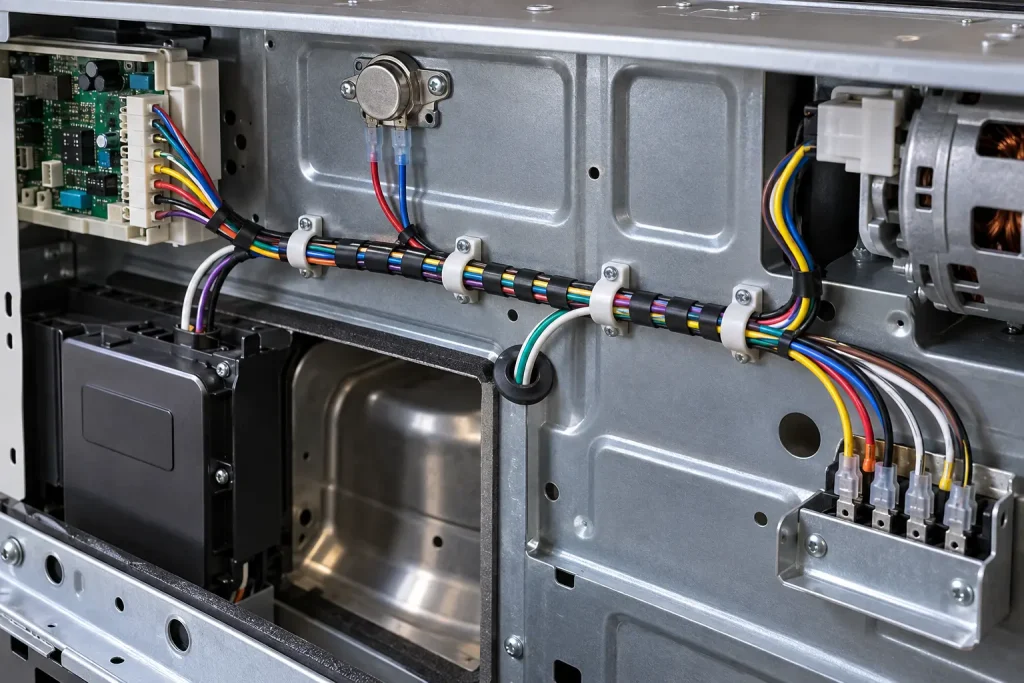
Colour Is Specified, Not Supplied by Default
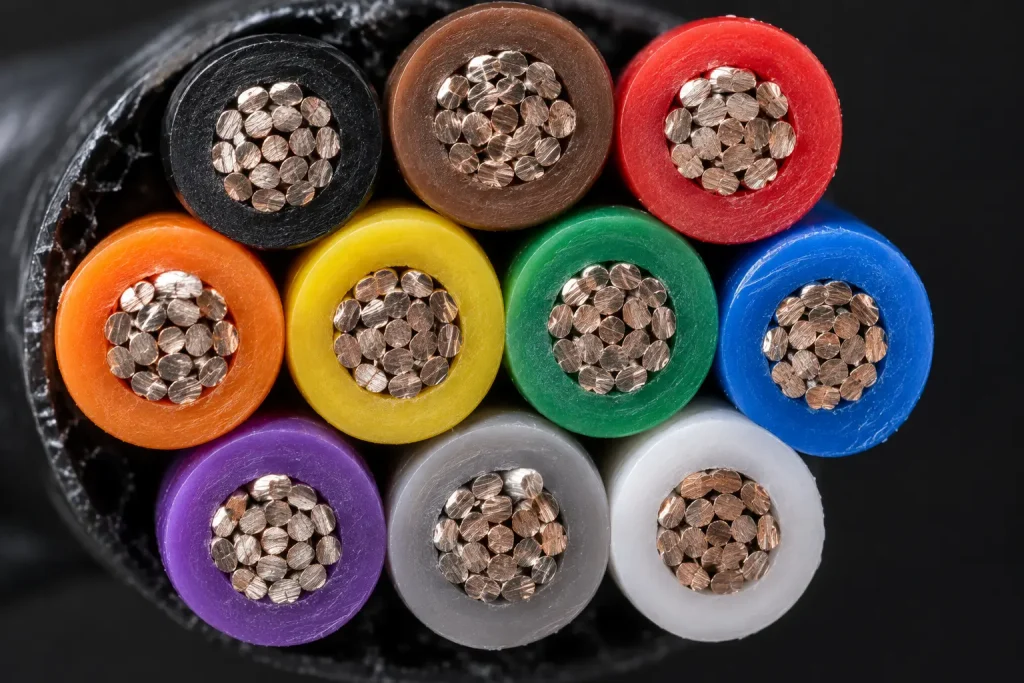
Colour identification is central to most harness drawings and entirely outside the Style.
The Style page establishes no universal colour set, and nothing here promises specific colours always in stock, standard colour availability, stable colour supply or guaranteed colour consistency. No claim is made that colour coding itself improves assembly efficiency.
Required insulation colours should be identified in the RFQ — ideally per circuit, referencing the wire schedule — and confirmed for the ordered construction.
Finished OD and Bundle Diameter
Style 1015 establishes no universal finished OD, and none is calculated here from conductor gauge plus minimum insulation wall. Actual dimensions depend on the actual conductor diameter, the solid or stranded construction, the strand configuration, the actual PVC extrusion and manufacturing tolerance.
Bundle diameter is a further step removed. It depends on the number of conductors, the individual wire OD, the arrangement, any twisting or lay, ties or sleeving, connector geometry and the assembly method — none of which Style 1015 defines. No bundle diameter is calculated or guaranteed from Style data.
For harness or grouped-lead programs, specify the maximum finished OD, the OD tolerance, the connector cavity size, the terminal entry and the routing-channel dimensions where these are controlled.
Optional Oil Rating
Style 1015 includes an optional 60°C or 80°C Oil rating. Not all Style 1015 wire is oil resistant.
Where an appliance environment involves oil exposure, ask whether the applicable optional Oil rating is required and confirm it for the ordered construction. The optional rating is not expanded here into broader chemical-resistance claims.
Horizontal Flame
The verified Style-level flame designation is Horizontal Flame. VW-1, FT1 and vertical flame are not claimed here, and any separately confirmed additional flame requirement remains order-specific rather than becoming a Style 1015 claim.
Appliance Enclosure Context
Where this page refers to an appliance cabinet or internal appliance enclosure, it means an enclosure that is part of the appliance itself.
It does not mean an industrial switchgear cabinet, a building control cabinet, a field-wired panel or a standalone industrial control enclosure. The Use does not extend to industrial control cabinet wiring, control-panel wiring generally, PLC cabinet wiring, building wiring, field wiring, branch circuits, tray, conduit, raceway, machine-tool field wiring, portable cord, external appliance cord or general electrical equipment wiring.
The audiences this page is written for are appliance OEMs, appliance harness assemblers, appliance component sourcing teams and buyers specifying internal appliance lead sets.
Bulk Wire and a Finished Harness
This page primarily represents bulk single-conductor wire suitable for use as an input to appliance harness assembly where the ordered construction meets the specification.
Nothing here should be read as a quotation for a completed harness, terminals, connectors, cut and stripped leads or crimped assemblies. Where processed leads or finished harnesses are required, those are separately specified and confirmed — and saying which is needed in the first enquiry avoids quoting the wrong scope.
What Style 1015 Does Not Define
- Conductor material, plating, strand count, strand diameter and lay length
- Conductor resistance, ampacity and current rating
- Bundle ampacity, bundle derating and bundle diameter
- Finished OD and OD tolerance
- Colour
- Terminal, connector, cut length and harness geometry
- Bend radius and flex life
- MOQ, stock, lead time and production capacity
Each requires the customer specification, the harness drawing, verified SKU documentation, the applicable qualified construction, or commercial confirmation.
Common Procurement Errors
- All Style 1015 assumed to be 105°C. 80°C and 90°C are equally Style options.
- The 750 Vdc rating omitted. Both voltage ratings are part of the Style.
- 2,500 V peak treated as ordinary working voltage. It is an electronic-use tag.
- Stranded tinned copper assumed. Conductor material is not set at Style level.
- The 30/27 mil wall applied to every Style size. Seven groups apply.
- Grouped wires assumed to have a UL-defined bundle ampacity. None exists.
- Grouping assumed to change thermal performance by a fixed amount. No derating factor is defined.
- Style 1015 assumed to certify a finished harness. It defines the single conductor.
- One universal finished OD assumed.
- The listed conductor range treated as stocked inventory.
- The Style used for general industrial control-panel or building wiring.
Appliance Harness RFQ Checklist
- UL AWM Style 1015 requirement
- Required AWG for each circuit, and quantity of each AWG
- Solid or stranded conductor
- Required conductor material
- Required conductor plating or finish
- Strand construction, if controlled
- Required temperature rating: 80°C, 90°C or 105°C
- 600 Vac or 750 Vdc requirement
- Optional Oil rating, if required
- Insulation colour for each circuit
- Maximum finished OD, if controlled, and OD tolerance
- Number of different lead circuits
- Whether wires will be grouped into a harness
- Customer harness drawing, if available
- Wire identification requirements
- Terminal or connector interface, if relevant
- Cut length, if processed leads are required
- Whether bulk wire or processed leads are being requested
- Marking requirement
- Quantity, packaging and destination
- Required compliance documentation
None of these values is invented here, and no requested combination is presented as automatically available.
Style Selection
UL 1007 and UL 1015 are separate AWM Styles with their own ratings, conductor ranges, insulation requirements, optional ratings and Style definitions. Neither is described here as a lighter-duty version of the other, and any Style substitution is reviewed against the actual appliance specification.
The same applies to silicone, fluoropolymer and XLPE constructions: none becomes more appropriate merely because a different polymer is wanted. AWM Style selection considers the official Use, the temperature, the voltage, the construction, the conductor range, the insulation requirements and the customer drawing.
UL Marking and Documentation
Material is supplied as UL-recognized component wire where supplied under qualified manufacturing scope, and UL marking is applied according to the confirmed ordered construction. The Style-level marking designation is General.
CSA AWM, FT1, VW-1 and dual UL / CSA certification are not claimed here; any additional certification depends on the ordered construction. Applicable RoHS / REACH documentation can be confirmed according to the ordered construction.