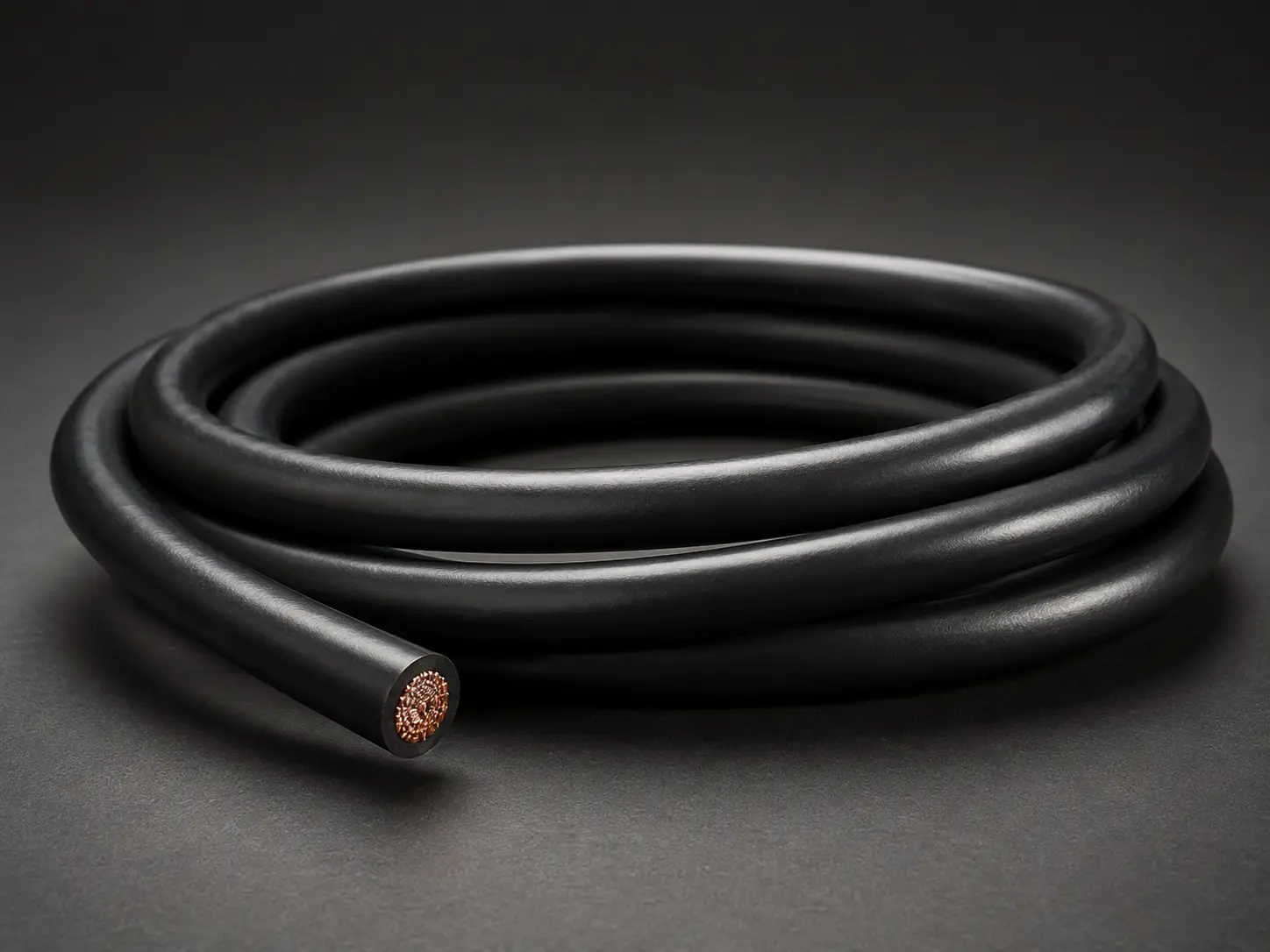
UL 1032 2 AWG PVC Power Wire Overview
UL AWM Style 1032 is a single-conductor PVC insulated wire construction, supplied by CableApex as a factory-direct manufacturer. This page focuses specifically on the 2 AWG configuration within Style 1032’s broader 30 AWG–2000 kcmil conductor range. The wire is rated 90°C, 1000 Vac and/or 1200 Vdc, with PVC insulation applied at the Style’s 7–2 AWG thickness band for the featured 2 AWG size. UL defines the Style’s use as internal wiring of appliances; “power wire” and “large-conductor appliance power connection” are CableApex’s commercial positioning for this product, not UL’s own terminology.
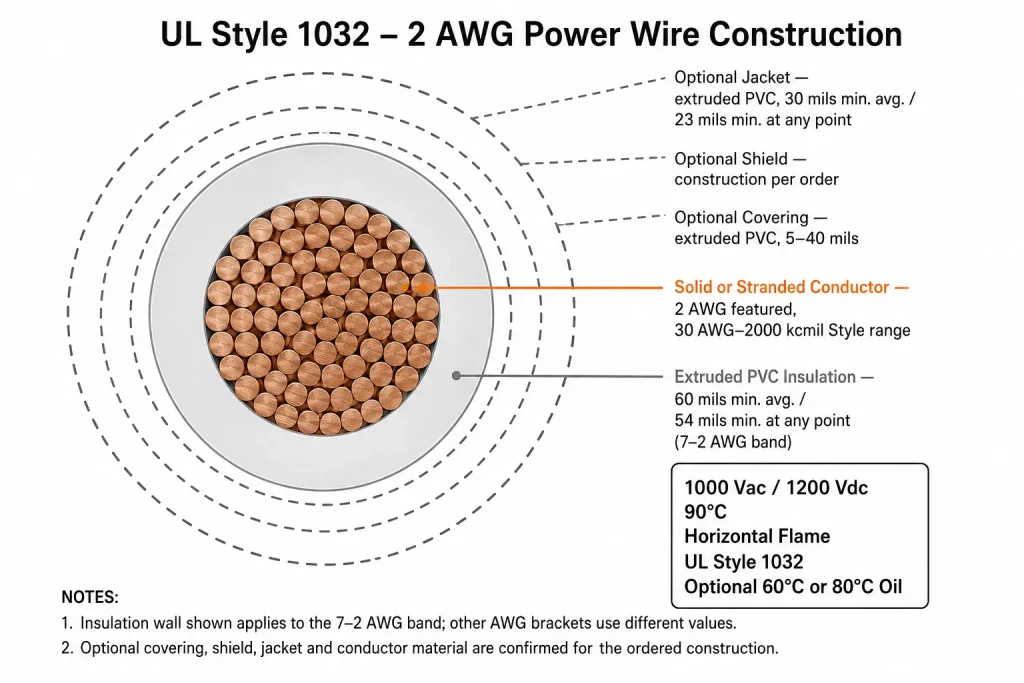
90°C / 1000 Vac / 1200 Vdc Rating
| Parameter | UL Style 1032 |
|---|---|
| UL Subject / Section | 758, Section 1 |
| Construction | Single conductor with extruded insulation |
| Featured Conductor Size | 2 AWG |
| UL Style Conductor Range | 30 AWG – 2000 kcmil |
| Conductor Form | Solid or stranded |
| Rated Temperature (Maximum) | 90°C |
| Voltage Rating | 1000 Vac and/or 1200 Vdc |
| Flame Rating | Horizontal flame |
| Insulation | Extruded PVC |
| Applicable 2 AWG Insulation Wall | 60 mil min. average / 54 mil min. at any point |
| Optional Covering | Extruded PVC, 5 mil min. at any point / 40 mil max. |
| Optional Shield | Yes, according to qualified construction |
| Optional Jacket | Extruded PVC, 30 mil min. average / 23 mil min. at any point |
| Optional Oil Designation | 60°C or 80°C, where qualified |
| Marking | General; tags may also indicate “3500 V peak – for electronic use only” |
| Use | Internal wiring of appliances |
| RoHS / REACH | Confirmed during quotation according to ordered materials and documentation requirements |
1000 Vac and 1200 Vdc are both confirmed continuous ratings for this Style. Certain qualified Style 1032 constructions may carry the permitted “3500 V peak – for electronic use only” tag statement — this is a distinct marking provision, not a 3500 Vac or 3500 Vdc continuous rating, and this page does not describe the product as a 3.5kV wire on that basis.
2 AWG Large-Conductor Appliance Power Wiring
This page focuses specifically on the 2 AWG configuration within UL Style 1032’s 30 AWG–2000 kcmil conductor range. The featured combination — 2 AWG, PVC insulation, 90°C, 1000 Vac / 1200 Vdc, and the applicable 60 mil insulation wall — differentiates this page from a general Style 1032 overview. We do not publish an ampacity figure, maximum current, continuous amps, or recommended fuse or breaker rating for 2 AWG or any AWG; current-carrying requirements depend on the equipment design, installation conditions, and applicable end-equipment evaluation, not on AWG alone.
60-Mil PVC Insulation Construction
2 AWG falls within Style 1032’s 7–2 AWG insulation band, which specifies a minimum average PVC thickness of 60 mils and a minimum thickness of 54 mils at any point. This is distinct from the Style’s other bands — for reference, the complete UL 1032 insulation-wall schedule is:
| Conductor Size | Min. Average Thickness | Min. Thickness at Any Point |
|---|---|---|
| 30–9 AWG | 30 mils | 27 mils |
| 8 AWG | 45 mils | 40 mils |
| 7–2 AWG (featured 2 AWG) | 60 mils | 54 mils |
| 1–4/0 AWG | 80 mils | 72 mils |
| 250–500 kcmil | 95 mils | 86 mils |
| 550–1000 kcmil | 110 mils | 99 mils |
| 1100–2000 kcmil | 125 mils | 112 mils |
We do not calculate or publish a finished outside diameter from AWG and insulation thickness, as conductor geometry and production tolerances are not part of the confirmed technical basis for this page.
Optional Covering, Shield and Jacket Configurations
UL Style 1032 permits three distinct optional construction layers beyond the primary PVC insulation, and this page keeps them clearly separate rather than merging them into one universal multilayer product:
- Optional covering — extruded PVC, 5 mils minimum thickness at any point, 40 mils maximum thickness.
- Optional shield — permitted according to the qualified construction; shield material, coverage, and construction are not established by the Style-level record and are confirmed for the ordered specification.
- Optional jacket — extruded PVC, 30 mils minimum average thickness, 23 mils minimum thickness at any point.
None of these three layers is standard on every UL 1032 2 AWG wire. The base construction is single-conductor PVC-insulated wire; a covered, shielded, or jacketed variant is supplied only where the qualified order requires it. The Style also permits an optional 60°C or 80°C oil designation, which is likewise construction-dependent rather than automatic.
UL 1032 Technical Specifications
See the specification table above for the complete confirmed ratings applicable to this featured 2 AWG product.
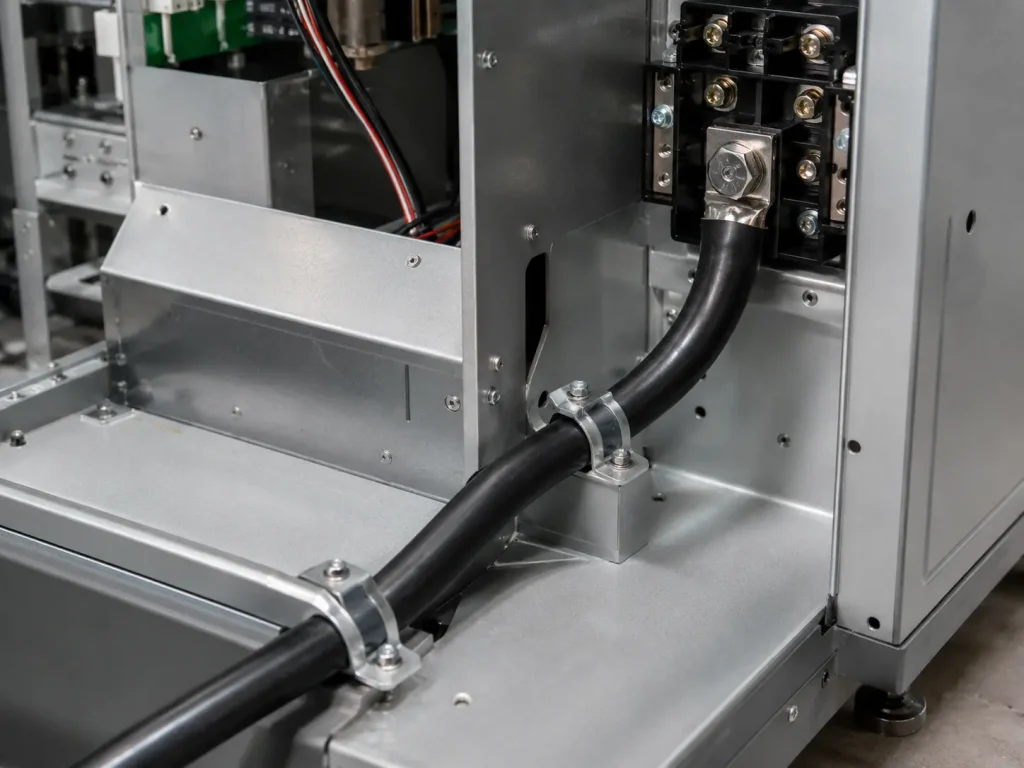
Appliance Internal Power Wiring Applications
UL Style 1032’s confirmed use is internal wiring of appliances. Appropriate commercial application language for this page includes appliance internal power wiring, protected internal appliance power connections, internal power routing inside appliances, OEM appliance internal electrical connections, and large-conductor internal wiring where UL Style 1032 is specified. This page does not extend the use to building wiring, feeder wiring, service entrance cable, branch circuits, tray cable, conduit wiring, outdoor exposed wiring, or direct burial, and does not position UL 1032 as generic industrial power cable for factory power distribution, machine supply feeders, or switchboard field wiring — final acceptability for any specific installation depends on the equipment design and applicable end-product requirements.
UL 1032 vs Other PVC Power Wire Styles
UL Style 1032 is distinct from CableApex’s other PVC AWM power-wire products. Our UL 1283 8 AWG PVC Power Wire is rated 105°C / 600 Vac — a different temperature and voltage envelope, and a different featured conductor size, from UL 1032’s 90°C / 1000 Vac / 1200 Vdc rating at 2 AWG. Our UL 10269 pages address a separate Style with its own 1000 Vac / 1250 Vdc envelope and construction — UL 1032 and UL 10269 are not interchangeable, despite both supporting elevated voltage ratings. Select based on the confirmed Style, rating, and conductor size your application actually requires.
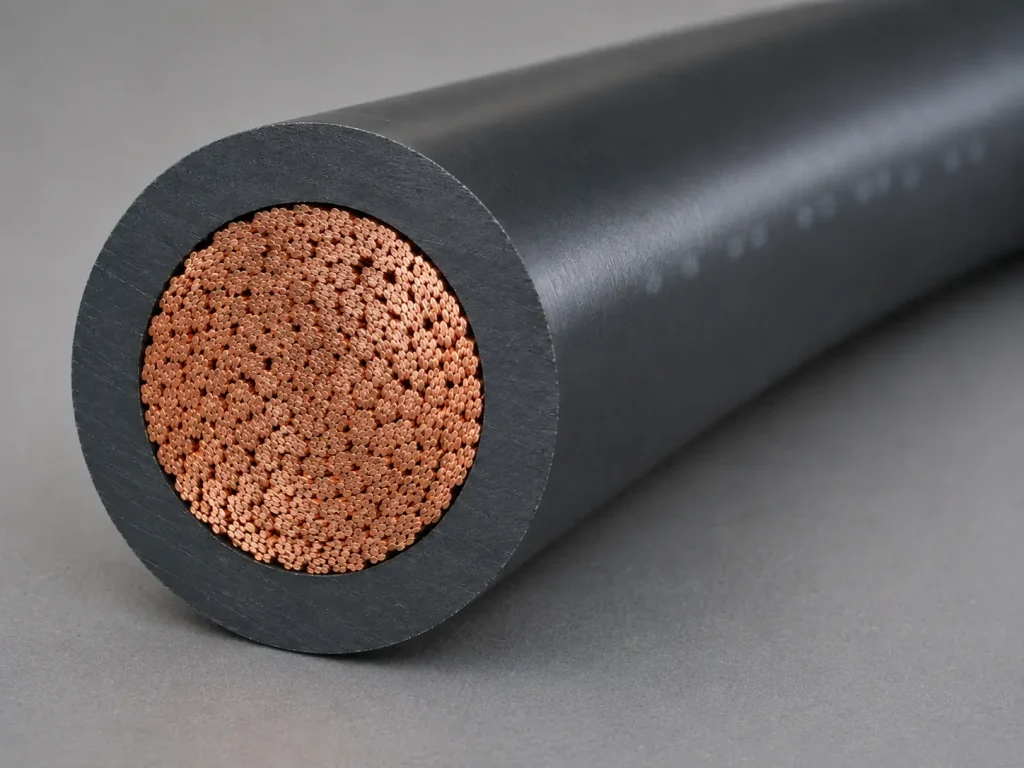
What to Specify When Ordering UL 1032 2 AWG Wire
To provide an accurate quotation for UL 1032 2 AWG PVC power wire, please specify:
- Required conductor size (this page’s featured size is 2 AWG)
- Solid or stranded construction
- Conductor material or plating requirement
- Operating voltage — AC or DC circuit requirement
- Operating temperature
- Optional oil designation requirement, if applicable
- Optional covering requirement
- Optional shield requirement
- Optional jacket requirement
- Required finished OD, if dimensionally constrained
- Insulation colour
- Marking requirement
- Order quantity
- Packaging requirement
- UL documentation requirement, including RoHS / REACH if needed
- Appliance type
- Internal power connection application
- Shipping destination
Send this information and we respond with a quotation within 12 business hours. Production lead time depends on the confirmed construction and order quantity, and shipping options and applicable Incoterms are confirmed during quotation according to destination.
UL Marking and Documentation
Qualifying UL AWM Style 1032 constructions can be supplied through the relevant qualified manufacturing scope for this Style. UL marking and documentation are confirmed according to the qualified Style 1032 construction supplied for the order and are not identical across every commercial variation. RoHS and REACH are separate regulatory frameworks from UL recognition; applicable RoHS / REACH documentation requirements can be confirmed according to the ordered construction.
Browse our full Power Cables category, or see the technical UL 1032 PVC Wire category for related constructions across the Style’s full conductor range.