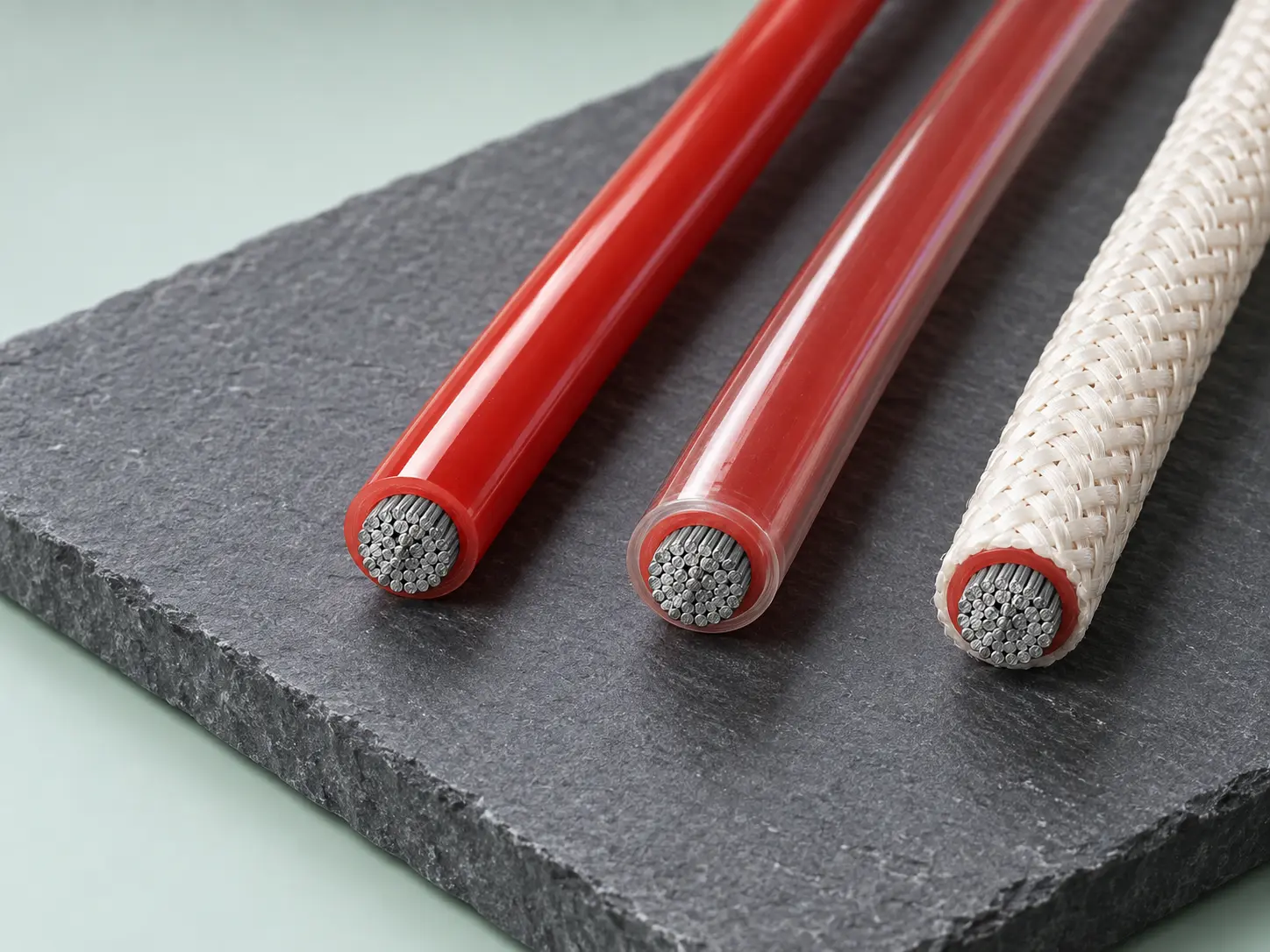
UL 1332 200°C 300V FEP Wire with Optional FEP Covering or Glass Braid
This page covers UL AWM Style 1332 constructions where the requirement is the standard FEP-insulated internal appliance wire together with a confirmed optional outer covering. It is written for appliance and equipment OEM engineering and procurement teams whose drawing, BOM or wire specification calls for Style 1332 with a covering over the insulation.
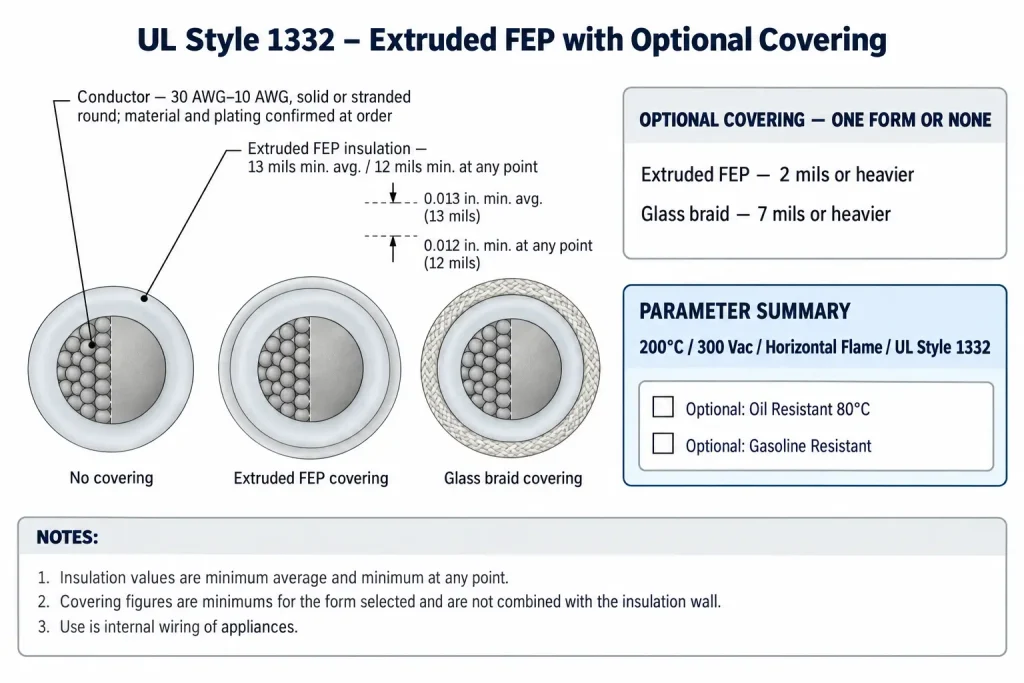
The Style is described in the record as a single conductor with covering, rated 200°C and 300 Vac with a Horizontal Flame designation. The conductor range is 30 AWG–10 AWG, solid or stranded round, the insulation is extruded FEP at 13 mils minimum average and 12 mils minimum at any point, Marking is General, and the official Use is “Internal wiring of appliances.”
The covering itself is an option with two permitted forms, and it is the subject this page is built around: an extruded FEP covering of 2 mils or heavier, or a glass braid of 7 mils or heavier. Neither is included unless the ordered construction supports it and the buyer specifies it.
Confirmed UL Style 1332 Construction and Ratings
| Parameter | Requirement |
|---|---|
| UL AWM Style | 1332 |
| Description | Single Conductor with Covering |
| Temperature Rating | 200°C |
| Voltage Rating | 300 Vac |
| Flame | Horizontal Flame |
| Optional Rating | Oil Resistant 80°C |
| Optional Rating | Gasoline Resistant |
| Conductor Range | 30 AWG–10 AWG |
| Conductor Construction | Solid or stranded round |
| Insulation | Extruded FEP |
| Insulation Thickness | 13 mil minimum average / 12 mil minimum at any point |
| Optional Covering | Extruded FEP, 2 mil or heavier |
| Alternative Optional Covering | Glass braid, 7 mil or heavier |
| Marking | General |
| Official Use | Internal wiring of appliances. |
| Optional Tag Information | Suitable for immersion in gasoline; gasoline vapor; 80°C in oil; and / or 600 volts peak for electronic use only, where applicable to the confirmed ordered construction |
| RoHS / REACH | Applicable RoHS / REACH documentation can be confirmed according to the ordered construction |
Nine points to clarify about the table above:
- The insulation is extruded FEP. PTFE, PFA, ETFE, PVC, XLPE, silicone and mica are different materials and are not this Style.
- The two covering entries are alternatives with different minimums. A construction carries one, the other or neither, and never both by default.
- Each covering figure is a floor for the form chosen, not a nominal or typical thickness.
- The oil and gasoline resistance ratings are optional and independent of one another.
- The oil rating is stated at 80°C, which is separate from the 200°C Style temperature rating.
- The tag information applies where the confirmed ordered construction supports it, written with “and / or”, so a construction may carry some, all or none of those indications.
- 600 volts peak for electronic use only is a tag indication, not the normal voltage rating, which remains 300 Vac.
- Conductor material, plating, strand count, strand diameter and lay length are not defined by the Style.
- Finished OD, OD tolerance, conductor resistance, metric cross-section and ampacity are not defined by the Style.
FEP Insulation Wall Requirement
The insulation is extruded FEP, and the wall must satisfy two conditions together: an average thickness of at least 13 mils, and a thickness of at least 12 mils at every point around the conductor. Both are floor values, and the second is not a tolerance on the first.
The requirement does not step with conductor size, so the same two minimums govern a 30 AWG construction and a 10 AWG one. What changes is the proportion: on a fine conductor that wall is a large share of the finished wire, while on a heavier one it is comparatively slim.
Minimum wall values do not produce a finished outer diameter, and this page publishes no AWG-to-diameter, resistance or current table. Actual OD depends on the conductor material and form, the actual conductor diameter, whether a covering is applied and which form, the FEP extrusion and manufacturing tolerance. Where connector entry, sleeve fit or routing clearance is controlled, state a maximum finished OD and OD tolerance in the RFQ so the proposed construction can be checked against it.
FEP belongs to the fluoropolymer family, but the product identity here remains FEP specifically, and properties published for other fluoropolymers are not transferred to this Style. Beyond the optional ratings described below, the record states no chemical, solvent, moisture, dielectric or low-friction property, so none is attributed to the insulation.
Optional Extruded FEP Outer Covering
UL Style 1332 may include an optional extruded FEP covering of 2 mils or heavier when the ordered construction supports it. That is the whole of what the record establishes about this form: the material, the minimum thickness and its optional status.
Two consequences follow for a specification. First, a Style 1332 wire does not carry this covering unless it is specified, so an enquiry requiring it must say so and an enquiry that is silent will be quoted without it. Second, the 2 mil figure is a minimum for the covering layer alone; it is not added to the 13 mil insulation requirement to produce a single combined wall figure, and it is not a nominal covering thickness.
The record assigns the covering no function, so this page claims none for it, whether abrasion resistance, mechanical protection, flame behaviour, dielectric contribution or chemical performance. It is a construction element permitted by the Style, confirmed at order.
Optional Glass Braid Covering
A glass braid of 7 mils or heavier is the other covering form permitted by the Style, again when the ordered construction supports it. It is an alternative to the extruded FEP covering rather than an addition to it.
The same discipline applies. The 7 mil figure is a minimum for that form, not a nominal thickness and not interchangeable with the 2 mil figure quoted for the extruded FEP covering. A drawing that controls the covering should therefore name which form is required, because the two are specified differently and produce different constructions.
The record states no function for the braid, so it is not described here as a shield, an EMI shield, an electrical screen, a grounding layer, armor or a fireproof layer, and no abrasion, mechanical, flame, dielectric or chemical performance is claimed for it. It also does not raise the Style temperature rating: the rating remains 200°C whether a covering is applied or not.
Optional Oil and Gasoline Resistance
Two further options appear in the record, and they are secondary to the covering identity of this page. An Oil Resistant 80°C designation is optional, and a Gasoline Resistant designation is optional. Neither is a universal property of Style 1332, neither implies the other, and both are confirmed during RFQ review against the ordered construction.
The oil designation is stated at 80°C. That temperature belongs to the oil rating and does not follow the 200°C Style temperature rating, so oil exposure at a higher temperature is not established by this Style.
Separately, the tag may indicate suitability for immersion in gasoline, gasoline vapor, 80°C in oil, and / or 600 volts peak for electronic use only, where applicable to the confirmed construction. Those indications describe properties of a qualified wire construction as the record words them. They are not general chemical compatibility statements, they are not extended here to fuels, solvents, coolants or additives the record does not name, and they do not turn the wire into a fuel system, automotive, petrochemical or hazardous-location component. Where the tag wording matters to a design, the required indications should be listed in the enquiry.
Internal Wiring of Appliances
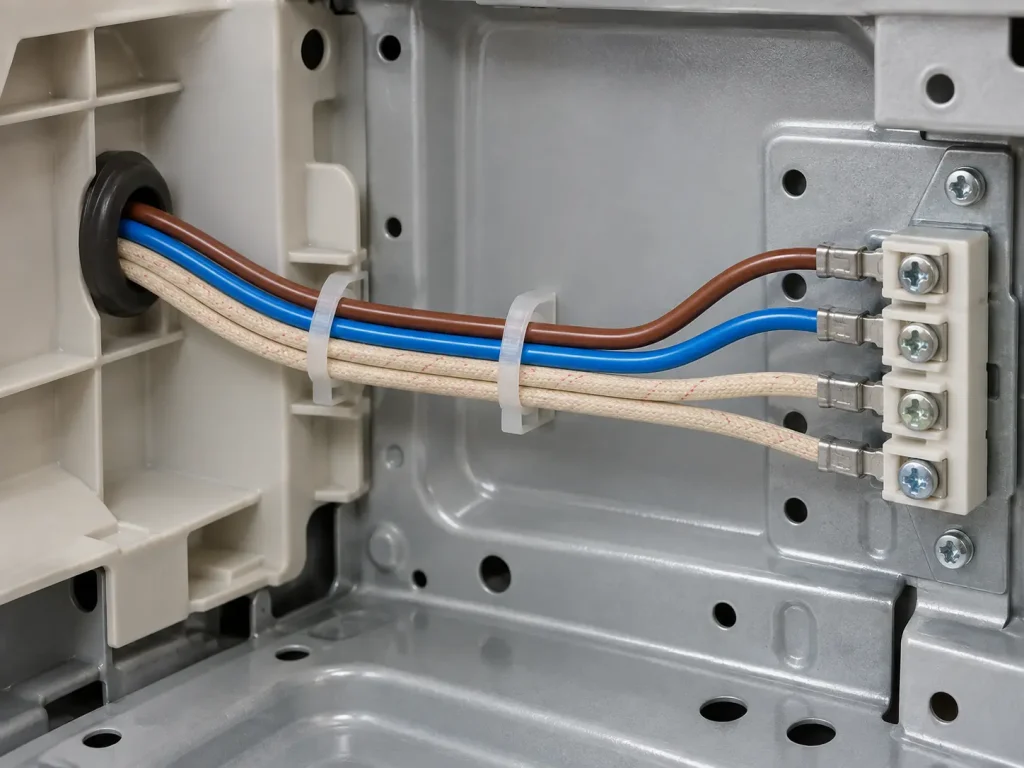
The official Use is “Internal wiring of appliances.” This page keeps that wording and does not extend it to building wire, field wiring, branch circuits, conduit wiring, tray cable, external wiring, portable cord, facility power distribution, motor power cable or outdoor wiring.
In practice the Use is matched to a requirement by working from the drawing rather than from the Style number alone. A drawing or BOM line that calls for Style 1332 identifies the construction family; the internal wiring position within the appliance, the conductor size, the conductor form and any covering or optional designation then complete it. Where an existing wire is being replaced, the installed construction should be described in the enquiry so the proposed one can be compared against it directly.
Compliance of a finished appliance or assembly is established at the equipment level and is not conferred by the Style designation of one internal wire. Current-carrying capacity is likewise evaluated through the buyer’s equipment design and the applicable approval process; the record gives no ampacity, and none is inferred here from conductor size or the ratings.
How to Specify UL 1332 with Optional Covering in an RFQ
A Style designation is a construction requirement, not a complete purchase specification. A complete enquiry for this construction states:
- the UL AWM Style 1332 requirement
- the conductor size within 30 AWG–10 AWG
- solid or stranded round construction
- conductor material and plating, if controlled by the drawing
- whether an optional extruded FEP covering or a glass braid covering is required, and which
- whether an optional Oil Resistant 80°C designation is required
- whether an optional Gasoline Resistant designation is required
- insulation colour
- marking requirements
- the drawing or BOM
- documentation requirements
- quantity and packaging
- destination and Incoterm
Conductor material, plating, strand count, strand diameter, finished OD, OD tolerance and conductor resistance are SKU-specific characteristics rather than Style values. Where a drawing controls any of them, they are confirmed separately during RFQ review and checked against the proposed construction. Marking requirements and the applicable UL marking are likewise confirmed according to the ordered construction.
Pricing and order conditions depend on the confirmed conductor size, conductor construction, optional outer covering, optional oil or gasoline designation, insulation colour, marking requirements, documentation, packaging, order quantity, destination and Incoterm. Final commercial terms are confirmed case by case after RFQ review.
What This Page Covers
This page is specifically for UL 1332 at 200°C and 300 Vac in 30–10 AWG for appliance internal wiring, with an optional extruded FEP outer covering or an optional glass braid covering. An enquiry that turns on which covering form applies, or on whether a covering applies at all, belongs here.
Broader questions about Style 1332 in general are better answered from the UL 1332 category and core product pages. Where the deciding requirement is an optional oil or gasoline resistance designation rather than a covering, the dedicated UL 1332 page for those optional ratings is the more precise starting point, and it is linked below as a separate optional-rating page.
What Style 1332 Does and Does Not Define
Style 1332 defines:
- 200°C temperature rating and 300 Vac voltage rating
- Horizontal Flame
- a single conductor with covering, conductor range 30 AWG–10 AWG, solid or stranded round
- extruded FEP insulation, 13 mil minimum average / 12 mil minimum at any point
- an optional covering of extruded FEP at 2 mils or heavier, or glass braid at 7 mils or heavier
- optional Oil Resistant 80°C and optional Gasoline Resistant designations
- Marking: General
- Use: Internal wiring of appliances.
- the tag information for gasoline immersion, gasoline vapor, 80°C in oil, and / or 600 volts peak for electronic use only
Style 1332 does not universally define:
- conductor material, plating, strand count, strand diameter or lay length
- a function or performance for either covering form
- a combined insulation-plus-covering wall figure
- finished OD, OD tolerance, bend radius, flex cycles or flex class
- conductor resistance, ampacity, current rating or metric cross-section
- a normal 600 V rating
- chemical or solvent compatibility beyond the optional ratings and tag indications as worded
- fuel system, automotive, petrochemical or hazardous-location suitability
- colour, reel length, MOQ, stock, lead time, production capacity or shipping term
Common Procurement Errors
- Assuming every Style 1332 wire carries an outer covering.
- Assuming both covering forms are applied together, or treating the 2 mil and 7 mil figures as interchangeable.
- Adding the covering minimum to the insulation minimum to produce one wall figure.
- Describing the glass braid as a shield, screen, armor or grounding layer.
- Claiming that a covering raises the temperature rating or adds flame, abrasion or dielectric performance.
- Treating the optional oil or gasoline designation as standard.
- Applying the 200°C rating to the oil designation, which is stated at 80°C.
- Reading the tag indications as general chemical compatibility, or as fuel system suitability.
- Describing Style 1332 as a 600 V wire, or dropping “for electronic use only” from the tag wording.
- Omitting the 12 mil minimum-at-any-point requirement, or treating 13 mil as a nominal wall.
- Deriving a finished OD, resistance or ampacity from the published values.
- Substituting PTFE, PFA, ETFE or another material under the Style 1332 name.
- Extending internal wiring of appliances into installation, external or field wiring.
RFQ Information to Confirm
Style and ratings
- UL AWM Style 1332 requirement
- 200°C temperature rating requirement
- 300 Vac voltage rating requirement
- Conductor size within 30 AWG–10 AWG
- Whether the optional Oil Resistant 80°C designation is required
- Whether the optional Gasoline Resistant designation is required
- Which tag indications are required
Conductor and covering
- Solid or stranded round construction
- Conductor material and plating requirement, if controlled by the drawing
- Strand construction, if controlled
- Maximum conductor resistance, if controlled
- Optional covering requirement: extruded FEP or glass braid
- Maximum OD and OD tolerance, if controlled
Identification and application references
- Insulation colour
- Marking requirements
- Appliance internal wiring location
- Drawing, BOM or equipment specification
Commercial
- Quantity and packaging
- Destination and Incoterm
- Requested UL marking and compliance documents, including any RoHS / REACH documentation requirement
UL Marking and Documentation
Supplied wire is UL-recognized component wire where supplied under a qualified manufacturing scope, with UL marking according to the confirmed ordered construction. The Style record lists Marking as General, and marking requirements should be confirmed according to the ordered construction.
Applicable RoHS / REACH documentation can be confirmed according to the ordered construction. CSA, FT1, VW-1, CE, CPR, VDE, DIN, EN, IEC and dual UL/CSA designations are not claimed here. Commercial, origin, compliance and transport documents are identified during quotation and confirmed according to the order.
Internal Links
- UL 1332 FEP Wire — category page for broad Style 1332 enquiries
- Fluoropolymer Wire
- AWM Wire
- UL 1332 with optional oil and gasoline resistance — separate page for the optional-rating requirement