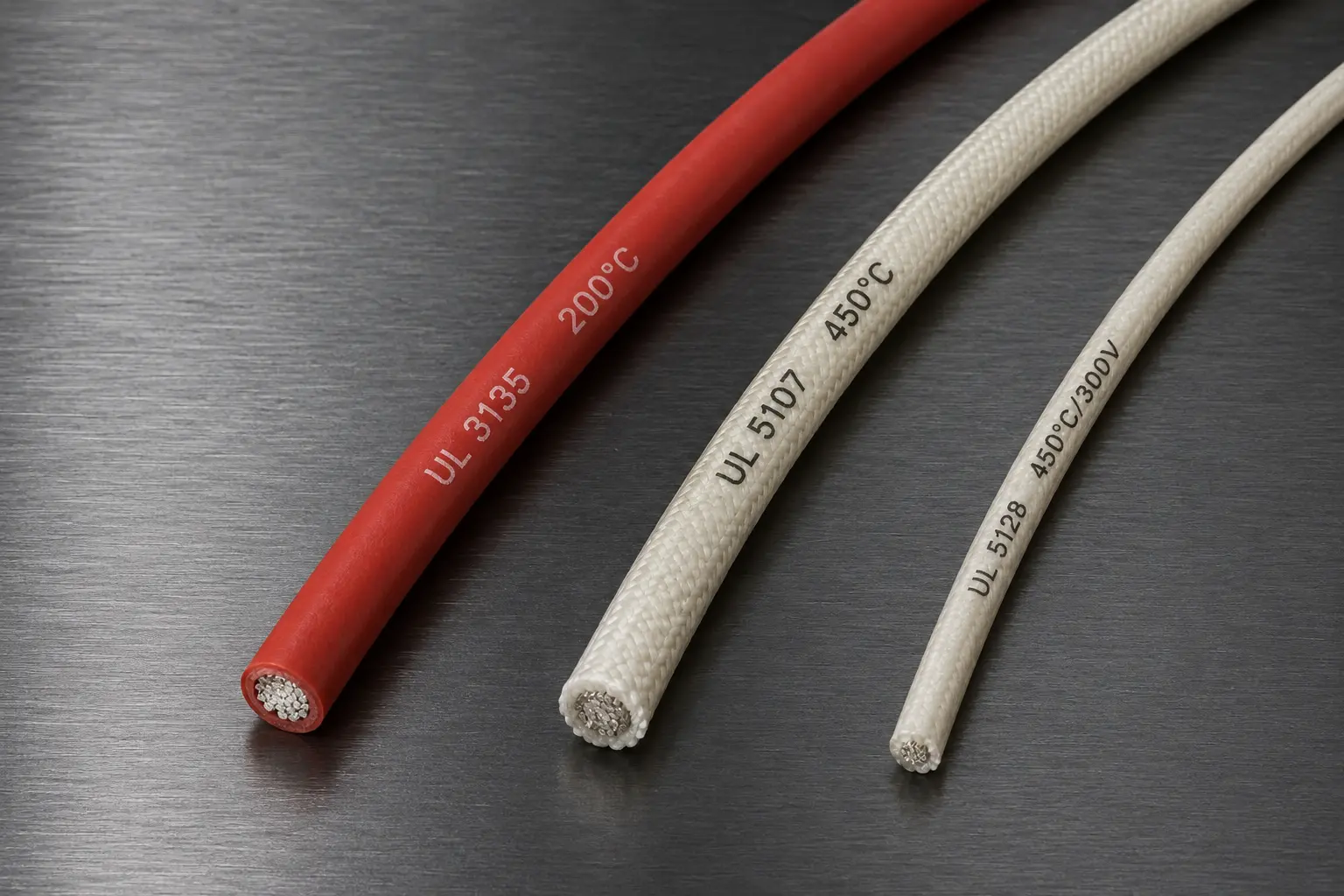
Wire for Industrial Oven Internal Wiring — UL AWM Selection Guide 200°C to 450°C
Industrial oven internal wiring failures are almost always caused by one of two specification errors: using PVC wire rated at 105°C in a zone where the actual wire surface temperature reaches 150–200°C, or using 200°C silicone rubber wire in a zone where actual wire surface temperature reaches 250–350°C. Both failures share the same root cause — the wire temperature rating was selected based on the oven’s nominal process temperature rather than the actual wire surface temperature at the specific routing position inside the oven.
This guide provides the UL AWM wire selection framework for industrial oven internal wiring — matching each oven type and wiring position to the correct UL Subject 758 wire style based on actual wire surface temperature, circuit voltage, and AWG range. All styles covered are available with complete UL compliance documentation, from 100 meters MOQ, with 12-hour quote response.
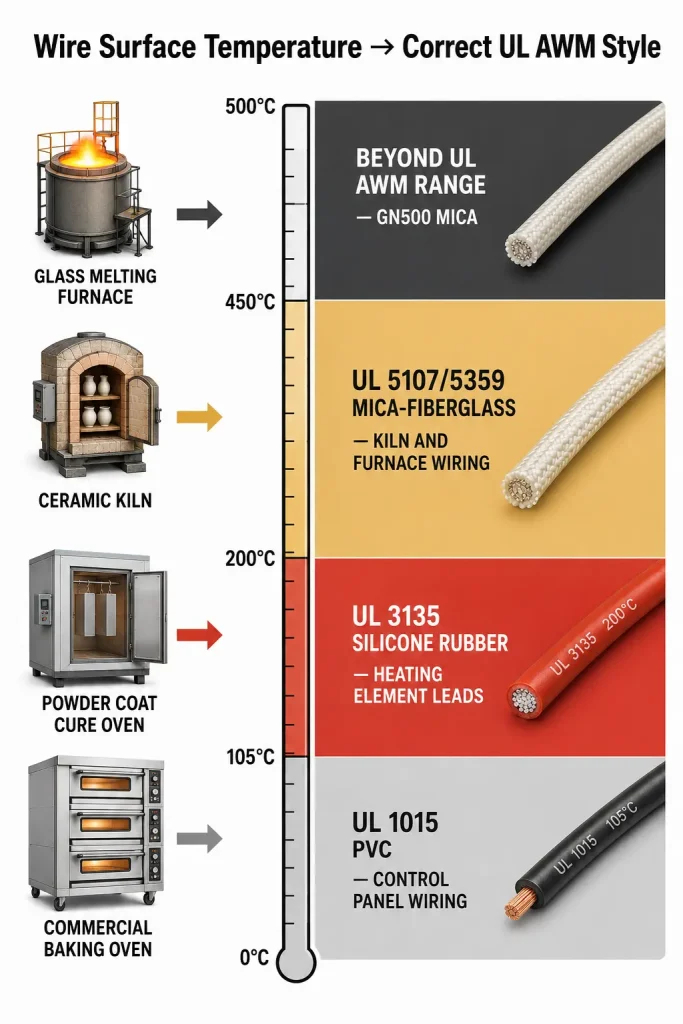
The Most Important Principle: Wire Surface Temperature ≠ Oven Process Temperature
The parameter that determines which UL AWM wire is correct for a specific oven wiring position is the actual wire surface temperature at that routing position — not the oven’s nominal process temperature, not the heating element surface temperature, and not the oven chamber air temperature.
In a commercial oven with a 250°C process temperature, the wire routed through the oven door hinge channel may only experience 80–100°C — making UL 1015 PVC wire adequate for that specific position. At the same time, the wire directly connected to the heating element terminal stud in the same oven may experience 180–200°C — requiring UL 3135 silicone rubber. And the wire routed through the heating element mounting block ceramic insert may experience 300–350°C — requiring UL 5107 mica-fiberglass.
Three wires, three UL styles, one oven — each specified correctly for its specific routing position temperature.
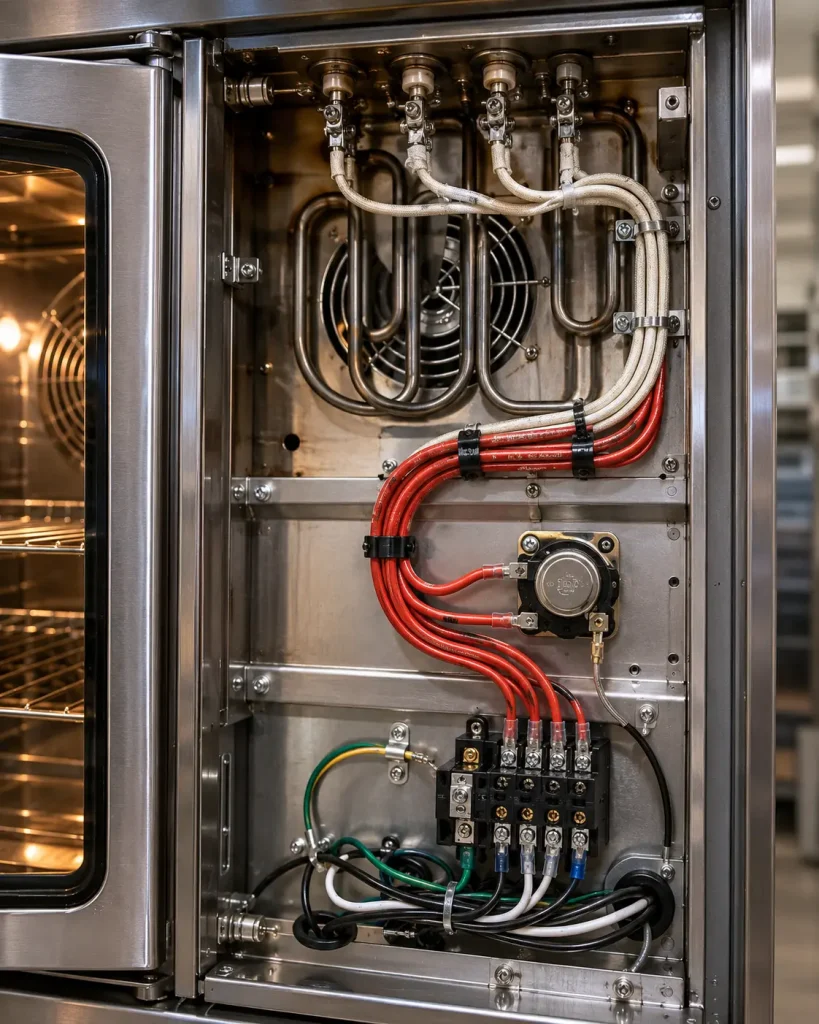
UL AWM Wire Selection by Oven Type and Wire Position
| Oven Type | Wire Position | Typical Wire Surface Temp | Recommended UL Style | Voltage |
|---|---|---|---|---|
| Commercial baking oven | Control panel → thermostat | 60–100°C | UL 1015 PVC 105°C | 600V |
| Commercial baking oven | Heating element terminal leads | 150–200°C | UL 3135 Silicone 200°C | 600V |
| Powder coating cure oven | Heater element leads (180–220°C cure) | 160–200°C | UL 3135 Silicone 200°C | 600V |
| Powder coating cure oven | Thermocouple leads in hot zone | 180–220°C | UL 3122 Silicone 200°C / 300V | 300V |
| Plastic injection barrel heater | Heater band terminal leads | 200–300°C | UL 5107 Mica 450°C | 600V |
| Ceramic kiln | Element terminal leads in hot zone | 300–450°C | UL 5107 Mica 450°C | 600V |
| Ceramic kiln | Thermocouple leads in hot zone | 300–450°C | UL 5128 Mica 450°C / 300V | 300V |
| Glass annealing lehr | Zone heater element leads | 350–450°C | UL 5107 / UL 5359 Mica 450°C | 600V |
| Industrial sintering furnace | Multi-zone element leads | 350–450°C | UL 5359 Mica 450°C multi-conductor | 600V |
UL AWM Styles for Oven Wiring — Specifications at a Glance
UL 3135 — Silicone Rubber 200°C / 600V
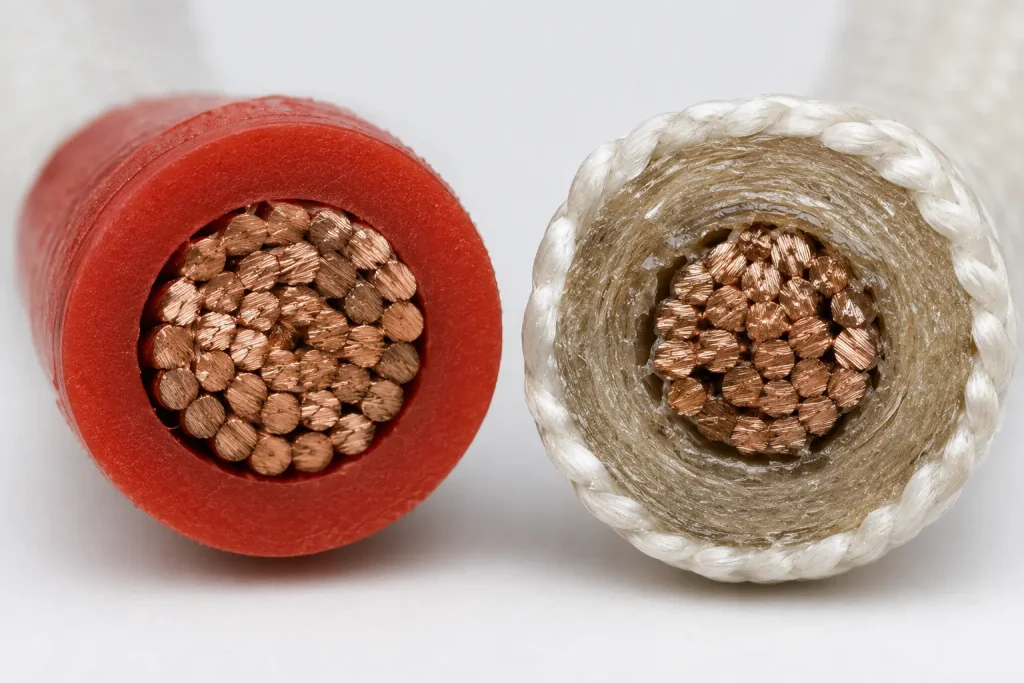
The standard oven wire for commercial baking, food processing, and powder coating applications where wire surface temperature reaches 150–200°C. Extruded silicone rubber insulation at 30 mils minimum average, 26–12 AWG, rated 600V. Key advantage: silicone rubber maintains flexibility from –60°C to 200°C — the wire bends cleanly during oven assembly at room temperature and survives sustained 200°C operation without hardening or cracking. Specify for: heating element terminal leads in commercial ovens, thermostat circuit wiring in powder coating cure ovens, fan motor leads inside convection oven enclosures.
UL 3122 — Silicone Rubber 200°C / 300V with Fiberglass Braid
The instrumentation and thermocouple lead wire for 200°C oven applications where circuit voltage is 300V or below and the mechanical protection of a fiberglass braid outer covering is desired. 26–16 AWG, rated 300V. Specify for: thermocouple extension leads, temperature sensor wiring, and control signal circuits in 200°C oven hot zones where the fiberglass braid provides additional mechanical protection during installation and servicing access.
UL 5107 — Mica-Fiberglass 200°C or 450°C / 600V
The heavy-duty oven and furnace wire for applications where wire surface temperature exceeds 200°C — the ceiling of silicone rubber insulation. Mica tape with glass braid, 600V, covering 26 AWG through 550 kcmil. Specify for: heating element terminal leads in plastic injection barrel heaters, ceramic kiln element connections, glass annealing lehr zone heater leads, and industrial sintering furnace power circuits where wire surface temperature reaches 300–450°C. Static routing only — not suitable for repeated flexing.
UL 5128 — Mica-Fiberglass 450°C / 300V
The instrumentation grade mica wire for 450°C thermocouple and sensor leads where 300V rating is adequate and a more compact wire profile is preferred. 24–4 AWG, 300V. Optional stainless steel 304 braid for mechanically aggressive environments. Specify for: thermocouple extension leads, RTD sensor wiring, and temperature controller signal circuits in ceramic kilns, glass furnaces, and industrial sintering equipment where wire surface temperature reaches 300–450°C.
UL 5359 — Mica-Fiberglass 200°C or 450°C / 600V with Multi-Conductor Option
The multi-zone oven cable option — mica tape construction with multi-conductor assembly available up to 1.500 inch OD. Specify for: multi-zone oven control cable assemblies where multiple thermocouple or heating circuit conductors must be routed together through a single oven wall penetration, minimizing the number of penetrations in the furnace or kiln structure.
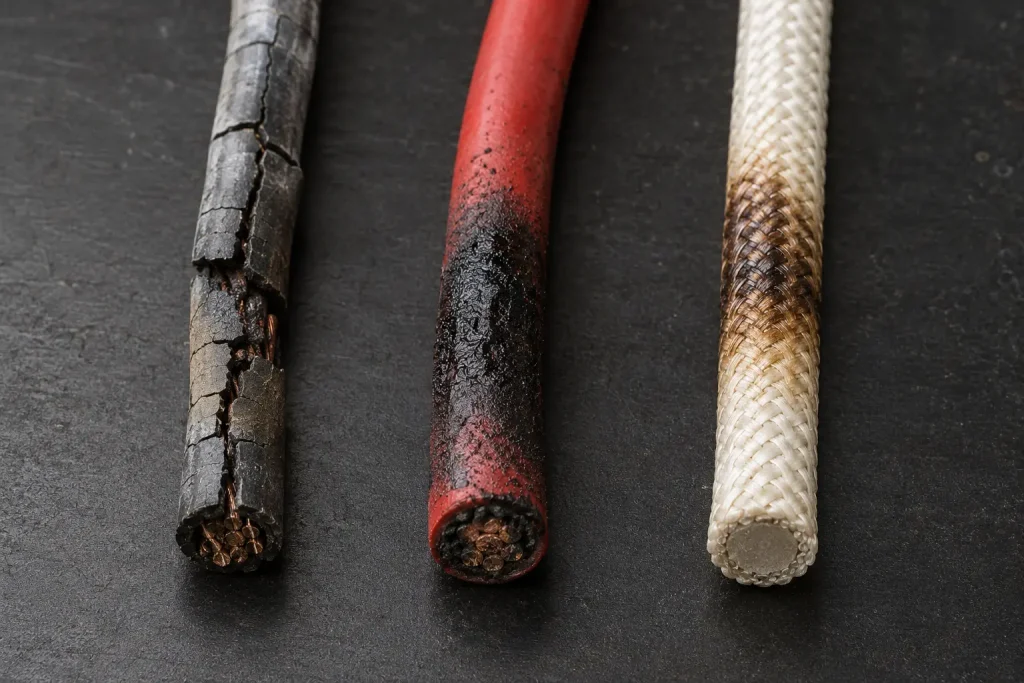
Oven Wire Failure Diagnosis — Replacing the Correct Wire
When an oven internal wire fails in service, the failure mode itself provides information about whether the replacement wire specification is correct:
- PVC wire hardened, cracked, and fractured — wire surface temperature exceeded the PVC thermal rating. Replace with UL 3135 silicone rubber (200°C) for the affected routing position. Do not replace with PVC wire of the same specification.
- Silicone rubber wire surface charred, carbonized, or turned to powder — wire surface temperature exceeded 200°C, the silicone rubber ceiling. Replace with UL 5107 mica-fiberglass (450°C) for the affected routing position. Silicone rubber cannot be used above 200°C.
- Wire insulation melted and dripped, causing short circuit — thermal failure of a polymer insulation above its melt temperature. Identify the actual wire surface temperature at the failure position and specify mica-fiberglass wire rated for that temperature tier.
- Wire conductor broken at terminal connection point — typically a mechanical failure from thermal cycling fatigue or vibration, not a wire specification issue. Replace with the same UL style and AWG but verify terminal connection torque and routing radius at the terminal.
Related UL Styles for Comparison
Oven internal wiring buyers commonly cross-reference: UL 3071 (200°C / 600V silicone rubber with fiberglass braid SF-2, for motor lead connections in the same oven where mechanical protection is required), UL 5334 (450°C / 300V mica, UL use classification explicitly references ovens — instrumentation grade), UL 5476 (450°C / 600V mica tape, latest 2025 revision for new oven equipment design specifications), and UL 1659 (250°C / 600V PTFE, for oven sensor leads where 250°C rating is sufficient and fluoropolymer chemical resistance is preferred).
Request a Quote — Oven Internal Wiring Wire
Submit your oven type, wire routing position, maximum wire surface temperature, AWG, voltage rating, and annual volume estimate below. Our technical team will confirm the correct UL Style and respond with a formal quotation within 12 business hours. Wire samples available for oven installation qualification testing.