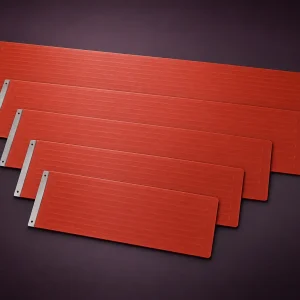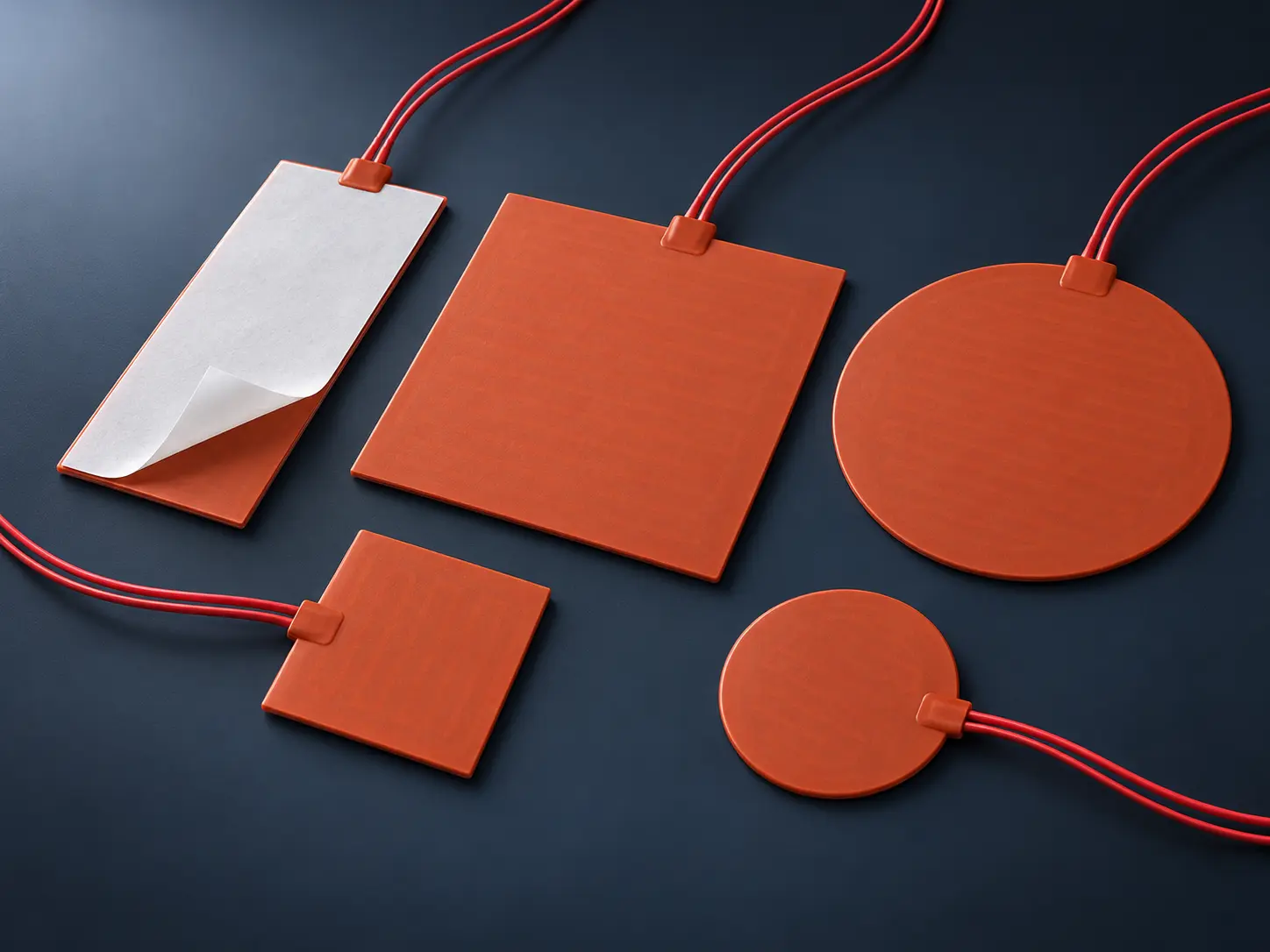
This 12V silicone heating pad is a thin, flexible silicone rubber heater supplied in small rectangular and round formats for low-voltage equipment. Standard 12 V pads run from 30 × 60 mm to 100 × 100 mm, with 50 mm and 100 mm round pads, and 24 V pads are offered in 50 × 50, 50 × 100 and 100 × 100 mm. Larger 220 V pads from 100 × 100 mm up to 300 × 300 mm, and round pads of 200 and 300 mm, complete the range. Every pad can be supplied with a self-adhesive backing for fixing to flat surfaces, and with an optional knob or digital thermostat.
A silicone rubber heating pad is chosen by four things: its size and shape, its supply voltage, its wattage, and how it is fixed and controlled. On a 12 V or 24 V supply the wattage also sets the current the pad draws, which decides the wiring and the controller. The sections below set out the listed sizes, how to specify wattage for a low-voltage pad, and what to confirm before ordering.
Key Features
- 12 V pads from 30 × 60 mm to 100 × 100 mm
- 24 V pads 50 × 50, 50 × 100 and 100 × 100 mm
- 12 V round pads, 50 and 100 mm diameter
- 220 V pads up to 300 × 300 mm and 300 mm round
- Thin, flexible silicone rubber construction
- Self-adhesive backing for fixing to flat surfaces
- Optional knob thermostat or digital thermostat
- Any size, shape and wattage made to order
Specification
| Parameter | Value |
|---|---|
| Product type | Flexible silicone rubber heating pad |
| Construction | Heating element laminated between silicone rubber insulating layers |
| 12 V rectangular sizes | 30 × 60, 40 × 40, 50 × 50, 50 × 100 and 100 × 100 mm |
| 12 V round sizes | 50 mm and 100 mm diameter |
| 24 V sizes | 50 × 50, 50 × 100 and 100 × 100 mm |
| 220 V sizes | 100 × 100, 100 × 150, 100 × 200, 150 × 200, 200 × 200, 200 × 300 and 300 × 300 mm; 200 and 300 mm round |
| Custom | Any size, shape, voltage and wattage to order |
| Wattage | Specified per order according to size, voltage and application |
| Mounting | Self-adhesive backing, or plain back for clamping |
| Control options | Knob thermostat mounted on the pad; separate digital thermostat; temperature sensor lead |
| Plug options (mains pads) | Plain plug or plug with leakage protection |
| Certification | Not stated for this item; confirm required documents per order |
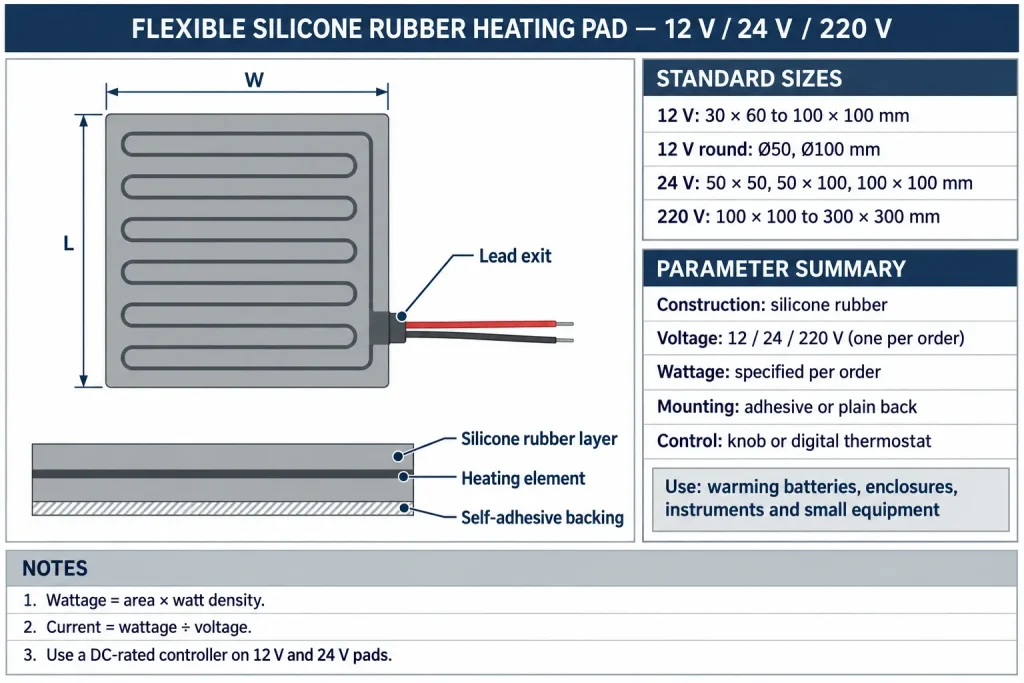
Specifying Wattage for a 12 V or 24 V Pad
These pads are built to the wattage the application needs, so the wattage is set at order rather than chosen from a fixed list. The usual way to specify it is by watt density, the power per square centimetre of pad. A low watt density gives gentle warming and a cooler pad surface; a higher one heats faster but runs the pad hotter. State either the wattage you need or the temperature the heated part must reach, and the pad can be matched to it.
On low voltage, wattage translates directly into current. The table below shows the current drawn by three common sizes at example watt densities. It is a planning aid only; the actual figures depend on the wattage ordered.
| Pad size | Area | At 0.3 W/cm²* | At 0.6 W/cm²* |
|---|---|---|---|
| 50 × 50 mm | 25 cm² | 7.5 W: 0.63 A at 12 V, 0.31 A at 24 V | 15 W: 1.25 A at 12 V, 0.63 A at 24 V |
| 50 × 100 mm | 50 cm² | 15 W: 1.25 A at 12 V, 0.63 A at 24 V | 30 W: 2.5 A at 12 V, 1.25 A at 24 V |
| 100 × 100 mm | 100 cm² | 30 W: 2.5 A at 12 V, 1.25 A at 24 V | 60 W: 5.0 A at 12 V, 2.5 A at 24 V |
*Example watt densities chosen to illustrate the calculation, not listed ratings. Wattage = area × watt density; current = wattage ÷ voltage.
Choosing a 12V Silicone Heater, 24 V or 220 V Pad
The smaller sizes are offered at 12 V and 24 V because small heated parts are often in equipment that already runs on a low-voltage DC supply: control cabinets, battery packs, instruments, vehicles and portable devices. A 24V heating pad draws half the current of a 12 V pad of the same wattage, which eases wiring and switching where 24 V is available. The larger sizes are offered as a 220 V silicone heater pad, where the higher wattage of a big pad would draw too much current at low voltage. Each pad is built for one voltage only, so state it with the order.
Self-Adhesive Backing and Mounting
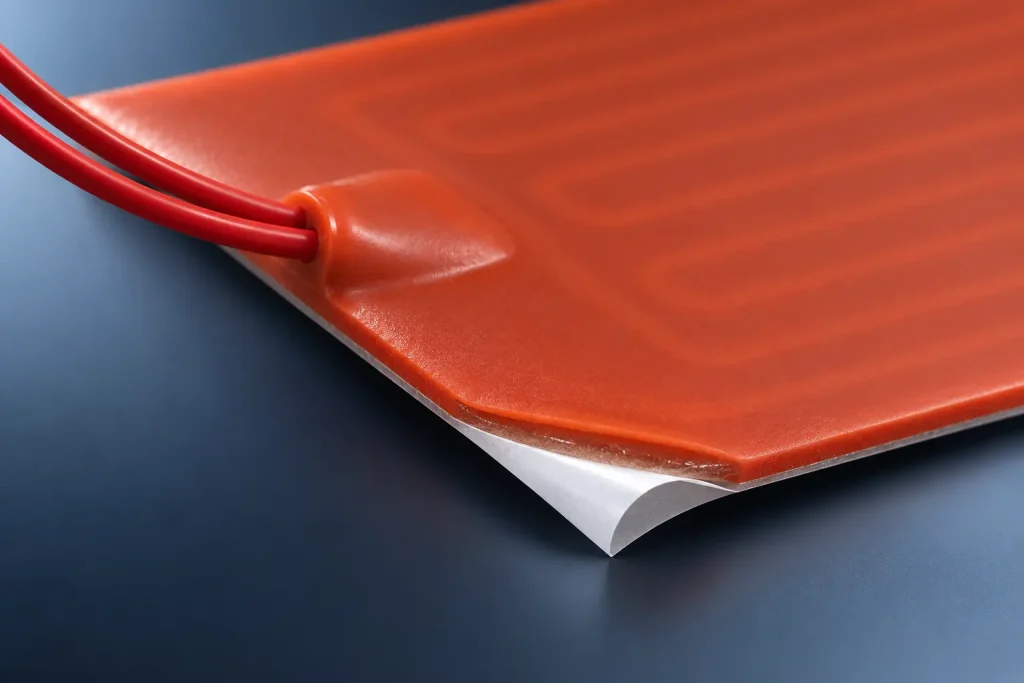
A self-adhesive backing lets the pad be pressed directly onto a clean, flat metal or rigid plastic surface without clamps. Full contact across the whole pad matters: air gaps under a pad stop heat leaving that area, which then runs hotter than the rest. For curved surfaces, the pad bends to follow a cylinder of reasonable radius; for parts that are removed often or that run hot, a plain-backed pad held by a clamp plate or strap can be the better choice. State the surface material and its operating temperature when choosing between the two.
Thermostat and Temperature Control
A pad with no control runs at full power whenever it is energised and settles at a temperature set by its wattage and how well the heated part carries heat away. Two control options are listed. A knob thermostat can be mounted on the pad itself for simple adjustable control. A digital thermostat with a temperature sensor lead gives a set point and display, and suits applications that need a stable temperature. Confirm at enquiry that the chosen thermostat is rated for the pad’s voltage and current; a mains thermostat is not suitable for a 12 V or 24 V DC pad.
Common Applications
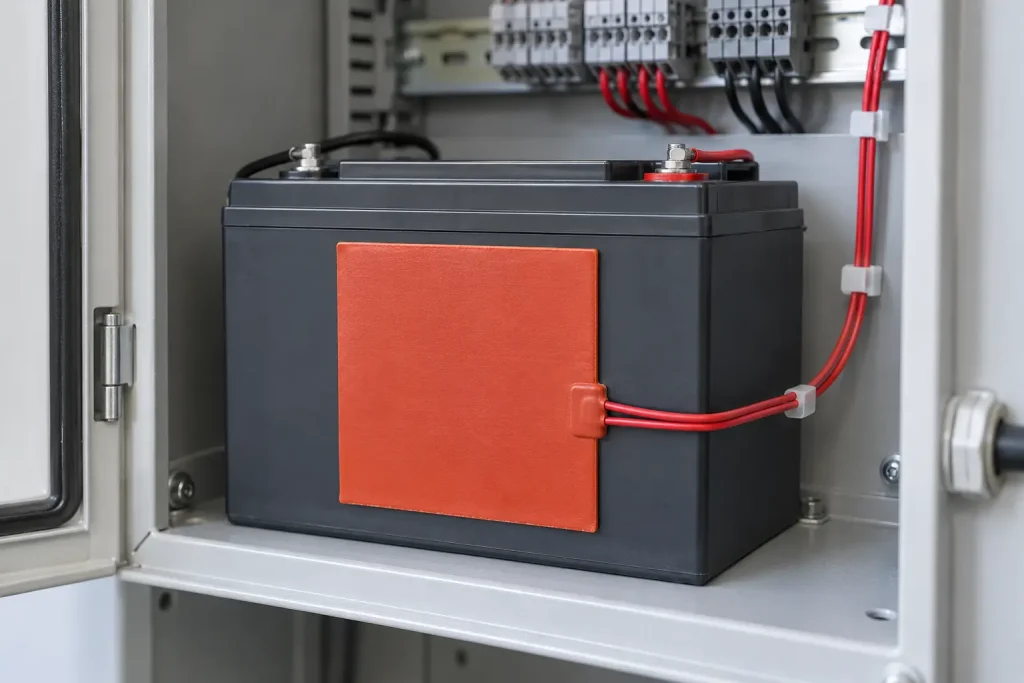
- Warming battery packs, sensors and instruments in cold conditions
- Anti-condensation heating inside control cabinets and enclosures
- Warming small tanks, cylinders and containers
- Heating fixtures for screen separation and electronics rework
- Laboratory and equipment heating where a thin flexible heater fits
Common Procurement Errors
- Ordering by size alone. The wattage must be stated, or the required temperature given.
- Leaving voltage unstated. Each pad is built for 12 V, 24 V or 220 V, not all three.
- Using a mains thermostat on DC. The controller must match the pad’s supply.
- Fixing to an uneven surface. Gaps under the pad create hot spots.
- Not stating the surface temperature. The adhesive backing has its own temperature limit.
RFQ Checklist
- Pad size and shape, or a drawing for a custom outline
- Supply voltage: 12 V, 24 V, 220 V or other
- Required wattage, or the temperature the heated part must reach
- Mounting: self-adhesive backing or plain back
- Control: none, knob thermostat, or digital thermostat with sensor
- Lead length, lead exit position and termination
- Plug type for mains pads
- Certification or test documents required for your market
- Quantity per size
Certification and Documentation
No certification is stated for this heater in the current specification. If your market or customer requires a specific approval or test report, state it at enquiry so that availability can be confirmed for the ordered size, voltage and control before quotation. Applicable RoHS / REACH documentation can be confirmed according to the ordered construction.
Related Categories
Heating tapes, spiral heat trace, crankcase belts, drum bands and custom heating plates are listed in the Silicone Rubber Heaters category, part of the High Temperature Wire Cable range.