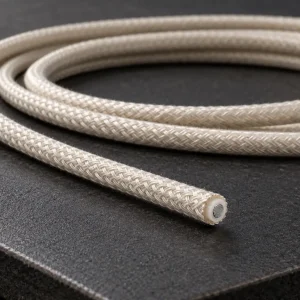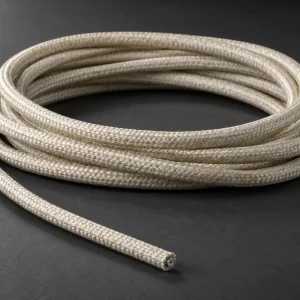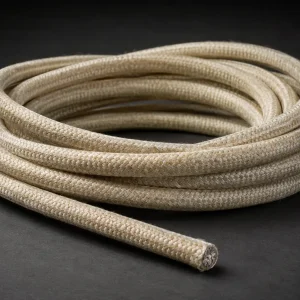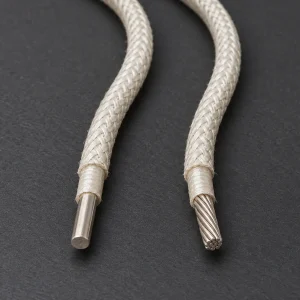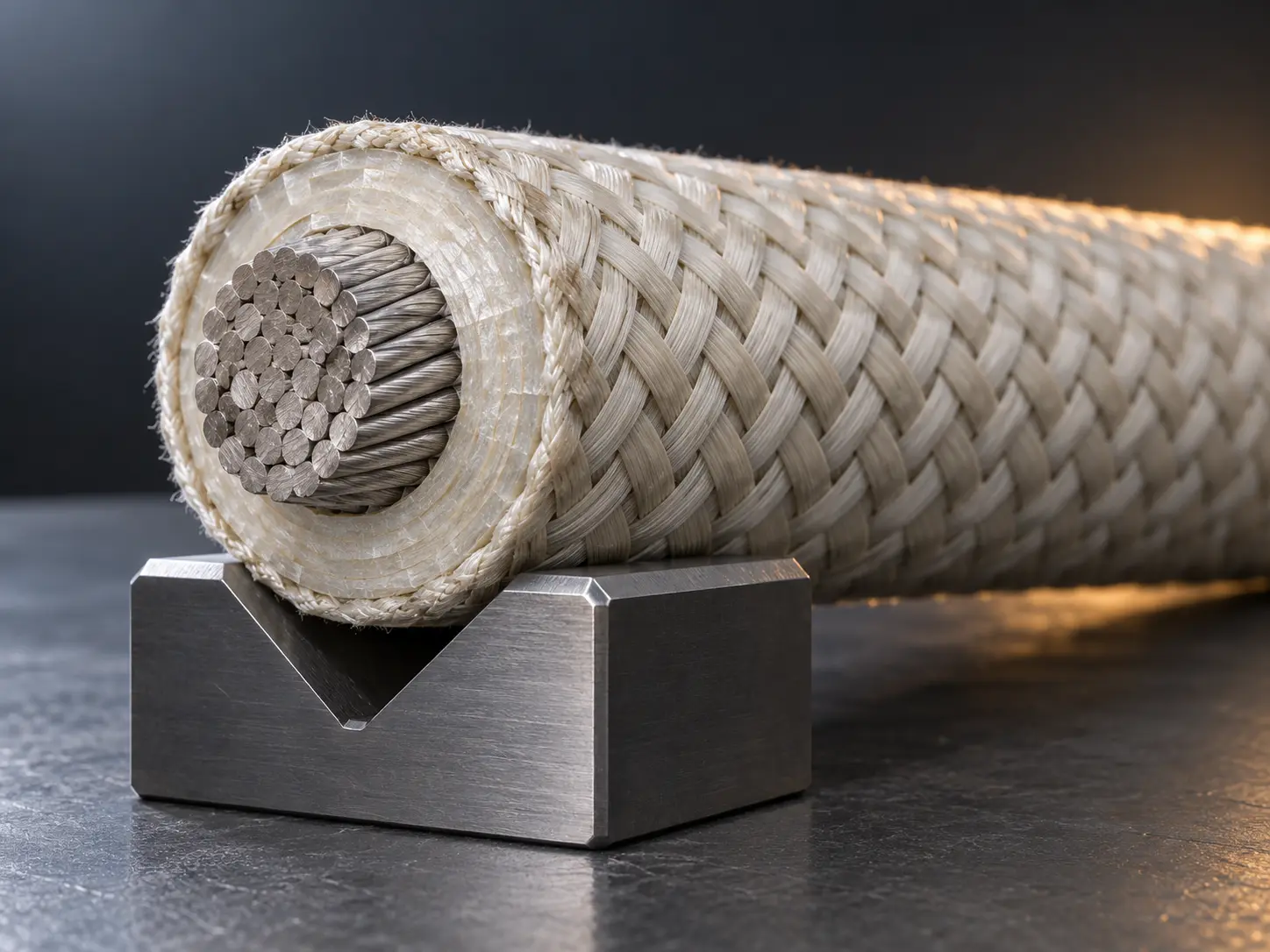
UL 5107 250–550 kcmil Mica Wire — 40/20 Mil Construction
UL AWM Style 5107 is a single or multiple conductor with other-than-extruded insulation, rated 200 or 450°C and 600 Vac with a Horizontal flame classification. Its largest conductor-size group, 250 kcmil to 550 kcmil, requires a minimum average thickness of 40 mils for the total mica tape layers and 20 mils for the treated glass braid. Because every size in this group is larger than 8 AWG, the Style permits stranded conductors only.
This page covers that 250–550 kcmil construction: the 40/20 mil minimum averages, the stranded-only rule, the braid treatment wording, and the Use boundaries, which apply to these large conductors exactly as they do to the rest of the Style. For the broader Style overview, see the UL 5107 Mica Wire category.
Verified UL 5107 250–550 kcmil Technical Specifications
| Parameter | UL AWM Style 5107 record, applied to 250–550 kcmil |
|---|---|
| Style | 5107 |
| Description | Single or Multiple conductor with other-than-extruded insulation |
| Conductor-size group | 250 kcmil – 550 kcmil (upper end of the 26 AWG – 550 kcmil Style range) |
| Conductor form | Stranded only (sizes larger than 8 AWG) |
| Temperature | 200 or 450°C |
| Voltage | 600 Vac |
| Flame | Horizontal flame |
| Insulation | Mica tape with braid, or Mica composite (see Facing Page) with braid |
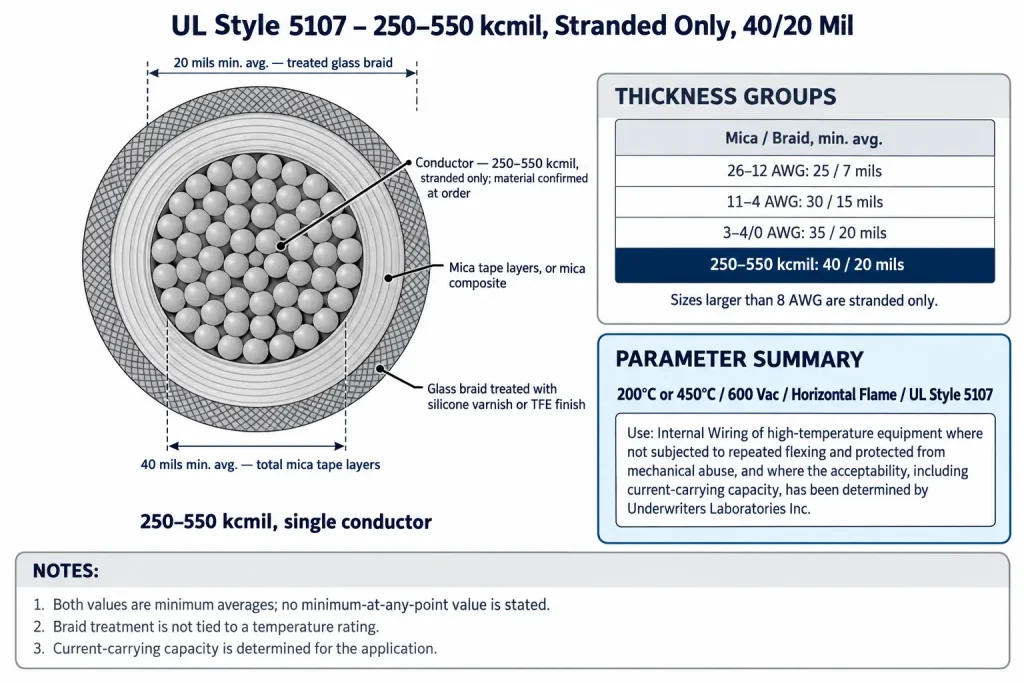
| Mica thickness | 40 mils (1.02 mm) minimum average thickness of total mica tape layers |
| Braid thickness | 20 mils (0.51 mm) minimum average thickness of treated glass braid |
| Braid treatment | Silicone Varnish or TFE Finish |
| Marking | General |
| Use | Internal Wiring of high-temperature equipment where not subjected to repeated flexing and protected from mechanical abuse, and where the acceptability, including current-carrying capacity, has been determined by Underwriters Laboratories Inc. |
Four points in this table need clarification. First, the millimetre values are arithmetic conversions (1 mil = 0.0254 mm), not separate UL specifications. Second, both thickness values are minimum averages; the record states no minimum-at-any-point value. Third, the record does not tie either temperature rating to a braid treatment or mica material. Fourth, the record does not state conductor material, plating or strand construction; these are confirmed according to the qualified ordered construction.
40 Mil Minimum-Average Total Mica Tape Layers
For 250–550 kcmil, the Style requires a minimum average thickness of 40 mils (1.02 mm by unit conversion) for the total mica tape layers.
- “Total mica tape layers”: the requirement applies to the combined thickness of all mica tape layers, not to any single tape.
- “Minimum average”: the average thickness of those combined layers must not fall below 40 mils.
The 40-mil figure is not a nominal, exact or typical thickness, and it is not a minimum at any point; the record states no point minimum. The actual mica thickness of an ordered construction may exceed 40 mils. The record also does not specify the number of tape layers, tape width or overlap.
Within the Style’s thickness schedule, 40 mils is the largest mica requirement, above the 25, 30 and 35 mils required for the smaller groups. That is the only comparison the record supports. It does not state that the larger value gives higher dielectric strength, greater voltage margin, better thermal, mechanical or abrasion performance, longer life or higher current capacity, and none of these is inferred here. The rating for this group is the same 200 or 450°C and 600 Vac as for every other group.
20 Mil Minimum-Average Treated Glass Braid
Over the mica layers, the Style requires a treated glass braid with a minimum average thickness of 20 mils (0.51 mm by unit conversion) for 250–550 kcmil. It is a minimum average only, not nominal, exact or a point minimum. This 20-mil braid value is the same as for the 3 AWG–4/0 AWG group; between those two groups, only the mica requirement increases, from 35 to 40 mils.
The record describes the braid as “Glass Braid Treated with Silicone Varnish or TFE Finish.” Either treatment is permitted by that wording. The record does not assign a treatment to a temperature rating, and this page does not link silicone varnish to 200°C or TFE finish to 450°C. The treatment and temperature rating that apply to an order are confirmed for the qualified ordered construction.
The treatment is a finish on the glass braid: TFE finish is not PTFE primary insulation, and silicone varnish is not silicone rubber insulation.
The mica and braid values are separate requirements for separate layers. They are not added together here as a single insulation wall, and neither the finished outside diameter nor the conductor diameter is derived from them. Where a drawing controls finished diameter, the requirement is confirmed against the ordered construction.
Why 250–550 kcmil Is Stranded Only in Style 5107
The conductor field reads: “26 AWG – 550 kcmil. Solid or stranded for sizes 26 – 8 AWG; Stranded only for larger sizes than 8 AWG.” The rule divides the range at 8 AWG:
- 26 AWG through 8 AWG: solid or stranded.
- Larger than 8 AWG: stranded only.
Every size from 250 kcmil to 550 kcmil is larger than 8 AWG, so the whole group is stranded-only within Style 5107. A solid conductor is not a permitted Style 5107 construction at these sizes.
The record states the form requirement and nothing more about the conductor. It does not define strand count, strand diameter, bunched or concentric construction, conductor class, lay length or compaction, and it assigns no flexibility class. Detailed stranding is confirmed for the ordered construction, and no mechanical or flexibility advantage is attributed to the stranded form here.
Mica Tape with Braid or Mica Composite with Braid
The insulation entry reads: “Mica tape with braid, or Mica composite (see Facing Page) with braid.” Both permitted systems include a braid, and the 40/20 mil schedule applies to the mica tape layers and the treated glass braid.
The Style is described in the record as “other-than-extruded insulation.” It is not described as MI cable, mineral-insulated metal-sheathed cable, magnesium-oxide cable or ceramic cable, and none of those terms applies here. The “Facing Page” referenced for the mica composite is not part of the data used for this page, and the record does not identify mica type, grade, origin or composition. A requirement for mica tape or a specific qualified mica composite is stated in the RFQ and confirmed against the qualified construction.
200°C or 450°C / 600 Vac / Horizontal Flame
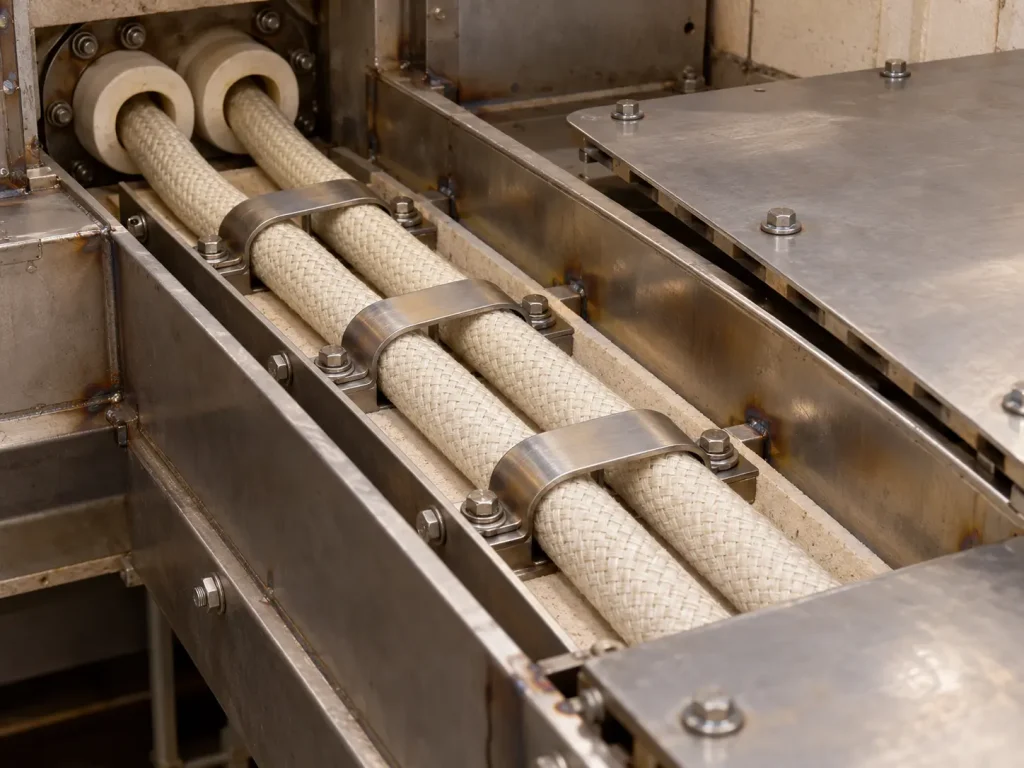
The rating field reads “200 or 450 deg C, 600 Vac, Horizontal flame.” The Style carries two alternative temperature ratings; a given construction is qualified at one of them, and the rating for an order is confirmed for the qualified ordered construction. Neither rating is described in the record as continuous or long-term, and no service life is inferred.
600 Vac is the only voltage rating in the record. No DC value or combined AC/DC figure applies. Horizontal flame is the flame classification; it is not VW-1, FT1 or FT2, and no vertical flame rating forms part of the Style.
High-Temperature Equipment Internal Wiring Boundaries
The full Use wording is: “Internal Wiring of high-temperature equipment where not subjected to repeated flexing and protected from mechanical abuse, and where the acceptability, including current-carrying capacity, has been determined by Underwriters Laboratories Inc.” At 250–550 kcmil these conditions apply unchanged:
- Internal wiring of high-temperature equipment: the large conductor size does not turn Style 5107 into power cable, feeder cable, building or branch-circuit wire, tray or field-wiring cable, switchgear or utility cable, motor feeder or medium-voltage cable.
- No repeated flexing: it is not a flexible, moving, robotic or drag-chain cable, and no bend radius, bending diameter or flex-cycle value is given.
- Protected from mechanical abuse: exposed, open-machinery, outdoor, direct-burial, cable-tray and field routing are outside the Use.
- Acceptability, including current-carrying capacity, determined by UL: a large conductor does not justify a generic current figure. No ampacity, current rating or power figure is published or calculated here, and general wiring-code ampacity tables are not applied to this AWM Style.
UL 5107 Insulation Thickness Groups
| Conductor size group | Total mica tape layers, min average | Treated glass braid, min average | Conductor form |
|---|---|---|---|
| 26 – 12 AWG | 25 mils | 7 mils | Solid or stranded |
| 11 – 4 AWG | 30 mils | 15 mils | Solid or stranded for 11 – 8 AWG; stranded only for 7 – 4 AWG |
| 3 – 4/0 AWG | 35 mils | 20 mils | Stranded only |
| 250 – 550 kcmil (this page) | 40 mils | 20 mils | Stranded only |
Two points in this table need clarification. First, the conductor-form column applies the record’s single rule (solid or stranded for 26–8 AWG; stranded only for larger sizes) to each group. Second, all thickness values are minimum averages, and each group’s values apply only to that group.
The Style also allows, as independent options, two or more insulated conductors cabled together with a maximum assembly O.D. of 1.500 inches, with a mica glass binder and/or fiberglass fillers; a shield of 36–30 AWG strands; and a treated glass braid over the assembly. These options are covered on the dedicated UL 5107 multi-conductor product page; no assembly fit or diameter is estimated here.
What Style 5107 Does and Does Not Define
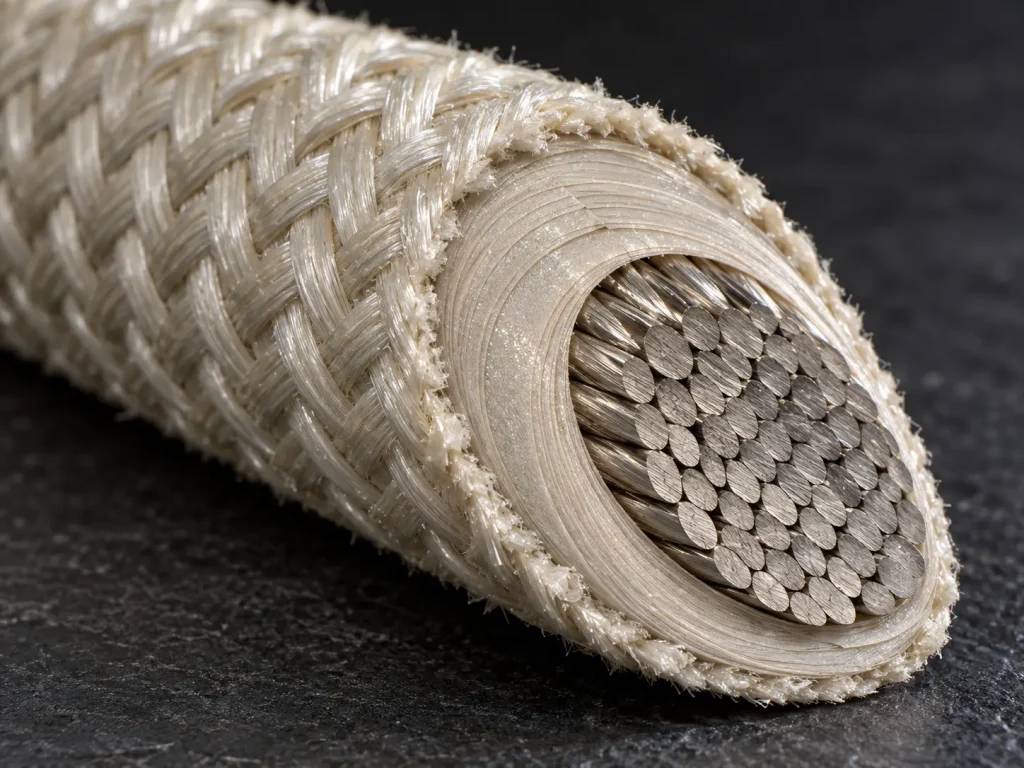
For 250–550 kcmil, the Style record defines the rating (200 or 450°C, 600 Vac, Horizontal flame); the conductor form (stranded only); the insulation systems (mica tape with braid, or mica composite with braid); the 40-mil minimum average of total mica tape layers; the 20-mil minimum average of treated glass braid; the braid treatment options; the marking field (General); and the Use with its conditions.
The Style record does not define:
- conductor material, plating or strand construction
- conductor resistance, conductor diameter or current rating
- minimum-at-any-point thicknesses
- finished outside diameter, tolerance or weight
- mica type, origin or the composition of the mica composite
- which braid treatment applies to which temperature rating
- a specific marking method or interval
- bend radius, flex life or service life
Common Procurement Errors
- Specifying a solid conductor at 250–550 kcmil.
- Applying the 35-mil mica value of 3–4/0 AWG to this group.
- Treating 40 or 20 mils as nominal or point minimums.
- Adding mica and braid values into a single wall figure.
- Assuming 200°C means silicone varnish and 450°C means TFE finish.
- Assuming a conductor material or plating.
- Assigning a current rating from conductor size.
- Treating the wire as power or feeder cable.
- Specifying it for repeated flexing or unprotected routing.
How to Specify UL 5107 250–550 kcmil Mica Wire in an RFQ
The Style fixes the rating options, the stranded-only form, the insulation systems, the 40/20 mil minimum averages, the treatment options and the Use. The following should be stated by the buyer and confirmed for the ordered qualified construction, not filled with assumed values:
- conductor size within 250–550 kcmil
- detailed stranded construction requirement
- conductor material and finish requirement
- required qualified temperature rating: 200°C or 450°C
- mica tape or qualified mica-composite requirement, if controlled
- braid treatment requirement, if controlled
- finished OD or tolerance, if controlled
- marking requirement
- quantity
- packaging
- documentation requirements
- equipment type
- exact internal routing location
- mechanical-protection conditions
- confirmation that repeated flexing is not involved
- any required current-carrying-capacity or end-equipment qualification information
UL Marking and Documentation
Style 5107 wire is supplied as UL-recognized component wire where supplied under qualified manufacturing scope. The marking field of the Style record reads “General”; it does not prescribe a fixed legend, marking method or interval. UL marking is applied according to the confirmed ordered construction, including its temperature rating, and should be confirmed at the order stage.
Applicable RoHS / REACH documentation can be confirmed according to the ordered construction. CE, UKCA, CSA, FT1, VW-1, CPR, VDE, DIN, EN and IEC are not declared for this product.
Commercial, origin, compliance and transport documents are identified during quotation and confirmed according to the order.