UL 3573 Ignition Wire Products
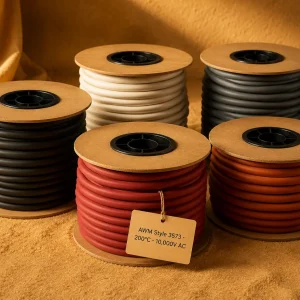
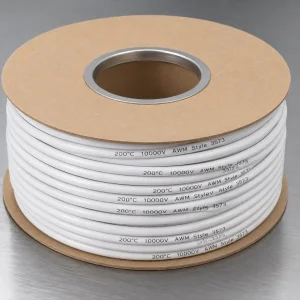
This page groups the available UL Style 3573 product constructions. UL Style 3573 is an insulated wire rated 200°C at 10,000 Vac, covering 22 AWG through 12 AWG in solid or stranded round conductor construction. The Style uses a three-part build: an SR silicone inner insulation at 30 mils minimum average, a fiberglass braid or serve intermediate layer, and an SR silicone outer insulation applied over the braid at 10 mils minimum at any point.
That silicone-braid-silicone construction is what distinguishes UL 3573 within the high-voltage ignition Styles — the braid sits between two silicone layers rather than forming the outer surface. Use the products below to review constructions against your own 22–12 AWG requirement. Conductor material, plating, detailed strand construction, colour, finished dimensions, marking, packaging and supporting documents are not fixed at Style level and are confirmed by quotation for the specific construction ordered.
UL 3573 Wire Specifications
| UL AWM Style | 3573 |
| Product type per Style file | Insulated wire |
| UL Subject / Section | 758, Section 3 |
| Temperature rating | 200°C |
| Voltage rating | 10,000 Vac |
| Conductor range | 22 AWG – 12 AWG, solid or stranded round |
| Inner insulation | SR silicone — 30 mils minimum average / 27 mils minimum at any point |
| Intermediate layer | Fiberglass braid or serve |
| Outer insulation | SR silicone over the braid — 10 mils minimum at any point |
| Flame rating | Horizontal flame per the UL Style file; VW-1 vertical flame testing available by confirmed construction and agreed order requirement |
| Marking | General, per UL Subject 758 marking requirements |
| Use per UL Style file | Electronic ignition or similar application in gas ranges or gas or fuel oil burner systems where protected from damage during handling, installation and servicing of the appliance |
Available 22–12 AWG Constructions
The UL Style scope covers 22 AWG through 12 AWG in solid or stranded round construction. Every construction within the Style shares the same three-part insulation build: SR silicone inner insulation, a fiberglass braid or serve layer over it, and SR silicone outer insulation applied over the braid.
The Style file fixes the insulation thicknesses — 30 mils minimum average and 27 mils minimum at any point for the inner silicone, 10 mils minimum at any point for the outer silicone over the braid — but does not define a universal conductor material, plating or strand count. Those are established at order stage, together with insulation colour, finished outside diameter, wire marking and packaging format. Not every combination of AWG, conductor construction, colour and packaging is continuously stocked; where a requested combination has not previously been produced, confirm feasibility during enquiry rather than assuming availability from the Style scope alone.
Choose a UL 3573 Ignition Wire Product
The product cards below represent different product specifications, application contexts and market requirements within the same UL Style 3573 scope. They differ in how the construction is specified and in the commercial terms attached to a particular order rather than in the underlying Style rating.
Two products serve as the general entry points into this Style: UL 3573 ignition wire for protected ignition circuits and UL 3573 ignition wire for burner systems.
Protected Ignition Applications
The UL Style 3573 file states the use as electronic ignition or similar application in gas ranges or gas or fuel oil burner systems, where the wire is protected from damage during handling, installation and servicing of the appliance.
The protection condition is part of the stated use, not an added recommendation. The wire must be protected from damage across the three phases the file names — during handling before installation, during installation into the appliance, and during any subsequent servicing of the equipment. That condition should be checked against the routing design and service access arrangements of the appliance before a construction is specified. The Style rating alone does not establish suitability for a given installation.
UL Marking and Order Documentation
The product construction actually produced, the UL marking applied, and the documentation accompanying a shipment must all be confirmed within the applicable certified scope before production. Only products bearing the applicable UL Mark should be represented as covered products.
Where RoHS, REACH or other compliance documents are required for the order, specify them during enquiry so availability can be confirmed for the ordered construction. Minimum order quantity, sample availability, packaging format, delivery schedule, marking and required documents are all confirmed in the quotation rather than fixed in advance.
Related High-Voltage Ignition Wire Styles
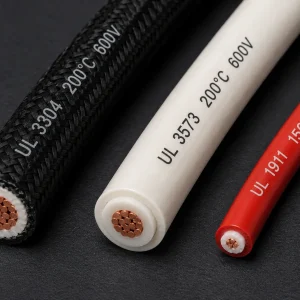
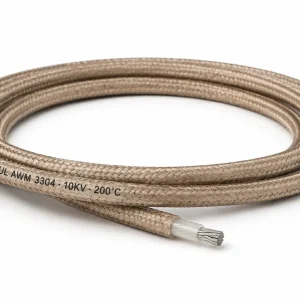
Two adjacent high-voltage Styles are commonly compared against UL 3573. UL 3304 is also rated 200°C at 10,000 Vac across 22–12 AWG, but its construction differs: a 40 mils minimum average silicone rubber insulation with a fiberglass braid covering as the outer layer, rather than the silicone-braid-silicone build of UL 3573. The difference is one of construction rather than rating — which is appropriate depends on the equipment design and whether an outer silicone layer over the braid is specified.
UL 1911 is a high-voltage wire rated 250°C at up to 50,000 Vdc across 24–10 AWG, with insulation material and individual ratings defined at construction level. Selection between these Styles should be based on the applicable Style file, the voltage form and level in the circuit, the required construction and the equipment requirements — not on the voltage figure alone.
The wider ranges are available under High Voltage Wire and AWM Wire.
Request a UL 3573 Wire Quote
Send the following with your enquiry so the construction can be confirmed against the applicable certified scope:
- AWG size
- Solid or stranded construction
- Requested conductor material or plating
- Colour
- Finished-dimension requirement
- Quantity
- Packaging format
- Required wire marking
- Required order documents
- Ignition-system voltage requirement
- Whether the application is a gas range, gas burner or fuel oil burner system
- Routing and protection conditions within the appliance
Showing all 11 results
- UL 1911 High Voltage Wire
UL 3304 3573 1911 Ignition Wire – Replacement & Selection Guide Gas Burner
Read more - UL 3573 Ignition Wire Products
UL 3573 10kV Insulated Wire — Three-Layer Silicone-Braid-Silicone Construction for Demanding Ignition Applications
Read more - UL 3573 Ignition Wire Products
UL 3573 10000V 200°C Dual-Insulation Ignition Wire – Mexico Supplier
Read more - UL 3573 Ignition Wire Products
UL 3573 Dual-Layer Ignition Wire | 10KV | Vietnam & Indonesia
Read more - UL 3573 Ignition Wire Products
UL 3573 Ignition Wire Turkey – 200°C 10kV Dual Layer Gas Range Burner Wire
Read more - UL 3573 Ignition Wire Products
UL 3573 10kV Insulated Wire — UK Supplier for Manufacturing Export to North America
Read more