UL 3666 32–10 AWG XLPE Wire — 15/13 Mil Insulation Group
UL AWM Style 3666 is an insulated wire rated 105°C and 600 Vac with a Horizontal flame classification. The Style record states the conductor as “32 AWG – 1000 kcmil solid or stranded round, tinned or bare copper,” the insulation as XLPE, and the Use as “Internal wiring where not subjected to mechanical abuse.” The insulation thickness is set by conductor-size group.
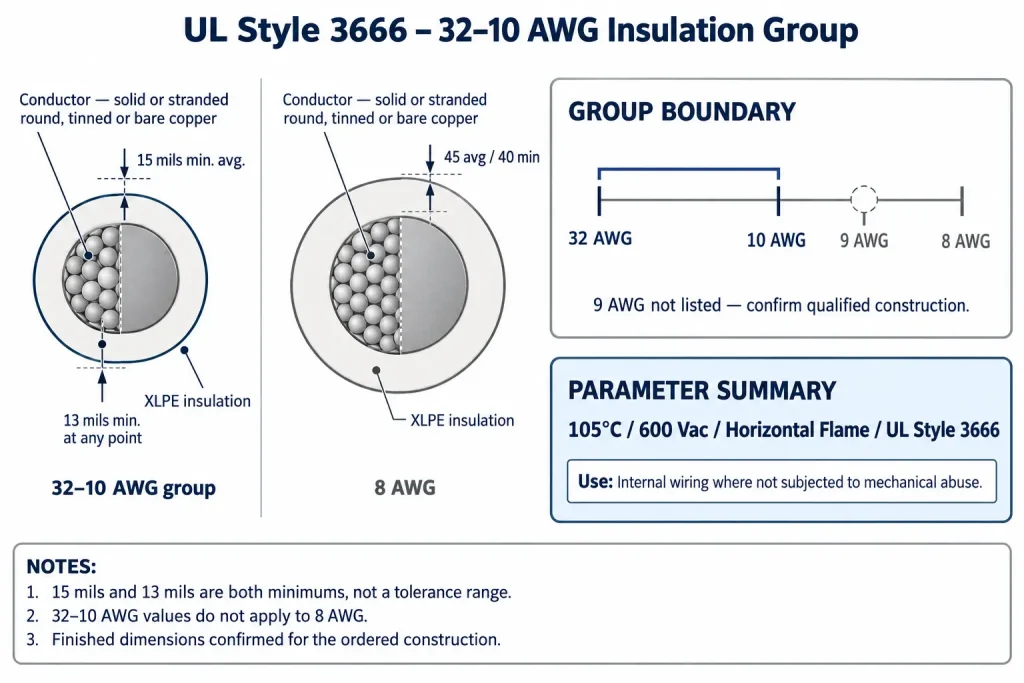
This page covers one of those groups: 32 AWG through 10 AWG, where the XLPE insulation must be at least 15 mils minimum average and 13 mils minimum at any point. It explains what those two values mean, where the group ends, which conductor options the Style states, and what an RFQ for this size group should confirm. The full 32 AWG–1000 kcmil range is summarised only briefly here; for the broader Style overview, see the UL 3666 XLPE Wire category.
Verified UL 3666 Technical Specifications
| Parameter | UL AWM Style 3666 record |
|---|---|
| Style | 3666 |
| Temperature | 105°C |
| Voltage | 600 Vac |
| Flame | Horizontal flame |
| Page-specific conductor group | 32 AWG – 10 AWG |
| Complete Style conductor range | 32 AWG – 1000 kcmil |
| Conductor form | Solid or stranded round |
| Conductor material / finish | Tinned or bare copper |
| Insulation | XLPE |
| 32–10 AWG minimum average thickness | 15 mils (0.38 mm) |
| 32–10 AWG minimum thickness at any point | 13 mils (0.33 mm) |
| Marking | General |
| Use | Internal wiring where not subjected to mechanical abuse |
Three points in this table need clarification. First, the millimetre values are arithmetic conversions (1 mil = 0.0254 mm), not separate UL specifications. Second, “tinned or bare copper” is a choice between two finishes stated by the Style; which one applies to a given order is confirmed for the ordered construction, and the Style does not define strand construction or resistance. Third, the voltage rating is stated as 600 Vac only; the record contains no DC rating.
15 Mil Minimum Average / 13 Mil Minimum at Any Point
For every conductor size from 32 AWG through 10 AWG, the Style sets two separate requirements for the XLPE wall:
- 15 mils minimum average: the average of wall-thickness measurements around the insulation must not fall below 15 mils.
- 13 mils minimum at any point: the thinnest point anywhere in the wall must not fall below 13 mils.
A qualified construction must meet both. A wall averaging above 15 mils still fails if one point measures below 13 mils, and a wall with no point below 13 mils still fails if its average is below 15 mils. The 2-mil difference is not a tolerance band around a nominal value, and neither figure is a nominal, exact, standard or target wall. Both are floors, and the actual wall of an ordered construction may exceed 15 mils.
For the same reason, the finished outside diameter cannot be calculated from conductor size plus the insulation minimums. Where a drawing controls finished diameter or its tolerance, that requirement should be stated in the RFQ and confirmed for the ordered construction.
The same 15/13 mil requirement applies across the whole group. 32 AWG and 10 AWG, the two ends of the group, carry the same insulation minimums, even though their conductors differ greatly in size.
Why 10 AWG and 8 AWG Use Different Insulation Groups
The group boundary matters because the requirement changes sharply at the next listed size:
- 32–10 AWG: 15 mils minimum average / 13 mils minimum at any point
- 8 AWG: recorded as 45 avg / 40 min (mils)
10 AWG and 8 AWG therefore belong to different insulation groups, and the 15/13 mil values must not be extended to 8 AWG. An 8 AWG construction specified with a 15-mil wall would not match the Style record.
The record’s insulation schedule contains no separate line for 9 AWG. The group for 32–10 AWG ends at 10 AWG, and the next entry begins at 8 AWG. This page does not assign 9 AWG to either neighbouring group and does not interpolate a value. If 9 AWG is required, its applicability under Style 3666 and its insulation requirement must be confirmed against a qualified construction.
Tinned or Bare Copper, Solid or Stranded Round
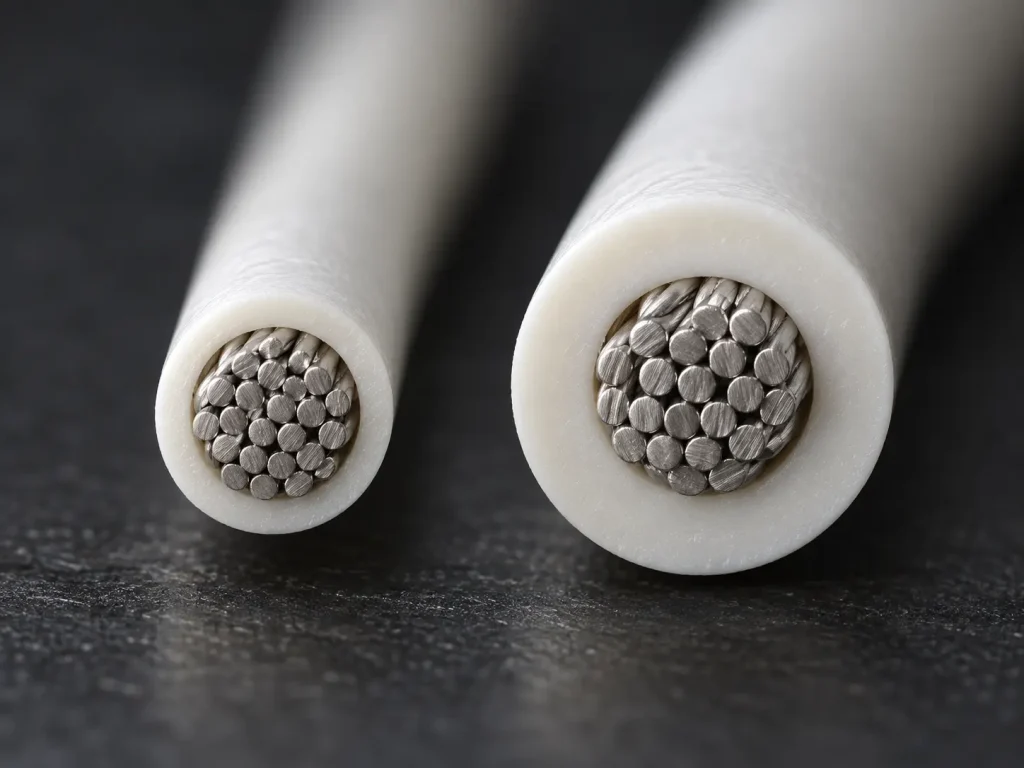
Unlike many AWM Style records, Style 3666 names the conductor material in its conductor field: “solid or stranded round, tinned or bare copper.” Within the 32–10 AWG group this gives four combinations: solid tinned copper, solid bare copper, stranded tinned copper and stranded bare copper, all in round form.
The Style stops there. It does not define strand count, strand diameter, lay length, conductor class, nominal conductor diameter or conductor resistance, and it assigns no current rating to any size. Where a drawing controls stranding, resistance or conductor dimensions, those requirements are confirmed for the ordered construction rather than assumed from AWG.
105°C / 600 Vac / Horizontal Flame
The rating field reads “105 deg C, 600 Vac, Horizontal flame.” 105°C is the rated temperature of the Style. The record gives no continuous-duty or long-term qualifier, and no service life, overload capability or thermal-ageing performance is derived from it here.
600 Vac is the only voltage rating in the record. No DC value or combined AC/DC figure applies.
Horizontal flame is the flame classification in the record. It is not VW-1, FT1 or FT2, and no vertical flame rating forms part of the Style. The record identifies the insulation material as XLPE but attributes no further performance to it, so no chemical, oil, overload, mechanical or service-life properties are assigned to the insulation on this page. The ratings and the insulation requirement apply equally across the 32–10 AWG group.
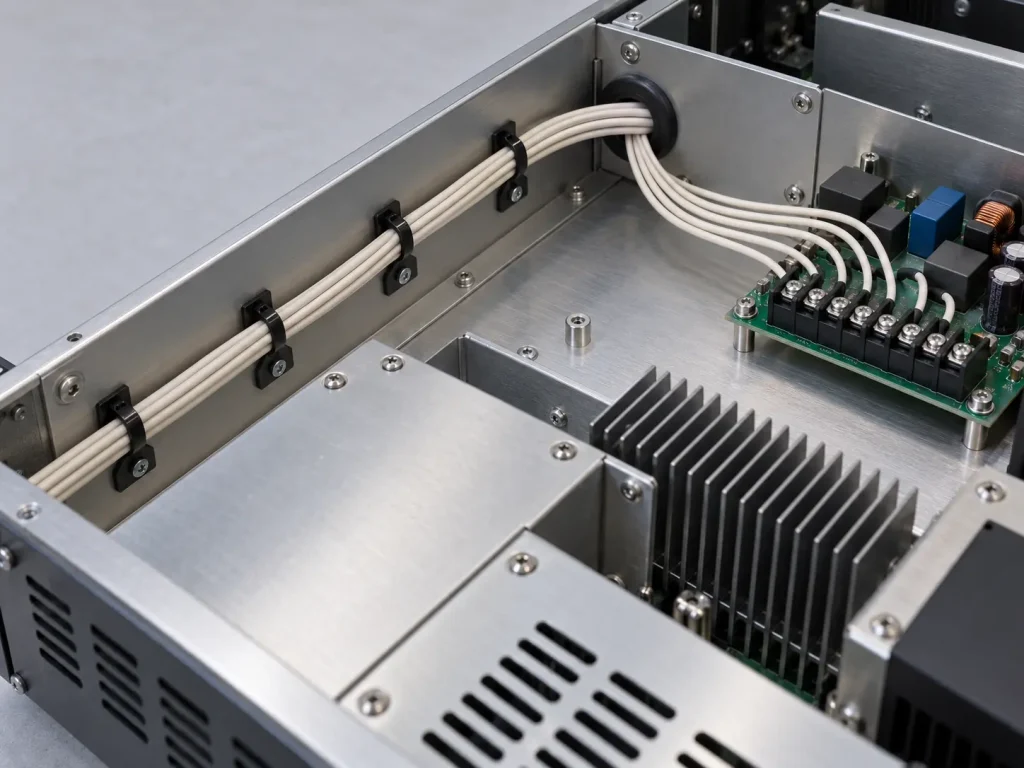
Internal Wiring Where Not Subjected to Mechanical Abuse
The Use field reads “Internal wiring where not subjected to mechanical abuse.” It has two parts. The first restricts the wire to internal wiring. The second is a condition on the routing: the wire is not to be subjected to mechanical abuse.
The condition is part of the Use. Locating the wire inside an enclosure does not by itself show that it is met. Routing, fixing, clearance from edges and moving parts, and exposure during assembly and servicing all bear on whether a particular location satisfies it, and that is determined within the equipment design and its own evaluation.
The Use does not extend to building wire, branch-circuit or field wiring, tray or conduit cable, exposed equipment wiring, external power or portable cable, facility distribution, motor feeder, VFD, battery, UPS, solar or medium-voltage cable. The 600 Vac rating does not widen this boundary. Whether a Style 3666 construction is acceptable in place of another Style in an existing design is a question for that design and its applicable end-product evaluation; shared temperature or voltage values do not establish interchangeability.
Other UL 3666 Insulation Groups
For reference, the remaining groups in the Style record are listed below exactly as recorded. They are outside the scope of this page.
| Conductor size group | Insulation requirement as recorded |
|---|---|
| 32 – 10 AWG (this page) | 15 mils min average / 13 mils minimum at any point |
| 8 AWG | 45 avg / 40 min |
| 7 – 2 AWG | 60 avg / 54 min |
| 1 – 4/0 AWG | 80 avg / 72 min |
| 250 – 500 kcmil | 95 avg / 86 min |
| 501 – 1000 kcmil | 110 avg / 92 min |
Three points in this table need clarification. First, only the 32–10 AWG line states its unit and terminology in full; the other lines are recorded in abbreviated form, and their values are read in mils. Second, no line exists for 9 AWG, and no value is interpolated for it. Third, each group’s values apply only to that group and are never carried over to a neighbouring size.
What Style 3666 Does and Does Not Define
For the 32–10 AWG group, the Style record defines the rating (105°C, 600 Vac, Horizontal flame); the conductor form and material (solid or stranded round, tinned or bare copper); the insulation material (XLPE) and its two minimum thicknesses (15 mils minimum average, 13 mils minimum at any point); the marking field (General); and the Use with its mechanical-abuse condition.
The Style record does not define:
- strand count, strand diameter, lay or conductor class
- conductor resistance or nominal conductor diameter
- current rating or ampacity
- nominal wall, finished outside diameter or tolerance
- a DC voltage rating or vertical flame rating
- bend radius, service life or chemical performance
- an insulation value for 9 AWG
- colours, put-up lengths or packaging
Common Procurement Errors
- Treating 15 mils as the nominal wall and calculating a finished diameter from it.
- Reading 15 and 13 mils as the limits of a tolerance range.
- Applying the 15/13 mil values to 8 AWG.
- Assigning 9 AWG to a neighbouring group without confirmation.
- Assuming a strand construction or resistance from AWG.
- Specifying tinned or bare copper ambiguously, leaving the finish undefined.
- Adding a DC rating to the 600 Vac rating.
- Assuming VW-1, FT1 or another vertical flame rating.
- Specifying the wire for routing that is exposed to mechanical abuse.
How to Specify UL 3666 32–10 AWG XLPE Wire in an RFQ
The Style fixes 105°C, 600 Vac, Horizontal flame, XLPE insulation, the 15/13 mil requirement for 32–10 AWG, the conductor options and the Use. The following should be stated by the buyer and confirmed for the ordered construction, not filled with assumed values:
- conductor size within 32–10 AWG
- solid or stranded round
- tinned or bare copper
- detailed stranding, if controlled
- colour
- required finished OD or tolerance, if controlled
- quantity
- packaging
- marking requirements
- documentation requirements
- equipment type
- routing condition
- confirmation that the wiring location is not subjected to mechanical abuse
UL Marking and Documentation
Style 3666 wire is supplied as UL-recognized component wire where supplied under qualified manufacturing scope. The marking field of the Style record reads “General” and does not prescribe a fixed print legend. UL marking is applied according to the confirmed ordered construction and should be confirmed at the order stage.
Applicable RoHS / REACH documentation can be confirmed according to the ordered construction. CE, UKCA, CSA, FT1, VW-1, CPR, VDE, DIN, EN and IEC are not declared for this product.
Commercial, origin, compliance and transport documents are identified during quotation and confirmed according to the order.