UL 3304 — 10kV Silicone Ignition Wire for Gas Range and Gas Burner Internal Wiring
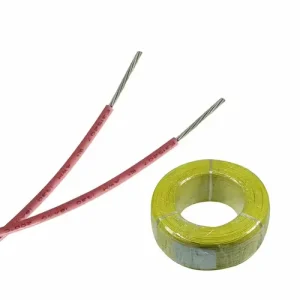
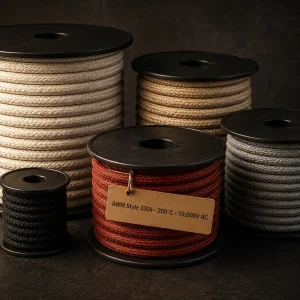
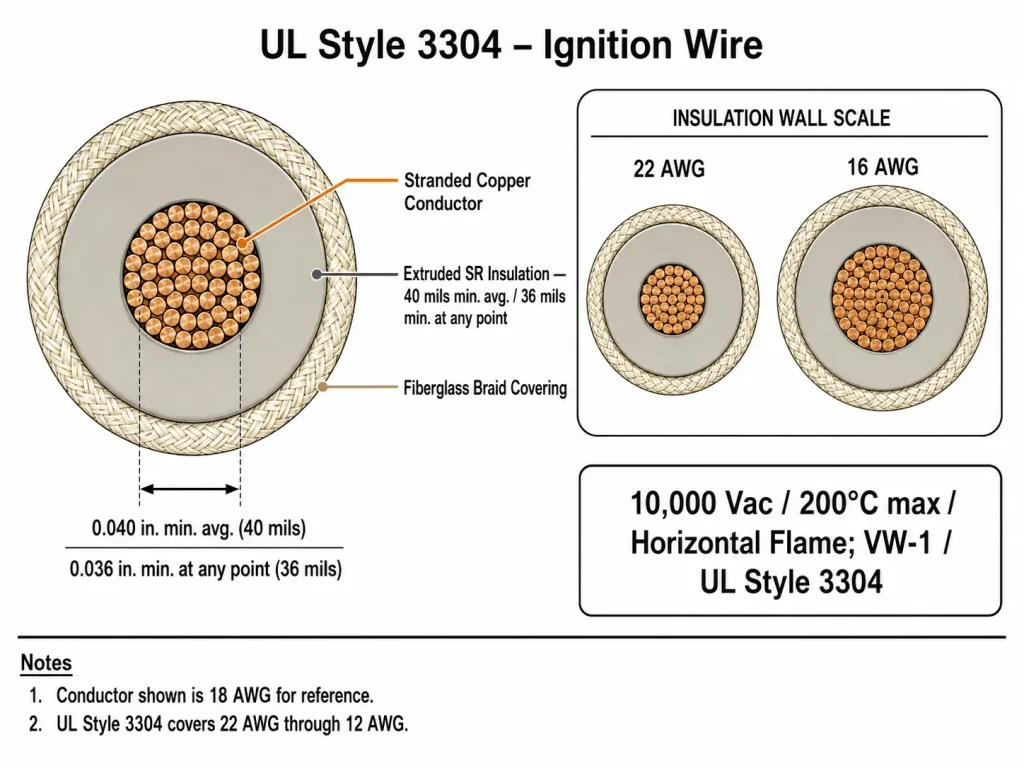
UL AWM Style 3304 is the standard UL-recognized component for electronic ignition wire in gas ranges, gas burner systems, and fuel oil burner systems, where the wire is protected from damage during handling, installation, and servicing of the appliance. The Style is rated at 200°C maximum and 10,000 Vac, with extruded silicone rubber insulation and a fiberglass braid covering, and covers 22 AWG through 12 AWG. CableApex supplies UL AWM Style 3304 from factory production in Yangzhou, with CIF Hamburg and CIF Rotterdam shipping available. UL AWM Style 3304 documentation is available for confirmed constructions on request. Marking and documentation depend on the qualified ordered construction.
UL 3304’s Role in an Electronic Ignition Circuit
In a modern gas appliance ignition system, the wire is not simply a connection between two points — it is an active circuit element with capacitance, dielectric loss, and voltage withstand limits that affect spark performance. Engineers specifying ignition wire for gas range and burner applications need to understand where UL AWM Style 3304 fits in the ignition circuit topology.
A standard electronic gas appliance ignition system has four main components, with UL 3304 connecting two of them:
- Power supply — 24V DC or 120V/240V AC input from the appliance main supply
- Ignition module — high-voltage generation circuit (flyback transformer, voltage multiplier, or capacitor-discharge system) that converts low voltage to 10–15 kV pulses
- UL 3304 high-voltage wire — delivers the 10–15 kV pulse from the ignition module output terminal to the spark electrode
- Spark electrode — terminates the wire at the burner with a 2–4 mm air gap to ground where the spark forms
The UL 3304 wire experiences the full ignition voltage during every spark event — typically 1–2 sparks per second during ignition sequences, repeated thousands of times over the appliance lifetime. The construction must withstand this dielectric stress while being mechanically routed through the appliance chassis and remaining thermally stable at sustained 200°C maximum ambient temperature near the burner assembly.
UL AWM Style 3304 — Key Specifications
| Parameter | Value per UL Style 3304 File |
|---|---|
| UL AWM Style | 3304 |
| UL Subject / Section | 758, Section 3 |
| Temperature Rating | 200°C maximum |
| Voltage Rating | 10,000 Vac |
| AWG Range | 22 AWG – 12 AWG, solid or stranded round |
| Conductor | Bare or tinned copper, solid or stranded round (confirm at order) |
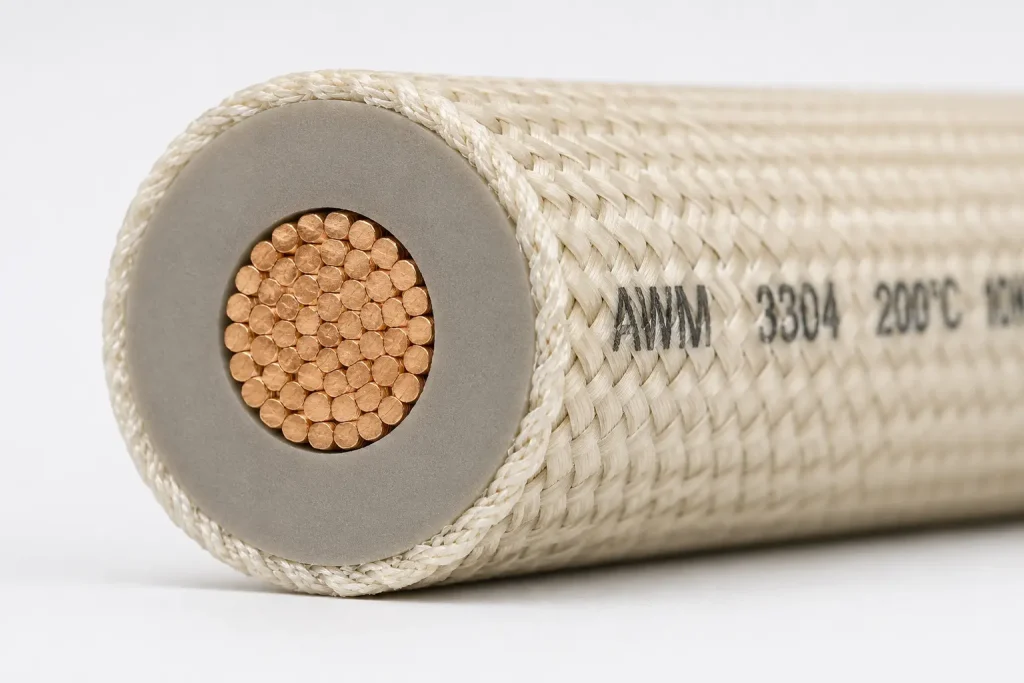
| Insulation Material | Extruded silicone rubber (SR) |
| Min Avg Insulation Thickness | 40 mils (1.02 mm) — per UL Style file |
| Min Insulation at Any Point | 36 mils (0.91 mm) — per UL Style file |
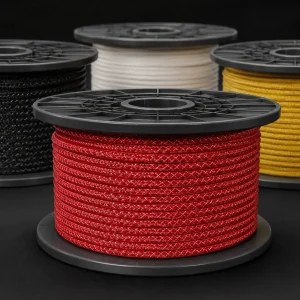
| Covering | Fiberglass braid (over silicone rubber insulation) |
| Flame Rating | Horizontal flame; VW-1 vertical flame test available |
| UL Recognition | UL Recognized Component — file on record |
| Permitted Use (per UL Style file) | Internal wiring of electronic ignition or similar application in gas ranges or gas or fuel oil burner systems — where protected from damage during handling, installation, and servicing of the appliance |
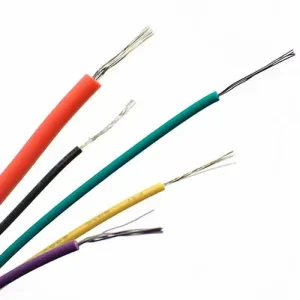
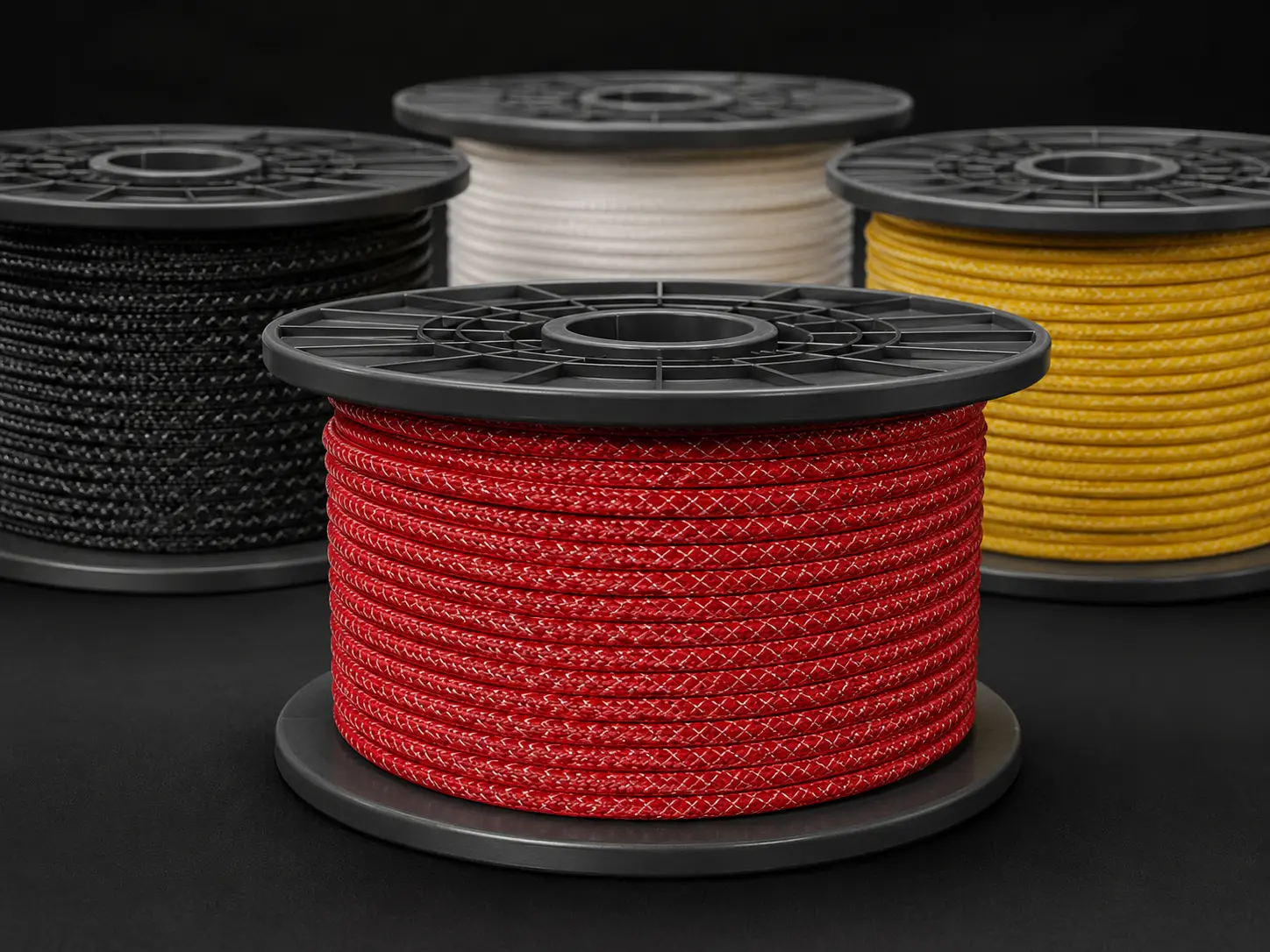
| Colour Options | Red, black, white, yellow; custom on request |
| RoHS / REACH | Documentation available on request, where applicable |
Four Failure Modes That UL 3304 Construction Addresses
Understanding how ignition wire fails in service helps clarify why UL AWM Style 3304’s specific construction — 40 mils silicone rubber plus fiberglass braid — is the correct specification for gas appliance ignition wiring.
Dielectric Breakdown of Insulation
If the wire’s insulation cannot sustain the spark voltage, an internal breakdown occurs — the spark conducts through the insulation to chassis or to an adjacent conductor instead of jumping the intended electrode gap. UL 3304’s 40 mils minimum silicone rubber wall provides substantial dielectric margin above the 10,000 Vac continuous rating, accommodating the voltage transients generated during the ignition pulse rise time. Final dielectric performance depends on the specific ordered construction and installation conditions.
Surface Tracking
Surface contamination — grease, dust, condensation — on the outer wire surface can create a conductive path along the surface even when the bulk insulation is intact. Fiberglass braid is a non-tracking material: surface contamination on fiberglass does not form persistent carbon tracks the way it can on unprotected polymer surfaces, reducing the risk of progressive surface fault development over the appliance service life.
Mechanical Abrasion at Chassis Edges
Ignition wires route through metal chassis with sharp edges, mounting brackets, and pass-through holes. Silicone rubber alone is mechanically soft and can be abraded by these features. The fiberglass braid covering provides the surface protection that plain extruded silicone cannot — sharp chassis edges and mounting hardware contact points are substantially less likely to penetrate the braided fiberglass outer layer during normal installation and service.
Thermal Aging at Sustained Elevated Temperature
Burner operation generates radiated heat that can maintain adjacent wiring at temperatures approaching 200°C in sustained operation. Silicone rubber retains its dielectric and mechanical properties at 200°C maximum across the expected appliance service life, with only minor mechanical hardening at long service durations. Standard PVC insulation is not rated for this thermal environment and degrades at temperatures above 105°C.
UL 3304 vs Automotive Ignition Wire — Why They Are Not Interchangeable
Engineers familiar with automotive ignition systems sometimes ask whether automotive ignition wire can substitute for UL AWM Style 3304 in gas appliance applications. The answer is no, for two distinct reasons:
- Certification scope. Automotive ignition wire is typically certified under SAE J1127, J1128, or ISO 6722 — vehicle electrical standards that are not applicable to appliance internal wiring under UL Subject 758. An appliance whose design specifies UL 3304 as the recognized ignition wire component cannot substitute automotive ignition wire without voiding the appliance’s UL component recognition for that construction. The appliance-level certification becomes invalid for the substituted construction.
- Construction optimization. Automotive ignition wire is designed for under-hood automotive environments — EPDM or specialized polymer constructions optimized for oil, coolant exposure, and mechanical vibration profiles specific to vehicle applications. UL 3304’s silicone rubber and fiberglass braid construction is optimized for the sustained-temperature, lower-contamination, higher-dielectric-cycle-count demands of gas appliance combustion environments. Both may carry similar voltage markings but are designed for fundamentally different installation and service conditions.
Engineering Notes for Gas Appliance Ignition Wiring Design
- Wire capacitance and spark energy: Every ignition wire has distributed capacitance to chassis ground — typically in the range of 50–200 pF per metre for silicone-insulated wires routed inside metal chassis. When the ignition pulse arrives, this capacitance must charge before the voltage at the spark electrode reaches the air-gap breakdown threshold. For wire runs under 200 mm the capacitive load is generally negligible. For runs over 1 metre in length, the capacitive load begins to absorb measurable pulse energy and can reduce spark intensity. Confirm the ignition module’s pulse energy specification accommodates the capacitance of the cable length used in the specific appliance design.
- Solid versus stranded conductor for ignition service: For fixed installations where the wire is routed once during assembly and not flexed during service, solid conductor is acceptable and reduces per-metre cost slightly. For installations where the wire must flex during normal service — sliding oven components, hinged access panels, removable burner assemblies — stranded conductor is required to avoid conductor fatigue cracking over the service life. Stranded 18 AWG tinned copper is the most commonly specified construction for general-purpose gas appliance ignition wiring at standard burner layouts.
- Service life expectation: Correctly specified UL AWM Style 3304 in standard residential and commercial gas appliance burner service — 1–2 sparks per ignition sequence, 1–10 ignitions per day at 200°C maximum ambient — typically achieves a service life equal to or exceeding the appliance design lifetime. Premature failure in service is usually attributable to installation damage during assembly, application conditions outside the rated parameters, or substitution of non-UL-recognized wire in the ignition circuit.
Supply for Deutschland and European Export Markets
- Factory supply, direct communication: UL AWM Style 3304 silicone ignition wire is produced at the Yangzhou facility and supplied through CableApex for B2B export to Deutschland and other European and international markets. Direct factory communication supports specification clarification, lead-time coordination, and documentation preparation before order placement.
- AWG and conductor options: Available from 22 AWG to 12 AWG, solid or stranded, bare or tinned copper. Confirm AWG, stranding, and conductor surface at enquiry stage. Stranded tinned copper is available as the standard construction for general gas appliance ignition wiring.
- Flame test capability: UL Style 3304 specifies Horizontal flame. VW-1 vertical flame testing is available according to the confirmed construction and order requirement.
- Export documentation: Commercial Invoice, Packing List, Certificate of Origin (CCPIT), Bill of Lading provided as standard. UL AWM Style 3304 documentation available for confirmed construction on request. RoHS and REACH documentation available on request where applicable. HS Code: 8544.49. CIF Hamburg or CIF Rotterdam available — transit approximately 25–30 days from Shanghai or Ningbo origin port. MOQ 100m per colour per AWG. B2B quotation response within 12 hours.
Related UL AWM Styles for Ignition and High-Voltage Applications
Buyers evaluating UL AWM Style 3304 commonly cross-reference: UL AWM 3573 (200°C / 10,000 Vac, silicone rubber inner insulation with fiberglass braid and silicone outer layer, 22–12 AWG — alternative high-voltage ignition wire with a dual-layer insulation construction for ignition applications requiring the additional outer silicone layer); UL AWM 3071 (200°C / 600 Vac, extruded silicone rubber with fiberglass braid, 18–13 AWG — same temperature class and braid construction at the lower 600 Vac voltage class for non-ignition silicone wire applications); UL AWM 3135 (200°C / 600 Vac, extruded silicone rubber without braid, 26–12 AWG — 600V silicone rubber AWM for non-ignition high-temperature enclosed appliance internal wiring); and UL AWM 1659 (250°C / 600 Vac, PTFE, 26–4/0 AWG — higher-temperature fluoropolymer alternative for non-ignition high-temperature internal wiring where 250°C rating is required).