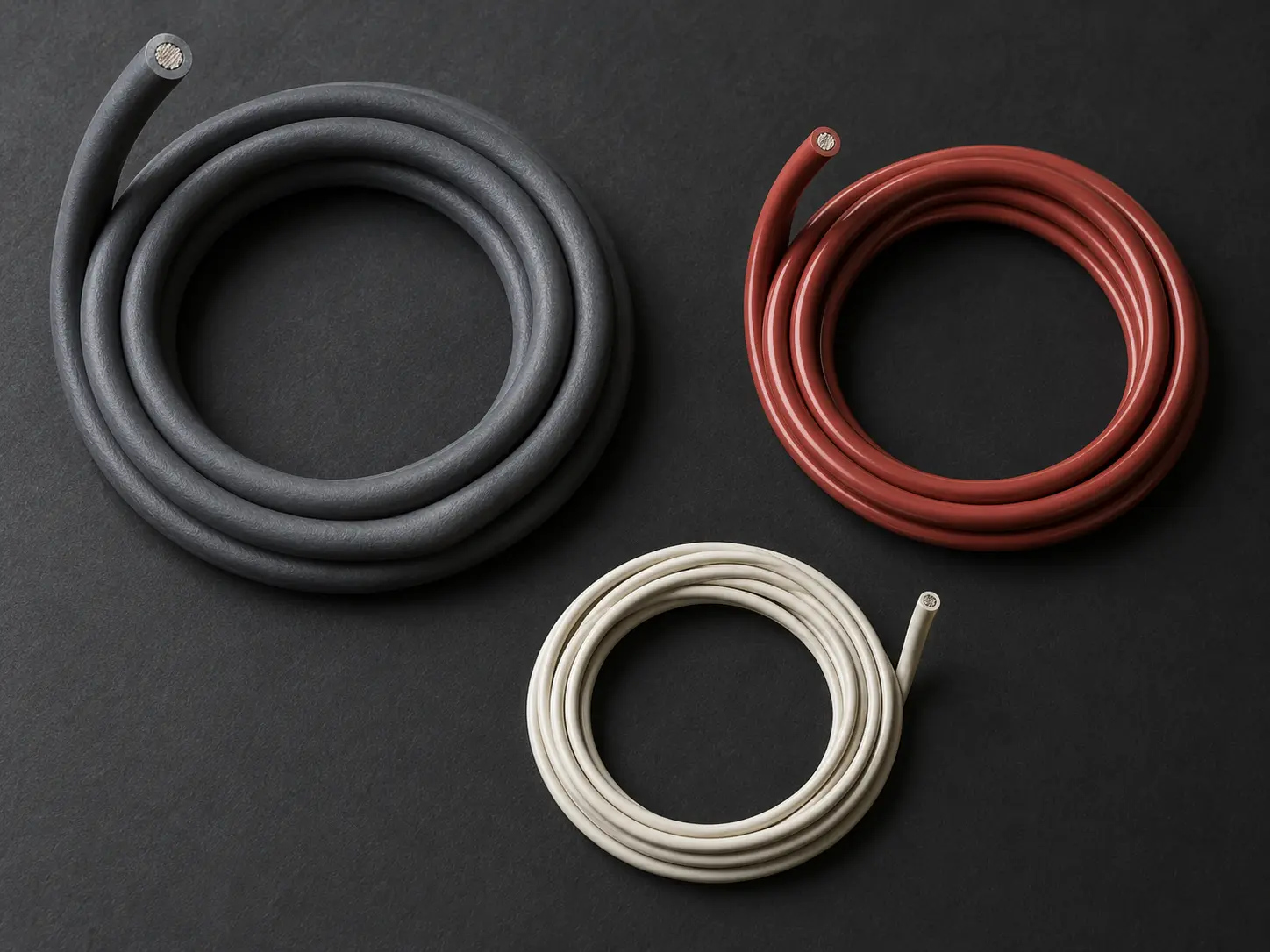
UL 1911 for Internal Wiring of Electronic Gas Ignitor Systems
UL AWM Style 1911 is described at Style level simply as High Voltage Wire. The Style lists a maximum temperature of 250°C and a maximum of 50,000 Vdc, with Horizontal Flame, across a 24 AWG through 10 AWG conductor range in solid or stranded round form.
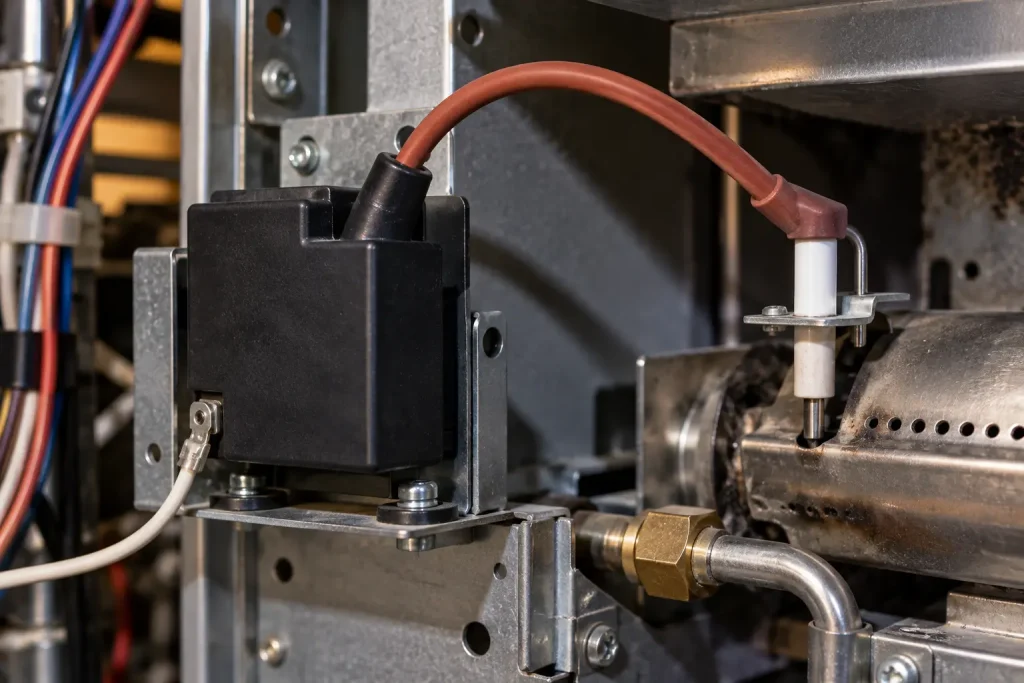
The official Use is narrow and specific: internal wiring of electronic gas ignitor systems. That single sentence is the whole application scope, and this page stays inside it.
Style 1911 is also unusual in how much it leaves to the individual construction. The Style page refers to a facing page for both the individual ratings and the insulation details — which means that on this Style, more than most, the ordered construction rather than the Style number is what defines the product.
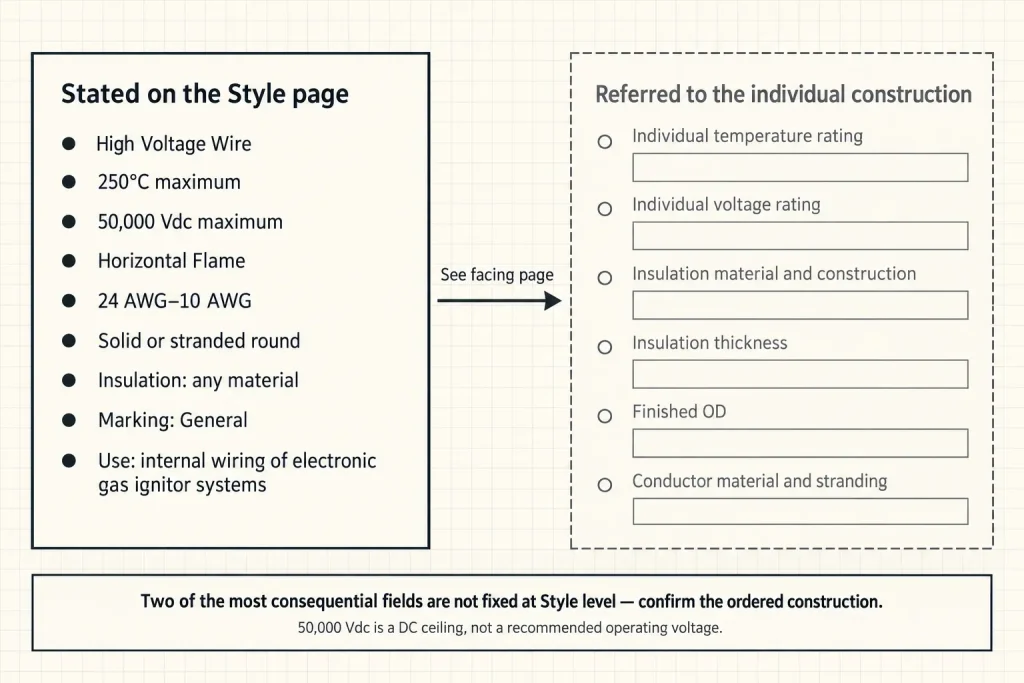
Verified UL Style 1911 Information
| Parameter | Style-level information |
|---|---|
| UL AWM Style | 1911 |
| Product description | High Voltage Wire |
| Temperature | 250°C maximum; individual rating must be confirmed |
| Voltage | 50,000 Vdc maximum; individual rating must be confirmed |
| Flame | Horizontal Flame |
| Conductor size | 24 AWG–10 AWG |
| Conductor form | Solid or Stranded Round |
| Insulation | Any material; see applicable individual construction for details |
| Marking | General |
| Official Use | Internal Wiring of electronic gas ignitor systems |
Note: The Style page identifies 250°C and 50,000 Vdc as maximum limits and refers to individual ratings on the facing page. The applicable ordered construction must therefore be confirmed before treating those maximum values as the rating of a specific wire.
50,000 Vdc Is a Style Ceiling, Not a Product Rating
The figure that draws attention to this Style is 50,000 Vdc, and it needs reading carefully.
It is a maximum within the Style rating envelope. It does not mean that every Style 1911 construction is rated 50 kV DC, and the Style page does not contain the individual rating table that would establish what any particular construction carries. A construction qualified at a lower DC voltage is still a Style 1911 wire.
The useful figure for an enquiry is therefore the circuit’s actual required DC voltage, not the Style ceiling. An ignitor circuit operating well below 50 kV does not need a 50 kV construction, and specifying the ceiling because it appears on the Style page is not the same as specifying a product.
The Rating Is DC
50,000 Vdc is a DC figure. It is not restated here as 50 kV AC, as 50,000 Vac, as an AC/DC 50 kV rating, or as a bare “50 kV ignition wire” where the Style rating is being discussed.
No AC equivalent is inferred. Where a circuit condition is AC or pulsed rather than DC, that is a separate requirement to state and have evaluated against the applicable qualified construction.
250°C Requires the Same Confirmation
Style 1911 lists a maximum temperature of 250°C, with individual construction ratings requiring confirmation.
Nothing here describes the Style as 250°C continuous, states that all Style 1911 is 250°C, or presents 250°C as a guaranteed operating temperature. The same facing-page reference that governs voltage governs temperature, and both are confirmed together for a given construction.
No ambient-temperature limit or thermal performance figure is inferred from insulation material either — which on this Style would be doubly unfounded, since the material itself is not fixed.
Insulation Is Not Fixed at Style Level
The Style page states the insulation as any material, with details referred to the facing page. That wording is literal.
Style 1911 is therefore not described here as a PVC wire, a silicone wire, a fluoropolymer wire, or as having a high-voltage-grade PVC or thermoplastic insulation system. None of those is a Style 1911 fact. No insulation wall thickness, layer count, jacket, braid or covering is stated either, because the Style page establishes none of them.
Where a customer drawing specifies an insulation material, that requirement is stated in the enquiry and matched against a qualified individual construction. Where it does not, the insulation follows the applicable construction rather than a default.
What the Missing Facing Page Means in Practice
On most AWM Styles, a Style number plus an AWG narrows the product considerably. On Style 1911 it narrows less, because two of the most consequential fields — ratings and insulation — are both referred elsewhere.
The practical consequence is that a Style 1911 enquiry benefits more than most from a construction reference. If a qualified construction has already been approved for the equipment, quoting that reference removes most of the ambiguity in a single line. If one has not, the required DC voltage, temperature and any controlled insulation requirement have to be stated so the applicable construction can be identified.
Nothing on this page fills the gap by inference from other high-voltage Styles.
Electronic Gas Ignitor Systems, Specifically
The Use names electronic gas ignitor systems. The relevant contexts are the internal high-voltage lead paths that form part of such a system, and OEM equipment containing one.
Gas ignitor is not a synonym for gas-fired. A gas-fired product is relevant here only when the specific wire is functioning as internal wiring of its electronic gas ignitor system. Where a lead belongs to another part of the same appliance, the Use does not reach it.
The Use also does not extend to general burner wiring, gas burner systems generally, fuel oil burner systems, general gas range wiring, general ignition systems, automotive ignition, spark-plug cables, transformer secondary wire, neon sign wiring, high-voltage DC power supplies, laser equipment, X-ray equipment, plasma equipment or general electronic high-voltage wiring. None of those appears in the Style Use, and none is presented as a normal Style 1911 application.
Style 1911 Is Not a Tier Above Other Ignition Styles
UL 3304, UL 3573 and UL 3239 each have their own constructions, ratings and official Use language. Style 1911 is not described here as better than any of them, as a higher-grade replacement, as a direct substitute, or as the correct choice whenever voltage exceeds 10 kV.
Their construction and Use language is also not transferred into this page: no silicone construction, no 10,000 Vac rating, no gas-range Use, no gas-burner or fuel-oil-burner Use, and no protected-from-damage clause. Those belong to those Styles.
Any replacement decision requires review of the actual equipment specification against each Style’s own Use, ratings and qualified construction.
Conductor Requirements
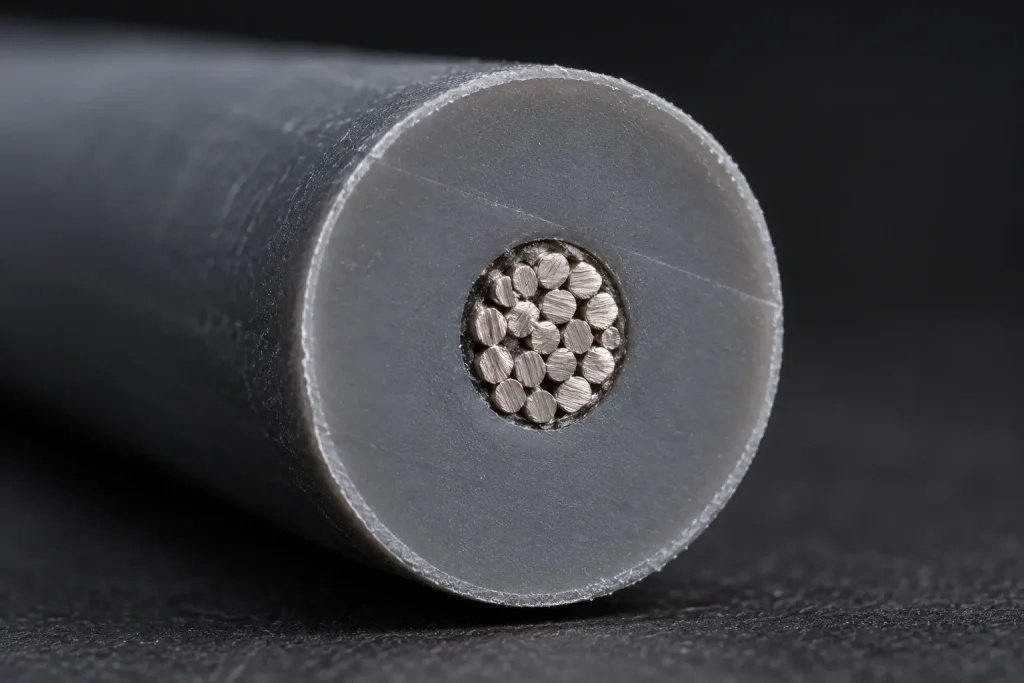
The verified Style page establishes 24 AWG through 10 AWG, solid or stranded round. It establishes nothing else about the conductor.
Copper, tinned copper, bare copper, silver-plated copper and nickel-plated copper are none of them established at Style level, and no strand count, strand diameter, lay length, conductor resistance or ampacity is stated here. Conductor material, finish and detailed stranding are confirmed according to the ordered construction.
Both conductor forms are permitted, so neither is a default, and the wire is not described as flexible on the basis that a stranded construction may be available — the Style page establishes no flex rating.
The 24–10 AWG range defines permitted conductor sizes. It does not indicate that every size is stocked or commercially available in every rating and construction combination.
Finished OD and Dimensions
No universal finished outside diameter is published. The available Style page defines none, and finished dimensions depend on the specific qualified construction — which, given that the insulation material itself is not fixed at Style level, can vary considerably between constructions carrying the same Style number.
Where clearance, creepage, routing or terminal-entry constraints apply, request the required AWG, the maximum OD, the OD tolerance and the applicable individual construction. No dimensional value is invented here, and no insulation wall, nominal wall, total wall or layer thickness is published.
Current and Electrical Performance
No universal current rating or ampacity is published for Style 1911, and none is available in the source. A high-voltage rating does not establish current-carrying capacity, and current is not inferred from AWG alone.
No claim is made here regarding leakage current, dielectric strength beyond the verified rating, corona resistance, partial-discharge performance, arc resistance, spark resistance, ignition stability, long-term high-voltage stability, capacitance, impedance or EMI behaviour. None of those values is established by the available Style page.
Flame Classification
The verified Style-level designation is Horizontal Flame. VW-1, FT1, vertical flame and flame retardance to any other named standard are not claimed here, and Horizontal Flame is not converted into any of them. Any additional flame requirement is separately confirmed.
Style Selection
Selection between high-voltage AWM Styles rests on the official Use, the required voltage type and level, the temperature requirement, the conductor size, the individual qualified construction and the equipment specification.
It does not reduce to picking Style 1911 for higher voltage, another Style for lower voltage, or a third for silicone. Those shortcuts skip the Use statement, which on Style 1911 is the narrowest element of all.
What the Available Style Evidence Does Not Establish
- A universal insulation material or insulation thickness
- Finished OD
- Conductor material, plating, strand count and strand diameter
- Conductor resistance, ampacity and current rating
- Bend radius and flex life
- Corona and partial-discharge performance
- Terminal, connector and cut length
- MOQ, stock and lead time
Each requires the applicable individual qualified construction, the buyer’s specification, verified SKU documentation or commercial confirmation.
Common Procurement Errors
- 50,000 Vdc maximum read as a 50 kV AC rating. The Style figure is DC.
- Every construction assumed to be rated exactly 50 kV DC. It is a Style ceiling.
- Every construction assumed to be 250°C. Individual ratings require confirmation.
- PVC assumed as the Style insulation. The Style states any material.
- Silicone assumed as the Style insulation. Same reason.
- Stranded tinned copper assumed. Conductor material is not set at Style level.
- A 28–18 AWG range used. The verified Style range is 24–10 AWG.
- Selected for generic burner wiring. The Use names electronic gas ignitor systems.
- UL 3304, UL 3573, UL 3239 and UL 1911 treated as interchangeable.
- Finished OD or insulation thickness quoted without the individual construction data.
RFQ Checklist
- UL AWM Style 1911 requirement
- Electronic gas ignitor-system application
- Required AWG within 24–10 AWG
- Solid or stranded round conductor
- Required conductor material and finish
- Stranding details, if controlled
- Required DC voltage
- Required temperature rating
- Specific approved or qualified construction, if already defined
- Required insulation material, if specified by customer drawing
- Maximum finished OD and OD tolerance, if controlled
- Insulation colour, if specified
- Installation position within the electronic gas ignitor system
- Terminal and connector specification
- Cut length, if processed leads are required
- Marking requirement
- Quantity, packaging and destination
- Required compliance documentation
These are buyer inputs. No requested combination is presented as automatically available.
UL Marking and Documentation
Material is supplied as UL-recognized component wire where supplied under qualified manufacturing scope, and UL marking is applied according to the confirmed ordered construction. The Style-level marking designation is General.
CSA AWM, FT1, VW-1 and dual UL / CSA certification are not claimed here; any additional certification depends on the ordered construction. Applicable RoHS / REACH documentation can be confirmed according to the ordered construction.